Sustainability played a major role in the construction process from the very beginning, explains Ralph Herben, project manager for estates and buildings development at UM. From the building plans to the construction itself to the furnishing – in fact, says Herben, repurposing the former military base in the first place was a sustainable decision. All exterior walls, windows and internal load-bearing walls were restored to their original state. New interior walls were given a different colour, and the steel beams that were added to carry the weight are clearly distinguishable from the original square concrete beams. Rooms are named after letters from the NATO phonetic alphabet – Alfa, Foxtrot, Tango, Whisky – as a nod to the building’s military past.
(The article continues underneath the photograph)
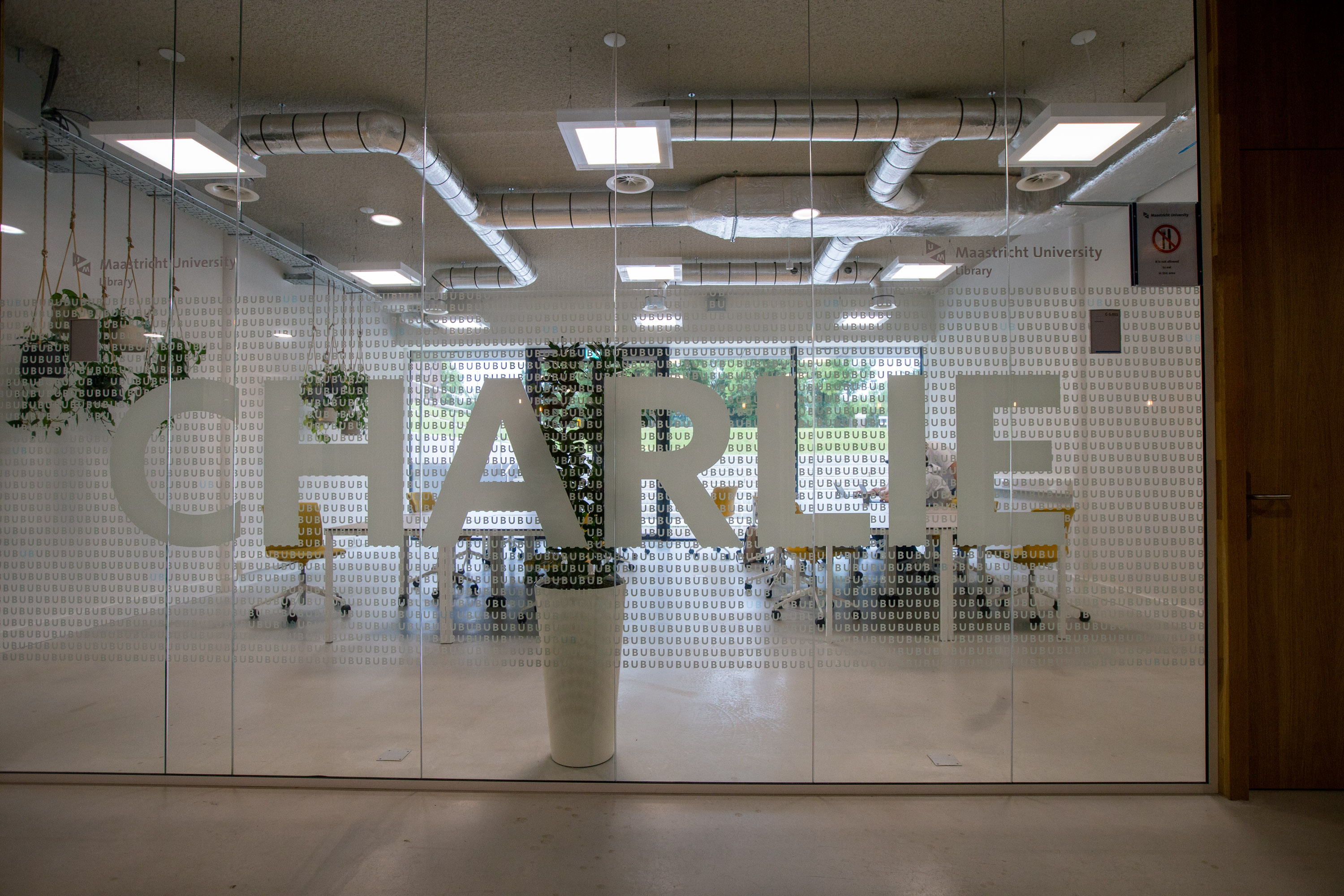 Room Charlie, the third letter in the NATO phonetic alphabet
Second life
Walking through the corridors on the first floor, you will see that the glass walls include different colours. “They’re made from leftover sheets of glass saved from the dump”, explains Herben. “The walls are eight metres long and consist of sheets of eighty or 120 centimetres wide. They sometimes differ in colour. We even have a few sheets of frosted glass.”
A lot of materials were given a second life in the redevelopment of the building. The roof tiles came from Tapijn buildings that had already been demolished (Loods M, the shower building, the gym and the old hospital), as did the stairs and banisters. The paving stones around the buildings were also reused. The carpet tiles on the first floor, where offices and several classrooms are located, are made from recycled fishing nets. “But they don’t smell like it”, laughs Herben.
The building is equipped with LED lights throughout and is heated by air source heat pumps, says Herben. “It also has two small gas boilers that will only be used during winter peak periods. Going completely gas-free was too large an investment. But apart from that, Tapijn is all electric and energy neutral.”
(The article continues underneath the photograph)
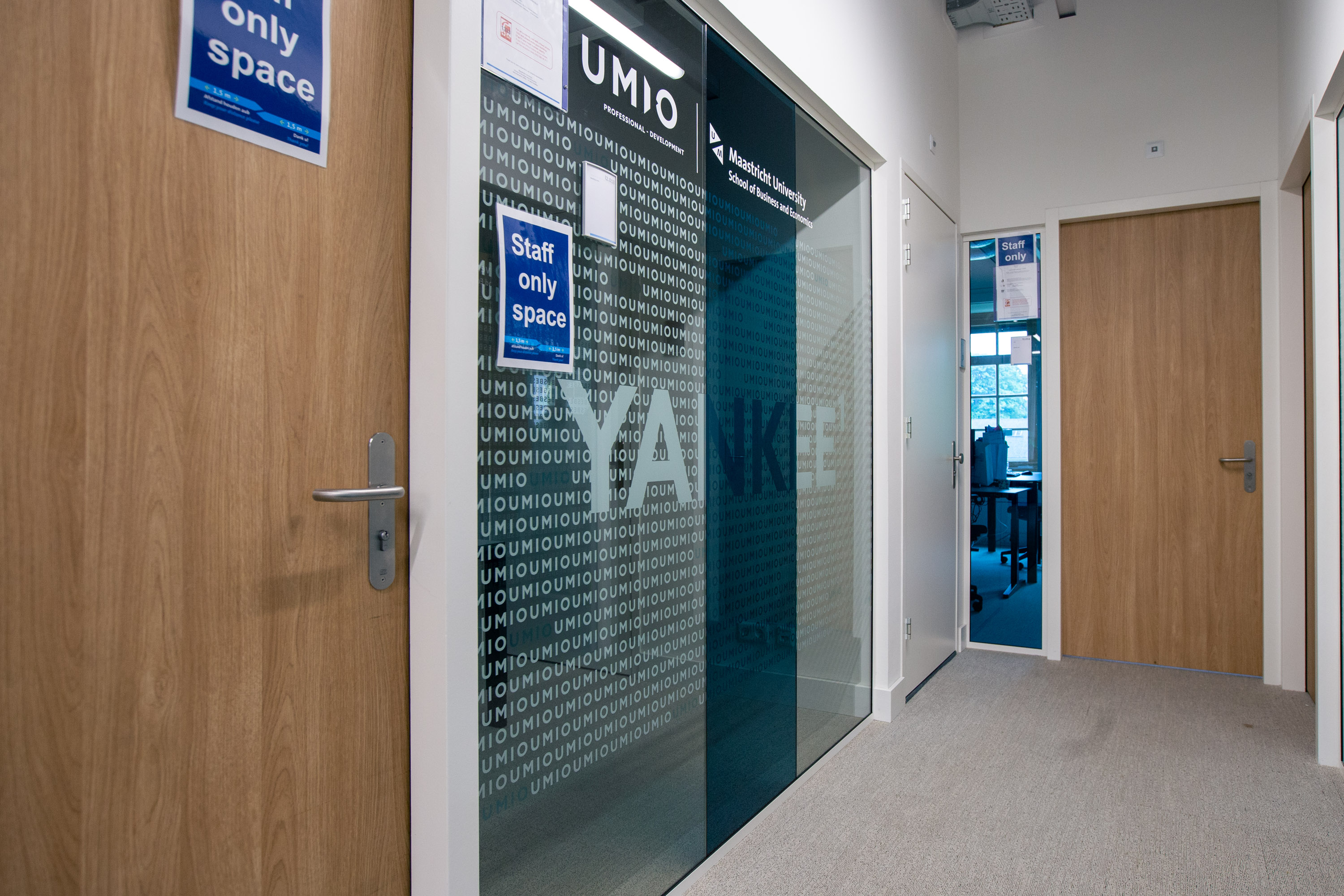 The wall in the 'Yankee room' is clearly made out of different strips of glass
Cleaning products
The building has an automatic ventilation system. A carbon dioxide sensor keeps track of when the indoor air must be refreshed. The newly introduced air is a combination of outside air and filtered air being recirculated. This is yet another environmentally conscious decision: this way, some of the heated air stays inside.
BREEAM even sets strict requirements for materials you can’t see. “For air quality reasons, we were not allowed to use any adhesives that may evaporate over time”, says Herben. Even the cleaning products that are used in Tapijn must be sustainable to meet the requirements of the sustainability certification system. No chlorine-based products are used, just like in all other UM buildings.
The rooms in Tapijn are designed to be as multifunctional as possible. For example, the lecture halls have flat floors. “That way, they can also be used for exams or large gatherings.”
Twix or Coca-Cola
And then there’s the WELL Building Standard, which prioritises health. UM is the first educational institution in Europe with this certification, says Herben proudly. “Office buildings with this certification are able to charge higher rents. UM can’t make use of that financial advantage, but we want to lead by example on sustainability.
“We already met a lot of the WELL Building Standard requirements thanks to BREEAM, for example when it came to advanced air filter systems or high levels of natural light.” But the WELL Building Standard also requires, for example, that products sold in the building do not contain a high concentration of sugar. That’s why you won’t find any Twix bars or cans of Coca-Cola at Tapijn. What you will find is plenty of greenery, maintained by the main users of the building: the School of Business and Economics and the University Library. You’ll also find colourful walls and furniture. “Using colour brings an environment to life. It boosts motivation and productivity.”