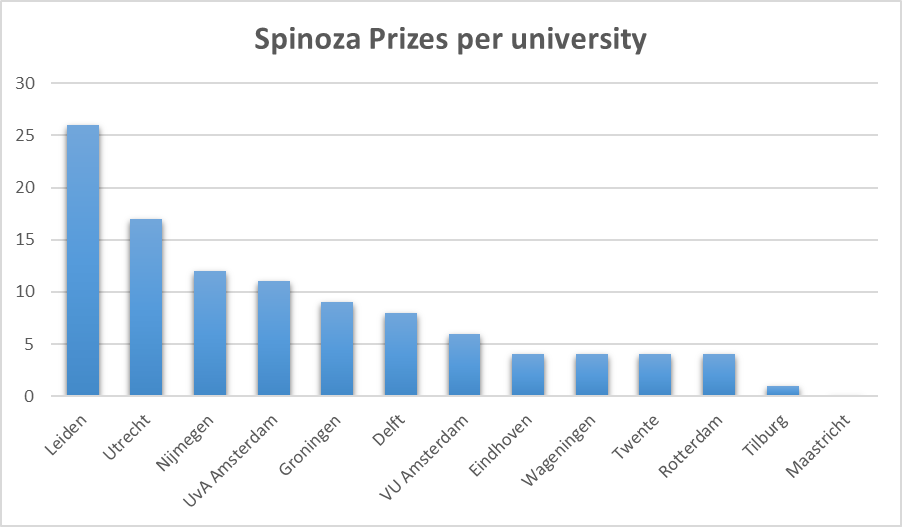
The Spinoza Prizes, also known as the ‘Dutch Nobel Prizes’, have been awarded by the research financer NWO annually since 1995. The counter now stands at 105 Spinoza laureates. These are not exactly equally distributed across the institutes. In about a quarter of the cases (26 times), the winner came from Leiden University. Utrecht and Nijmegen follow with 17 and 12 laureates, respectively. At the same time, some others – in particular ‘young’ universities, such as Eindhoven, Twente, Rotterdam (all four times) and Tilburg (once) – seldom win.
And the road to Maastricht has never been found by NWO. Is that a bad thing? UM rector Pamela Habibović reckons it is. “It is not good for the university’s prestige. It is an important recognition which we are now missing out on. And yet, we have plenty of researchers here who deserve a Spinoza Prize.”
Why did none of them win a prize? Habibović doesn’t have an explanation. “We don’t know how the NWO selects its winners. We do see that the distribution is uneven. About seven per cent of the professors in the Netherlands works at the UM, and we have zero Spinoza laureates. Leiden University has a comparable number of professors (at the end of 2021, there were 332 in Leiden against 271 in Maastricht, according to the website of umbrella organisation Universities of the Netherlands, ed.), but wins almost one in four times. Why that is the case? I have no idea.”
Lobby
Rector at the time, Luc Soete suggested in 2016 to Observant that the UM’s age – with 46 years the youngest university in the country – played a role. Habibović sees it differently. “Since its foundation, there have been several generations of researchers. Age says nothing about how good the current scientists are. It is true that the UM has traditionally placed the focus on education, but that should not reduce the chances of the scientists carrying out high-quality research.”
What is the cause then? A bad image? Or does the UM not lobby enough, maybe? “Selection process is undoubtedly sound and objective. The question is whether universities that miss out relatively often, are sufficiently visible. In other words: not make themselves visible enough.”
Help candidates
Nevertheless, Habibović reckons that the university should also look at itself. “Maybe our own efforts are lagging. The Executive Board is allowed to put forward two candidates every year. That hasn’t always happened the past few years: sometimes only one candidate was selected (the Board would not state how often this exactly occurred, because "nominations are confidential", ed.). We can be more alert to this matter.”
Where back in 2016 the strategy of rector Soete was “to persevere”, Habibović’s attitude is “work harder and take the prize more seriously”. For example, more attention should be paid to the selection of the candidates, who are recommended to the Board by the deans and the rector. “Not everyone within the university is aware of the importance of the prize. We need to take a better look around to identify likely candidates. And subsequently find out if we can help improve points that are important to winning a Spinoza Prize.”
In addition, we must rid ourselves of what Habibović refers to as ‘misplaced modesty’: “At the moment, we are sometimes too restrained when we select researchers, because we fear they will be disappointed if they don’t win. While it is an honour to be put forward for the highest academic distinction in the country.”