But this article shouldn’t be about him, Stoffels urges. “It should be about the things I saw as an eyewitness in Ukraine. I see it as my duty to tell that story.” He cites the Soviet writer Vasily Grossman (1905-1964). Deemed too unathletic and short-sighted for military service, Grossman instead served as a war correspondent with the Red Army during World War II, witnessing the atrocities committed by both Stalin and Hitler first-hand. He reported on his experiences in the army newspaper Red Star and later wrote a famous novel about them, Life and Fate. Why? What drove him? “It is the writer’s duty to tell the terrible truth”, wrote Grossman, “and it is a reader’s civic duty to learn this truth.”
Love for Irena
Stoffels had never been to Ukraine before. In 2019, he met his partner Irena (Ira to friends) on a Belgian train. A business economist from Kyiv, she was on holiday here. She decided to follow her heart and now works in Warsaw, Poland, with children with developmental disabilities. “She’s a natural”, says Stoffels. They hit it off immediately on the train, and since then – she went back to Warsaw after her holiday – they’ve been in “a very long-distance relationship”, says Stoffels with a smile. The covid pandemic didn’t make things any easier for them. And in early 2022, when he thought that he would finally get to meet his in-laws in Kyiv, Putin invaded Ukraine.
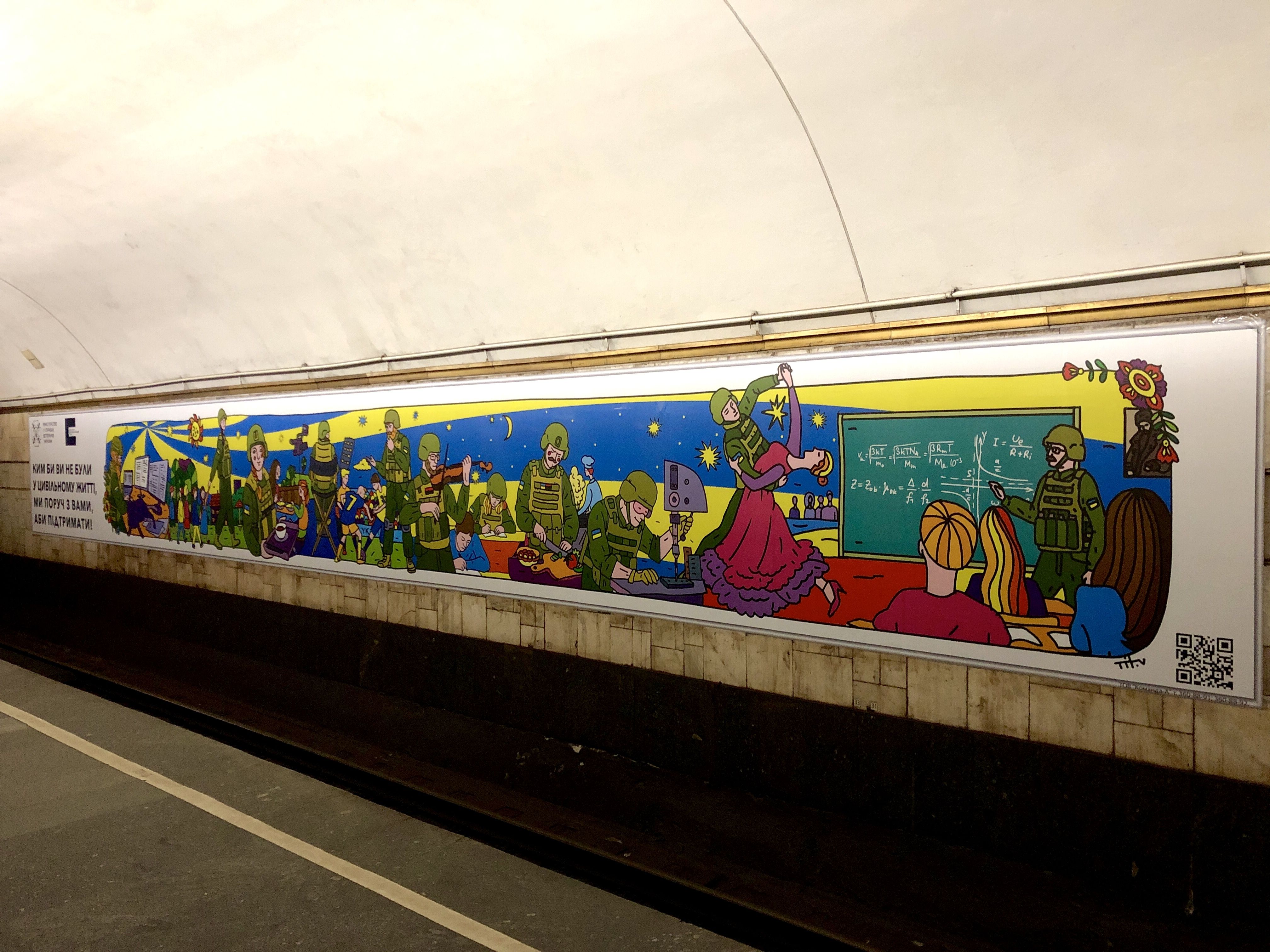 Subway station in Kiev, wall drawing is dedicated to the people now serving in the military
Brother-in-law Vladislav
His brother-in-law Vladislav (Vlad to friends), who would have celebrated his 51st birthday on 13 January, volunteered for the Kyiv reserve battalion right away. It no longer mattered that he had previously been rejected for military service – neither to him nor to the government, which ended up conscripting all male citizens between the ages of 18 and 60. “Vlad wanted to defend his country. He had already been involved in the 2013-2014 protests in Kyiv’s Maidan Square [which culminated in the ousting of pro-Russian President Victor Yanukovych and the overthrow of the Ukrainian government, but also in a war with the Russians in eastern Ukraine and Russia’s illegal annexation of Crimea in March 2014]. He camped in the square and refused to move for the soldiers. Just like then, he wanted to prevent Ukraine from being crushed by the Russians again.”
Stoffels met his brother-in-law in Warsaw in the summer of 2021. “It almost felt like we were family. We’re a lot alike; we’re both gentle people with big hearts. We want to fight injustice and have guts, courage, and determination. And we had the same profession – we both worked in IT.”
Hope and fear
Ever since Vlad left for the army, his family had been suspended between hope and fear. “It was constantly on our minds, every hour of every day. We hoped that he wouldn’t be stationed at the front. He wasn’t allowed to reveal his location, and he could only use his phone when he was on leave, when he was with his wife and 11-year-old daughter.” During their last Skype call, Stoffels saw a man who “had changed over the course of six, seven months. He’d gone completely grey. He was going through the most terrible things. I don’t know if he thought he might die there. He and I never talked about it.”
But he did die there. The news came two days after Christmas. Vlad had been killed in a mortar attack on the front line in Bakhmut, getting wounded soldiers to safety. “I was working from home in Maastricht when I saw that I had several missed calls from Ira. I immediately had this fear.”
Father-in-law Anatoliy
Ira left immediately for Kyiv from Warsaw. Stoffels dropped everything to make it to his in-laws in time to pay his last respects to his brother-in-law. Having taken a FlixBus from Poland, he met his parents-in-law on 1 January. His father-in-law, Anatoliy, is of Russian origin; born in the Soviet Union, he was an engineer in the Soviet Army. He and all of his family speak Russian. “Anatoliy can’t wrap his mind around the fact that he now lives in a world where his countrymen killed his son. My mother-in-law Natalia refuses to acknowledge that her son is dead. She hasn’t visited his grave since the funeral.”
Furious
In the night before the funeral on 2 January, the air raid sirens went off. Stoffels was staying in a hotel. “My parents-in-law live in a tiny apartment of forty square metres. Ira was staying there, as were Vlad’s widow and their daughter.” He went down to the bomb shelter, which was comfortable by Ukrainian standards. There was coffee and tea. “I wasn’t afraid, but I was angry. No, I was furious. And I still am. The fact that his family had to go to a bomb shelter in the night before his funeral… It affects everyone there. The city was hit by an air raid, a deliberate attack on civilians to demoralise them. Fortunately, the madman in the Kremlin is achieving the exact opposite.”
Orthodox funerals are normally open casket, but Vlad’s casket was kept closed due to the state of his body. “My father passed away nine years ago. I didn’t cry then; it was his time. But I wept at this madness, at the pain of the family that has to go on without a father, the parents who have lost their son, my girlfriend who has lost her brother.”
A few days later, Stoffels went back to visit Vlad’s grave with his girlfriend and father-in-law. “I was shocked by the increase in the number of graves in that short time – maybe a hundred more. Considering it’s only one of many cemeteries in Kyiv, just how many people are dying every day in Ukraine?”
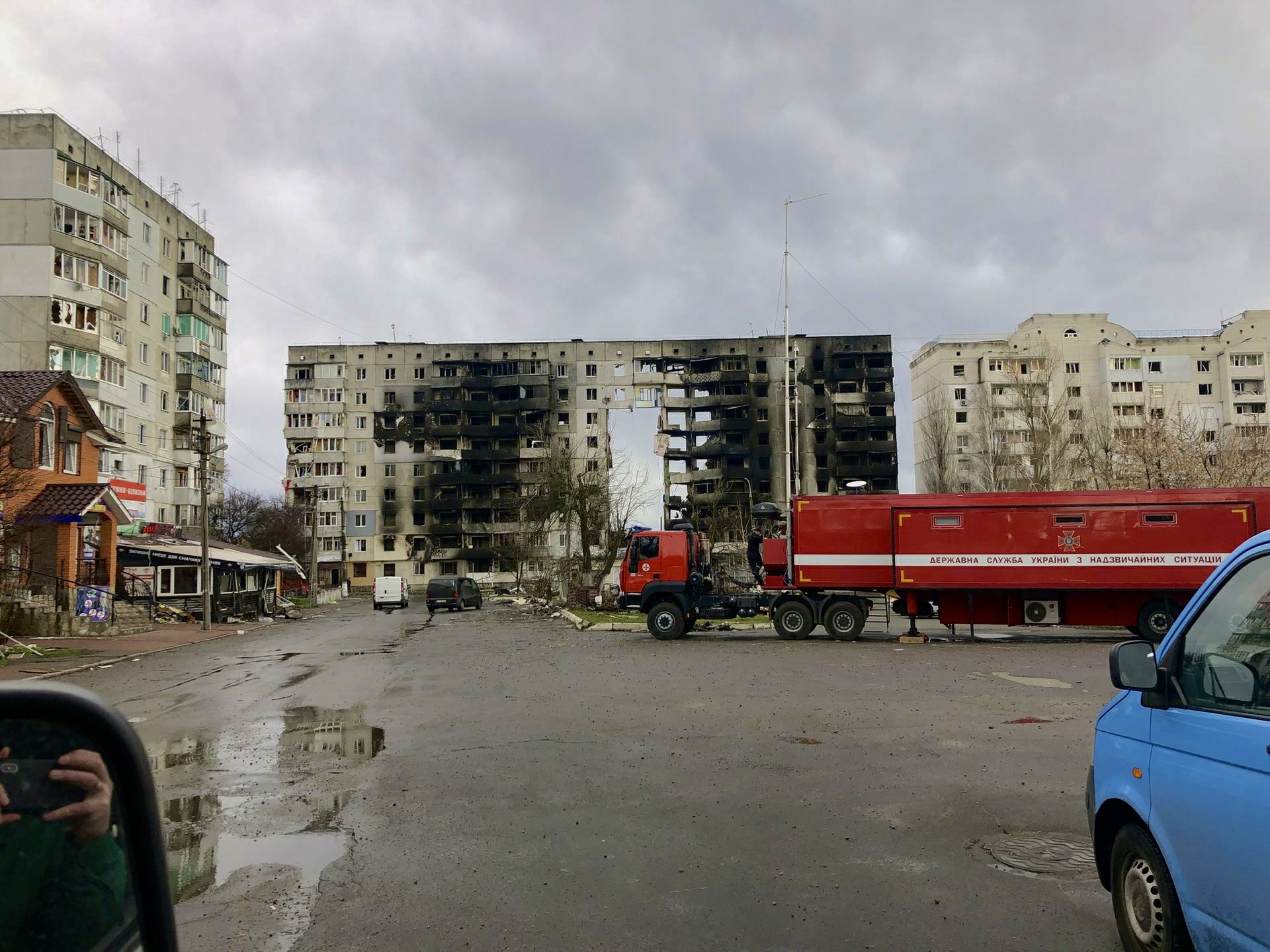 Consequences of a rocket attack in a suburb of Kyiv Photo: Pavlo Kovtonyuk
Friends Yulia and Viktoria
Despite the pain and grief, Ira wanted him to also see the beautiful parts of the city where she was born. “She showed me around with two friends. The suburbs have been damaged by the bombings, but the historic centre with its famous Saint Sophia Cathedral is still standing. It’s not just a symbol of Ukrainian identity, but also the cradle of both the Ukrainian Orthodox and the Russian Orthodox Church.” During their walk through the city, it became clear once more that the war has left no one unscathed. “Ira’s friend Yulia lost her parents in the first month of the invasion. They got covid, but they couldn’t be hospitalised because the hospitals only had room for the injured. And Viktoria, a flight attendant who had spent years putting aside money to buy an apartment in Kyiv, has lost everything. Her home was destroyed in a bombing.”
Support Ukraine
“I want people to realise that there is a war going on just a day’s journey from here”, says Stoffels. “I hope my story will help to inspire them to keep supporting Ukraine, despite soaring energy costs and inflation. It’s tough, but it’s nothing compared to what the Ukrainian people go through every day.”