Fifteen years ago, the Faculty of Health, Medicine and Life Sciences and the hospital started working together as MUMC+. Research, education and patient care were to be linked more closely, just like how other Dutch university hospitals are integrated with their university. More than three years later, little had come of it all. An evaluation report from back then showed that collaboration stagnated especially in the field of research. The complex administrative structure did not help the efforts either. So, the conclusion of the report was: the aim should be “a transparent management model with integrated supervision and administration”. WIth a single management board and a single supervisory board. But that hasn't succeeded yet. This should now finally happen, says UM president Rianne Letschert. And not just with FHML, the entire UM will collaborate with the hospital - an unique situation in the Netherlands.
Non-committal
There is currently an Executive Board of the university hospital that also includes the dean and vice-dean of the FHML, but they have no say in the 'whole thing'; "they have demarcated portfolios," says Letschert. “The collaboration between the hospital and the university was always too non-committal due to both institutes being too busy, having their own priorities, and then you see that they occasionally ‘lost sight of’ each other a little.” In other words, if they continued like this, they lost each other even more. Neither Letschert nor Heleen Mertens, chair of the MUMC board, wanted that. One option would be to transfer the FHML entirely to the hospital, "we didn't think that was wise. The faculty is big and important for UM. If that faculty went to the UMC, we would have actually lost it, we didn't want that." Moreover, the hospital actually has a desire to collaborate with other faculties as well.
Two collective labour agreements
What also doesn’t help: there are two collective labour agreements, two types of entry passes, e-mail addresses, HR policies, et cetera. Still, Letschert wants to emphasise that no new routes will be taken in terms of cutbacks. “In due course, some things will happen from an organisational aspect, services merging, but we are still exploring that. It is certainly not the first thing we are going to tackle.” The priority will be a joint strategy and a new management model. The exploration phase should be rond up in July 2024.
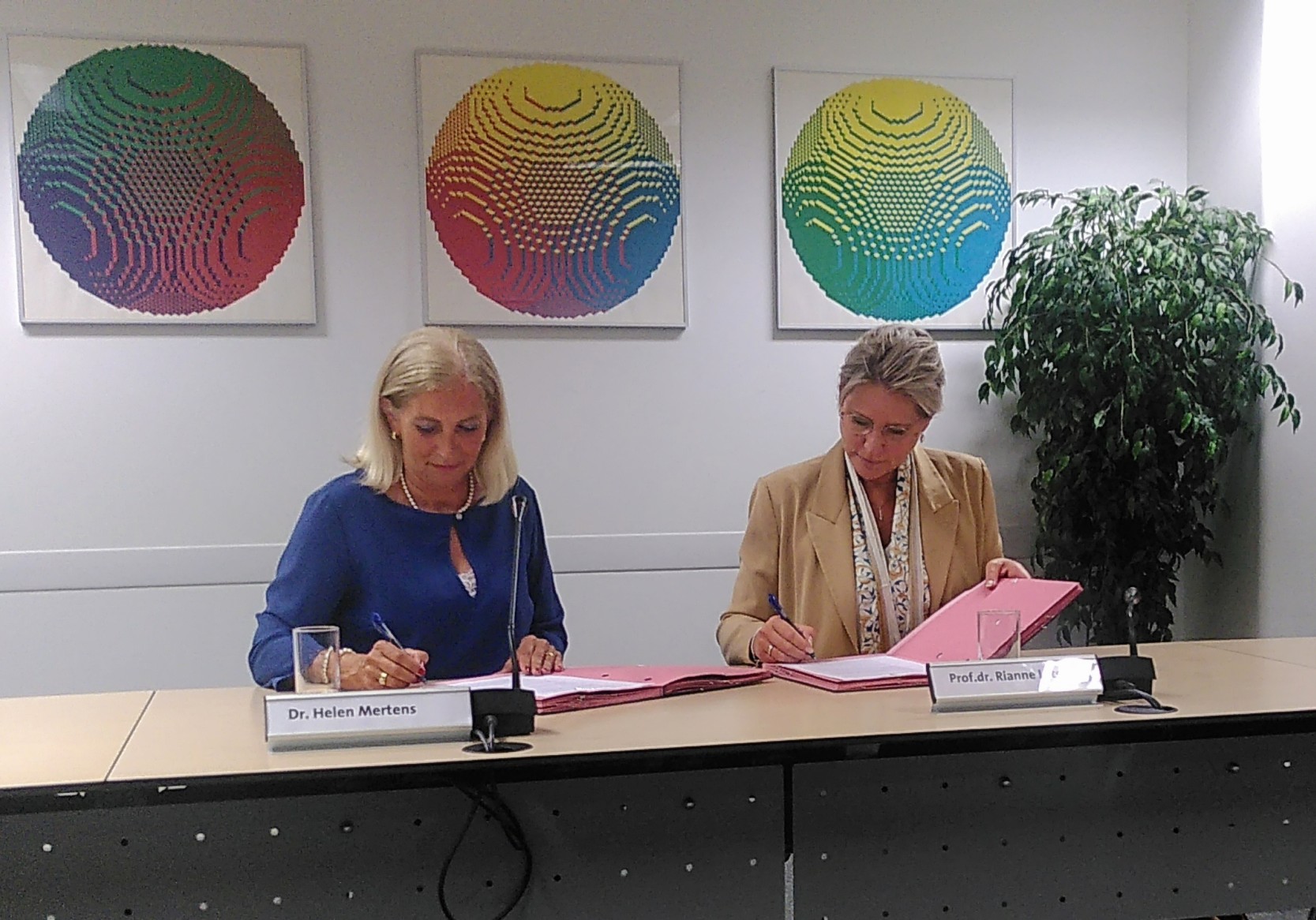 Heleen Mertens (left), president of the Maastricht UMC+ Board of Governors, and Rianne Letschert, president of the Executive Board, sign the declaration of intent. Photo: Observant
Durable
The press release mentions a “solid management model”, the two sides wanting to act as “a single party”. For the past few months, talks have taken place within a small circle as to what that should look like, says Letschert. “There are many possible variants, but we have said: it must be durable, regardless of who is on what board seat, so that we don’t find ourselves thinking in six months’ time: ‘Oh dear, what a jumble we have made’.” Equality is another focal point. “The identities of the two institutes will continue to exist.”
All faculties
Two themes will be important: Healthy Society and New Technology. The first mainly has to do with prevention, healthy food and data-driven healthcare (collecting data, for example, by self-monitoring gadgets or mobile apps, which provide insight into a person’s exercise and eating patterns). In the press release, both institutes emphasise their focus on affordable care, more personalised care and easing the workload of the already scarce healthcare workers.
As far as the second theme is concerned, medical technology, engineering and data sciences will be merged further. Examples include the operation room of the future and mathematic models as a replacement for animal testing in biomedical research. Letschert: “We see opportunities for collaboration for both themes with all our faculties and the Brightlands campuses.”
So, not just FHML, but also Law, Psychology or the School of Business and Economics. In this context, one could think of ethical, legal and economic issues relating to healthcare. According to Letschert, much more is possible on an interdisciplinary level. By the way, she also emphasises that UM is not becoming a healthcare university. FHML is the largest faculty, health is an important spearhead, but UM it much more. Attention will still be paid to themes such as Europe, globalisation, innovative education and sustainability.