There is always a box of tissues on his desk. “Yes, students regularly shed some tears here,” says Roy Janssen. Since September 2021, he has been the contact person for law students who are facing difficulties, answering to the striking name of dedicated wellbeing officer (DWO). So, is there also a ‘non-dedicated’ variant? He laughs a little about this himself. “I didn’t come up with the title. I do know that it was a deliberate decision to omit the word ‘psychologist’. That still has a negative connotation.” Initially, Janssen applied for the position of student advisor. “It just so happened that they were also looking for someone for the new position of DWO. Because of my background, I was a good match for the position.” Janssen graduated in 2012 from the Maastricht Faculty of Psychology and Neuroscience (FPN). He then got to work as a psychologist and later on as a system therapist in divorce cases. Now he has returned to UM. This time as an employee wearing two hats: as a student advisor and as DWO.
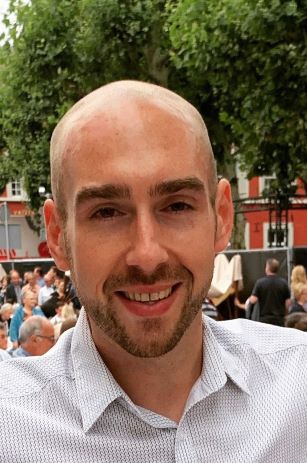 Roy Janssen, dedicated wellbeing officer
Students come to see him for a chat of 30 to 45 minutes, booked online beforehand. Sometimes with a question about study-related matters such as a second master’s, but mostly about mental issues, study pressure, stress. “Even when it is just about the study programme, I first ask how things are. That is the most important matter to me.” In theory, my work should be divided up fifty-fifty. In practice it depends on the week. “Just after the exams, when students receive their (low) grades, my DWO diary is overfull.”
He mainly sees a lot of students from European Law School. “These are often international students who have not only started a new study but often find themselves in a new country with a new culture. Pressure is high too: they must gain at least 40 of the 60 credits in their first year.” After the session each student walks away with a list. Anything from recommendations to referrals. “Sometimes to go and consult a UM psychologist, where they can receive a short treatment of a maximum of five sessions. Or to go to visit their general practitioner (GP). Many internationals don’t even know that you have to have a GP in the Netherlands, so I often start with that.” He takes ample time for every student. “In my last job it was all about billable hours. That was tough. After months of therapy the divorcing couple were sometimes still at each other’s throats. Here I already see progress after one session. The relief radiated by those students is so rewarding for me.”
A psychologist, student advisor and now also a dedicated wellbeing officer. Are we not pampering the students too much? Janssen doesn’t think so: “The transition from secondary school to university is, after all, a huge thing. By doing this we try to make the threshold for seeking help as low as possible. Unlike the psychologists, I am actually inside the faculty. That also makes it easier for lecturers. If they are worried about a student, they know where to find me.” Janssen doesn’t even want to pamper: “allow them to fail first. It is a fine line, because how far do you want to go as a university? We don’t have a clearly defined duty of care.” He tries to make that clear to the students. “The idea is not that they come here every week. And if that is the case, I use an all-embracing statement: ‘Maybe studying at the university is not the best choice for you at this moment.’” It is only advice, but Janssen hopes that they take it to heart.