Tuesday, May 28, 9.00 a.m.
Last night, windows, doors and walls of almost all UM buildings in the city centre were once again covered with pro-Palestinian slogans. At the Faculty of Arts and Social Sciences, the covering was done on walls around the enclosed garden where last week's tent camp was set up. How the offenders entered the premises last night or this morning is not known.
At one of the buildings, everything was captured on camera by security cameras belonging to a local resident. But who is behind the action cannot be deduced from this: the graffiti sprayers were wearing hoodies. Incidentally, some of them could use a language lesson. The windows of the inner-city library on Nieuwenhofstraat, for instance, read in large white letters, ‘Cute the ties.’ The university will press charges, a spokesperson informed. The same was done in response to last Wednesday's occupation; that involved housebreaking.
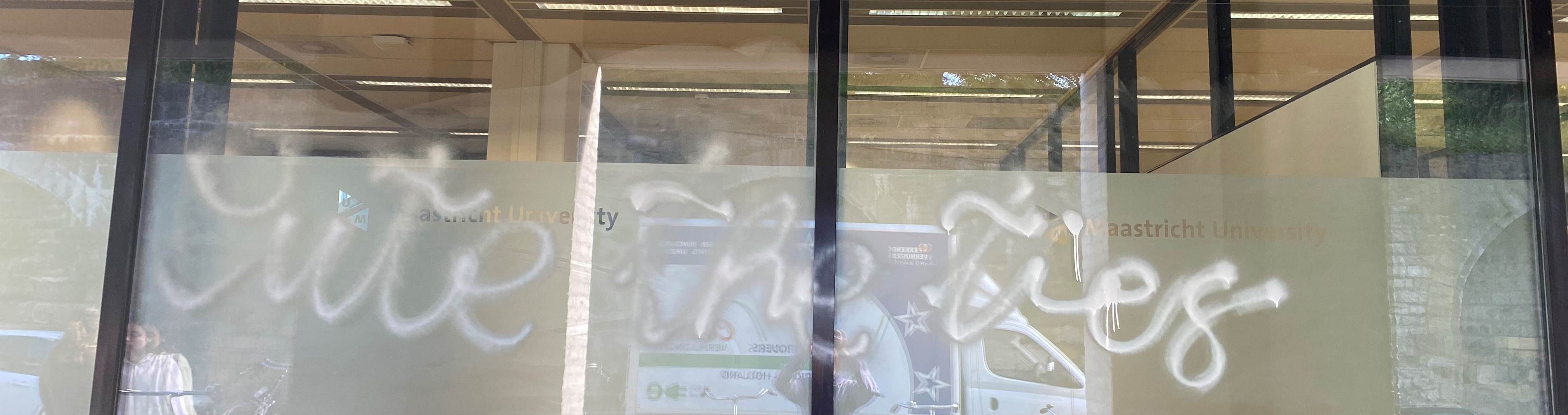 The windows of the inner-city library with the text: 'Cute the ties.'
Monday, May 27, 13:00 p.m.
Security guards are still stationed at the entrances of the faculty buildings and the administration building of Maastricht University. Only people with a UM card are allowed to enter. The measure was introduced last week after pro-Palestinian protests culminated in an occupation of the FASoS building on Grote Gracht 80-82 (FASoS itself had long been accessible only to UM employees and students). According to UM spokesperson Koen Augustijn the measure has been extended as a precaution—“we are keeping an eye on the situation”—and there are no indications that anything is about to happen. Last Wednesday evening, the demonstrating students cleared their tent camp in the FASoS garden (against their will, they say). The occupation of the FASoS building at Grote Gracht 80-82, which began that morning, was also ended. They announced that their protest would continue, albeit in other ways.
Friday, May 24, 11:00 a.m.
Maastricht University is freezing its administrative cooperation with institutions in the Middle East conflict zone. There will be no new collaborations until it is clear whether or not the universities and institutes concerned are involved in "violations of fundamental human rights standards". In these areas this cannot be determined at present, UM writes on its site today. At the same time, the dialogue with the board of the institution in question remains ongoing to determine whether the freeze will be temporary. Individual academic collaboration between scientists can continue as usual. Both the university council and the deans have agreed to this strategy.
Whether this meets the demands of the students who occupied the FASoS building last Wednesday is highly questionable. They are demanding, as demonstrated again Thursday night during a protest march through the city, that UM cuts all ties with Israeli institutions. How many ties there are, by the way, is not known.
This policy for partners in Israel and Gaza will become part of a broader tool to help make an informed assessment of whether partners in conflict zones anywhere in the world have clean hands. For as UM writes: " We do not want to be administratively linked in any way to institutions that are later found to have fuelled potentially life-threatening and degrading conflict situations." Individual scientists can, however, continue their collaboration in such a case.
This guideline is not yet finalised and will be further developed in the coming months. The university community will be involved in this. What that "university-wide dialogue" will look like is not yet clear.
All of this, UM writes, "came about in a democratic process of decision-making with the deans and the University Council. For some, this took too long, and we understand the impatience and frustrations expressed about this. On the other hand, we are convinced that carefulness in this process precedes speed and will produce a more sustainable outcome."
Thursday, May 23, 22.30 p.m.
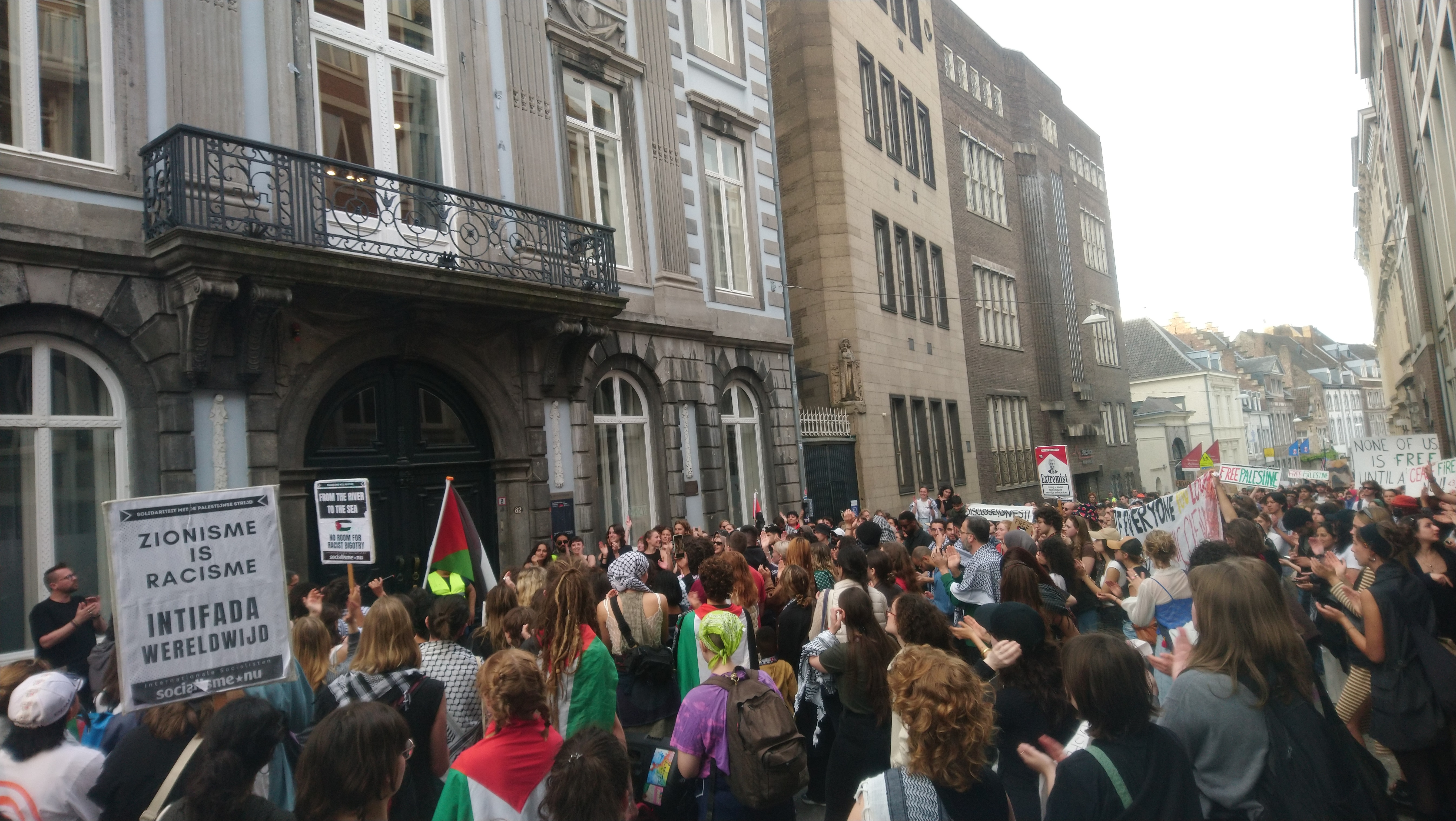 Demonstrants banging on the doors of Grote Gracht 82
Days after the occupation of the FASoS building at Grote Gracht 80-82, a group of pro-Palestinian protesters can once again be found on the pavement in front of the building. This time, however, they stick to banging on the doors and shouting slogans like "Shame on you" and "Cut the ties".
It is a brief intermission of the protest march, organised by among others Free Palestine Maastricht and International Socialists Limburg, which is marching from Stationsplein to the Vrijthof this Thursday evening from 7pm. Some two to three hundred protesters are marching, some of them UM students and staff. The FASoS building is the only university building on the route.
Showing solidarity with the students who protested in the tent camp in the FASoS garden for the past days was one of the goals of the march. "For now, it does not look like the CvB is going to bow to the demands," the announcement on social media read. And indeed: during speeches before and after the march, loud applause was heard several times for the students, and the hunger strikers (who have meanwhile stopped their action) in particular. The demand to UM remains: cut ties with Israeli institutions.
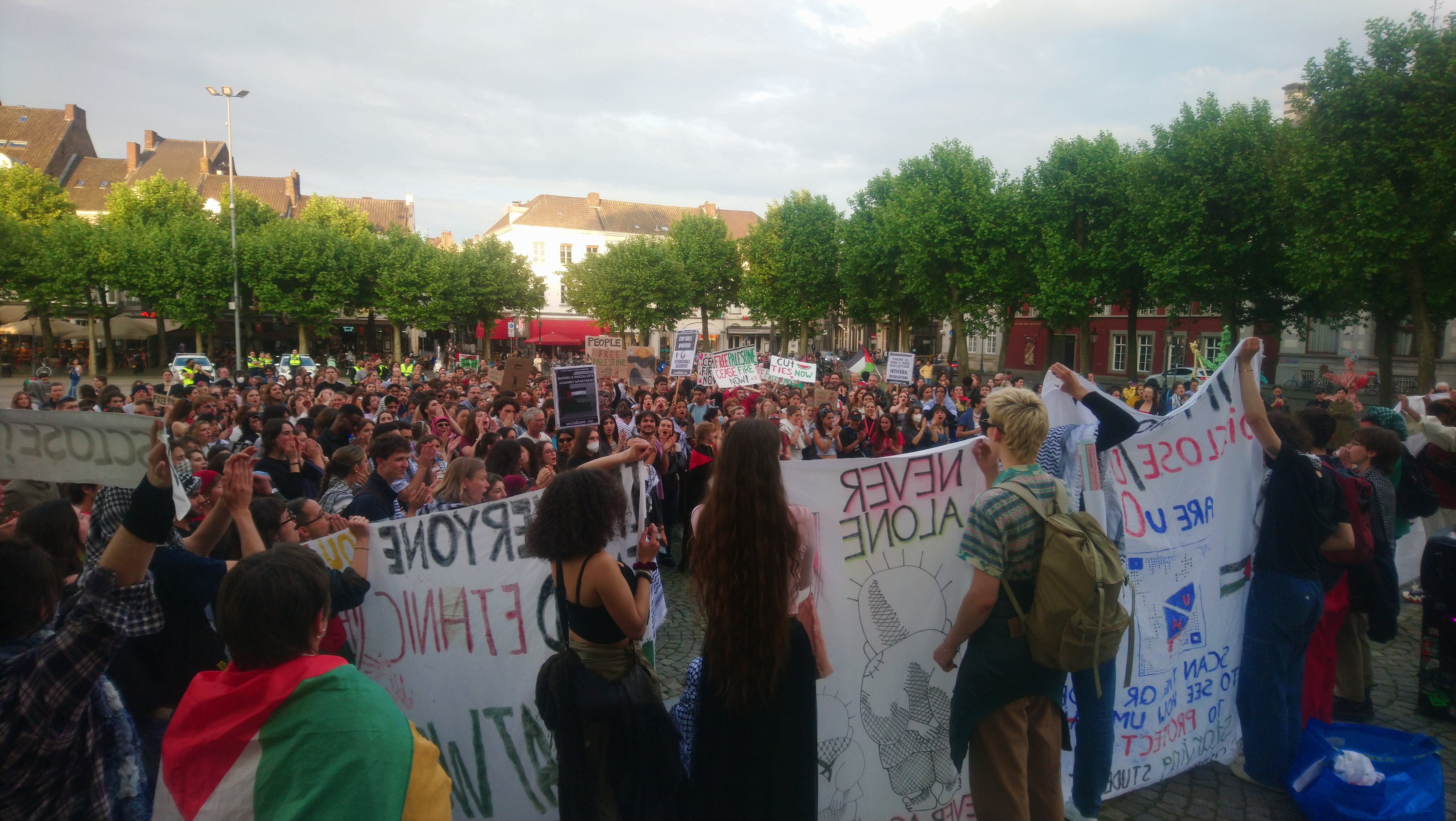 Students giving speeches at the Vrijthof
On the Vrijthof, some students also speak up. "Hopefully our hunger strike has caused the university to doubt itself," says one of the three students who ate nothing for a week. The message that the activists are not finished with their struggle, which was shared on Instagram yesterday after leaving the tent camp, also resonates now. "The occupation of the university building yesterday felt like the first spark of the revolution that is going to take place in Maastricht. We have not only the right, but even the obligation to escalate," one student shouts. Another: "Today we were able to recharge. Now, it is time to escalate." It is met with loud cheers.
Despite the fierce words, there is no sign of an angry crowd heading towards (the precautionary earlier closed) university buildings afterwards. After some jovial singing and dancing most of the protesters quietly leave the Vrijthof, when thick raindrops begin to fall around ten o'clock.
Thursday, May 23, 21 p.m.
Did the pro-Palestinian protesters leave the FASoS building and tent camp in the garden voluntarily on Wednesday or not? Maastricht University's Executive Board claims they did; the occupiers vehemently deny it. According to the students, they were ambushed late in the afternoon with a demand to leave within twenty minutes; or else the police would be called. UM President Rianne Letschert finds that account "not factual", she said in an interview with Observant.
Thursday, May 23, 12.30 p.m.
The three remaining hunger strikers also ended their action last night. The protesters wrote this in a statement on Instagram. The three students did not eat for almost a week. Three others dropped out earlier, among others due to health problems. Yesterday morning, one of the remaining hunger strikers still told Observant that he would only start eating again once UM fulfils the protesters' demand: severing all formal ties with Israeli institutions.
UM has still not made a decision on the latter. The activists wonder how they can "continue a hunger strike in front of a university that isn't willing to even clear its schedule, in front of the deteriorating health of one of its students." They are "appalled" by UM's "coldness", while hunger striking is "an incredibly powerful tactic of protest, often the last one people can resort to", that "must be treated with the utmost respect. (...) The physical damage the hunger strike is causing to our comrades supersedes the damage we were hoping it would cause to UM, for its complicity in the genocide of Palestinian people."
In addition, the protesters also reject the university's reading that they left their tent camp "voluntarily" last night. This was allegedly done "forcibly" by the university and police, with the demonstrants having only 18 minutes before the police proceeded to make arrests. They also called the communication by UM "ugly and manipulative".
The protesters warn that their actions will continue until their demand is met. "Please be assured that this is in no way the last form of pressure UM is going to face." Talks with the university, such as those that took place in recent days, seem taboo as of now. "We know once and for all that next time, we will not negotiate with the oppressor." They also state that "this is the moment to diversify our tactics further." On Instagram, the protesters are also calling to join a protest march through Maastricht tonight, organised by Free Palestine Maastricht and others.
Wednesday, May 22, 9.30 p.m.
 The gate at FASoS is closed Thursday morning
The group of demonstrating students left the tent camp under threat of possible police intervention. The occupation of a building of the Faculty of Arts and Social Sciences (FASoS) has also ended, "peacefully and without incidents", writes the Executive Board in an update. This message does not mention possible intervention by police. The protesters left the tent camp "voluntarily", is the reading.
In any case, it is the startling outcome of an hours-long conversation last afternoon between some of the protesters and the Executive Board.
For days the protesting students have been making it clear that they will not leave until UM cuts ties with Israeli institutions. Also this morning, during the occupation of FASoS, one of the hunger strikers told Observant that he will not eat again until "there is a legally binding decision". Whether the hunger strikers will eat again is unclear.
UM spokesperson Koen Augustijn stressed that the Executive Board made no concessions today. The call to think of "their own safety" was heeded by the activists, he says. He refers to this morning when dozens of protesters gathered on the Grote Gracht in front of the faculty building, on the pavement, but also on the street, i.e. the public space. UM could no longer guarantee safety, for the protesters, but also for people in the area. For instance, there was a small riot between some activists and a group of young people, passers-by.
The police were already involved in talks this morning - because of the occupation, housebreaking was reported.
The students received an appeal via email to leave the tented camp. They were reportedly given only "eighteen minutes" to do so, students told 1Limburg.
The University Council met confidentially this afternoon (for the second time in a few days) to discuss criteria, what to do with cooperation with partners in conflict zones, including Israel. What advice was rolled out there, UM has not yet disclosed. More information will follow tomorrow, according to Augustijn.
FASoS is closed until Monday; teaching will take place in an alternative way (other location or online). The other buildings, also in Randwyck, are only accessible with a UM card for the time being. The doors (except for the sports centre and the university library) close this Thurday between 6 and 7 p.m.
Wednesday, May 22, 5.30 p.m.
The pro-Palestinian demonstrations at UM have now also led to written questions from the Maastricht city council. "We get signals from citizens that they do not feel safe during these kind of demonstrations, they are shocked after the demonstration in Amsterdam," wrote Partij Veilig Maastricht in a letter to the mayor and Aldermen today. The party wants to know whether the municipality board is prepared to "enforce immediately" if disturbances occur, "to prevent Amsterdam scenes, in the interest of the safety of our citizens and city." In Amsterdam, though, the municipality intervened only after the University of Amsterdam pressed charges against demonstrators occupying university premises. As far as is known, the latter has not (yet) happened in Maastricht. UM did file a report earlier this week because of the graffiti on the walls of university buildings and anti-Semitic messages they received.
The party further wants to know whether the municipality will enforce the prohibition on wearing face-covering clothes, as some of the protesters do. According to the law, this is prohibited in certain locations, including educational institutions. The same question is asked about shouting illegal slogans, referring to the PVV motion to consider the controversial slogan "From the river to the sea" (which is regularly heard during the Maastricht protests) as a call for violence, and therefore punishable by law. That motion was passed by a narrow majority in the House of Representatives today. Which, however, does not yet mean that uttering that slogan is already criminalized: for that to happen, the government must first implement the motion. Moreover, the Amsterdam Court of Appeal ruled earlier that the sentence was not punishable.
Wednesday, May 22, 3 p.m.
The Executive Board still has the same focus: de-escalation, according to an update from UM- spokesperson Koen Augustijn. "We still hope and count on the continuation of the relatively peaceful way the protesters have observed in their activities on the Grote Gracht so far. A manner that we also want to continue as much as possible." At the same time, they want education to be disrupted as little as possible. Something that did happen today in any case. All teaching at the Faculty of Arts and Social Sciences has been cancelled, staff have been sent home. "We hope to have and provide clarity soon on whether teaching can be resumed soon without further intervention," he said.
Wednesday, May 22, 12.00
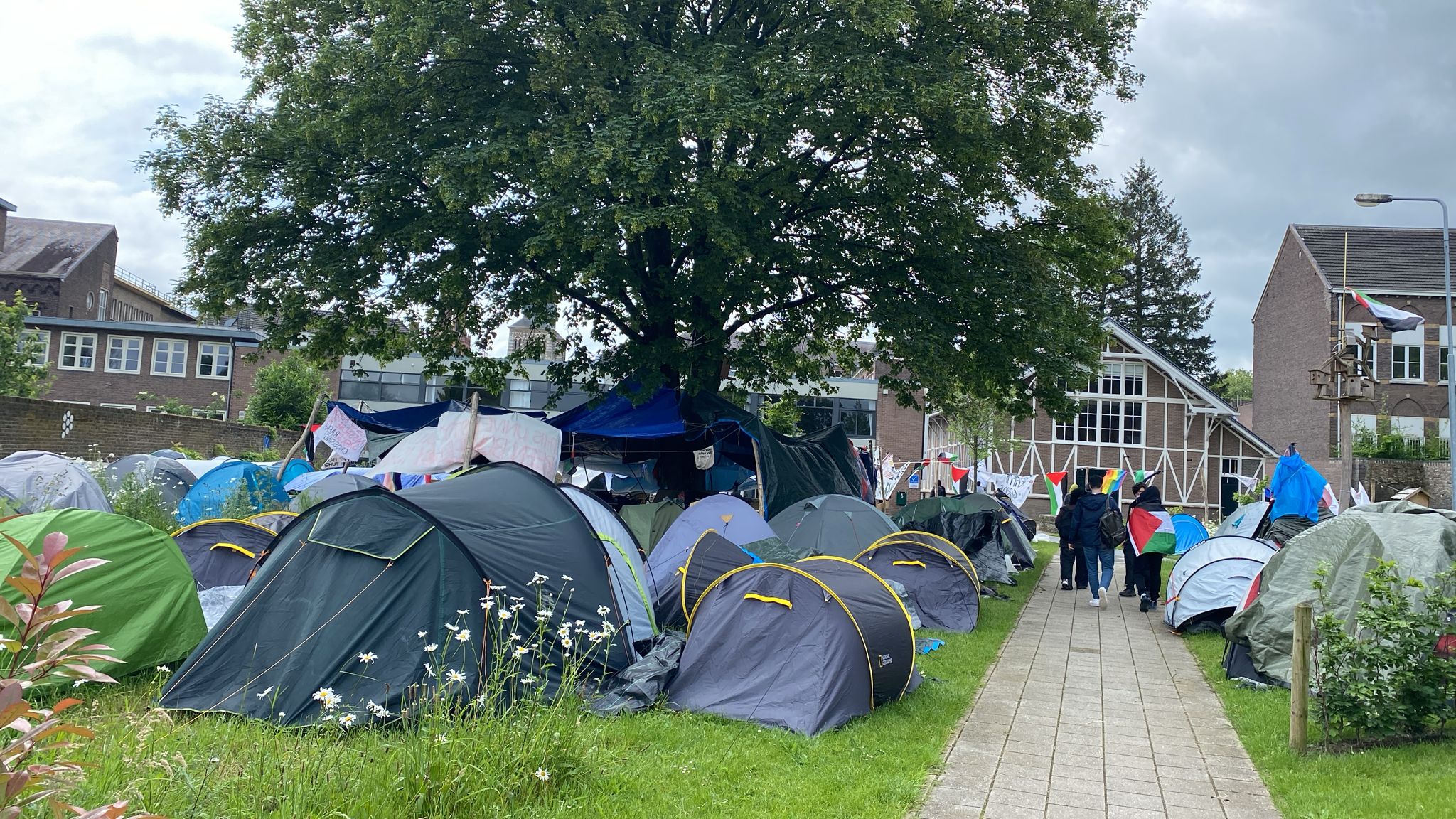 The tent camp appears to have expanded considerably
- Some of the activists have returned to the tent camp, which appears to have expanded considerably. An unknown number are still holed up in one of the buildings of the Faculty of Arts and Social Sciences at Grote Gracht 80-82, other FASoS premises are empty. All FASoS staff were sent back home this morning.
- The Law faculty on Bouillonstraat is closed as a precaution to people without UM card. A security guard at the main entrance checks anyone who wants to enter. The other buildings in the city centre, such as the university library, University College Maastricht, the UM administration building on Minderbroedersberg and the School of Business and Economics, are accessible as normal.
Wednesday, 22 May, 11.40 a.m.
The Executive Board is talking - behind closed doors - to a number of protesters. Margriet Schreuders, director of the student service centre, and FASoS dean Christine Neuhold are also present.
Wednesday 22 May - 11 a.m.
Hunger striker: "If UM cuts ties with Israeli institutions, I'll start eating again"
"How do I feel? Not so great, obviously, I haven't eaten for nearly seven days, and I've lost 6 kilos," says Alex, one of the three remaining hunger-striking students from Maastricht University. He speaks clearly and calmly. Together with the other two hunger strikers, he is sitting on the sidewalk in front of the FASoS building occupied by demonstrators. They repeat their demand: that Maastricht University severs all formal ties with Israeli institutions. He refers to "well-documented connections" with institutions including the Hebrew University in Jerusalem. According to him, such institutions provide "ideological and technical support" to the Israeli military. However, there are voices in society saying that breaking these ties won't change the situation in Gaza. He finds this too cynical, referring to the international boycott of South Africa in the 1980s due to the then racist regime. "That contributed to the abolition of apartheid."
Legally binding decision
Only when "there is a legally binding decision to sever the ties" will Alex start eating again, he says determinedly. He realizes that continuing the hunger strike could harm his health, "but compared to what is happening in Gaza, this is nothing: 35 thousand people have already been killed, thousands are starving." In this light, he doesn't understand why people think the demonstrators should also mention the Hamas attack on Israel on October 7, 2023. "That would relativize the genocide now taking place in Gaza. Every death is one too many, but it's not comparable."
Slogans
Does he – being Jewish himself – understand that some slogans heard at the pro-Palestinian protests might come across as threatening to other Jewish students? This morning, the slogan "We don't want two states, we want 1948" was heard – a reference to the founding year of the state of Israel. According to Alex, being Jewish and the state of Israel are two different things: for him, being Jewish is "a cultural or religious, not a national identity. It has nothing to do with Zionism."
Wednesday 22 May - 9.30 a.m.
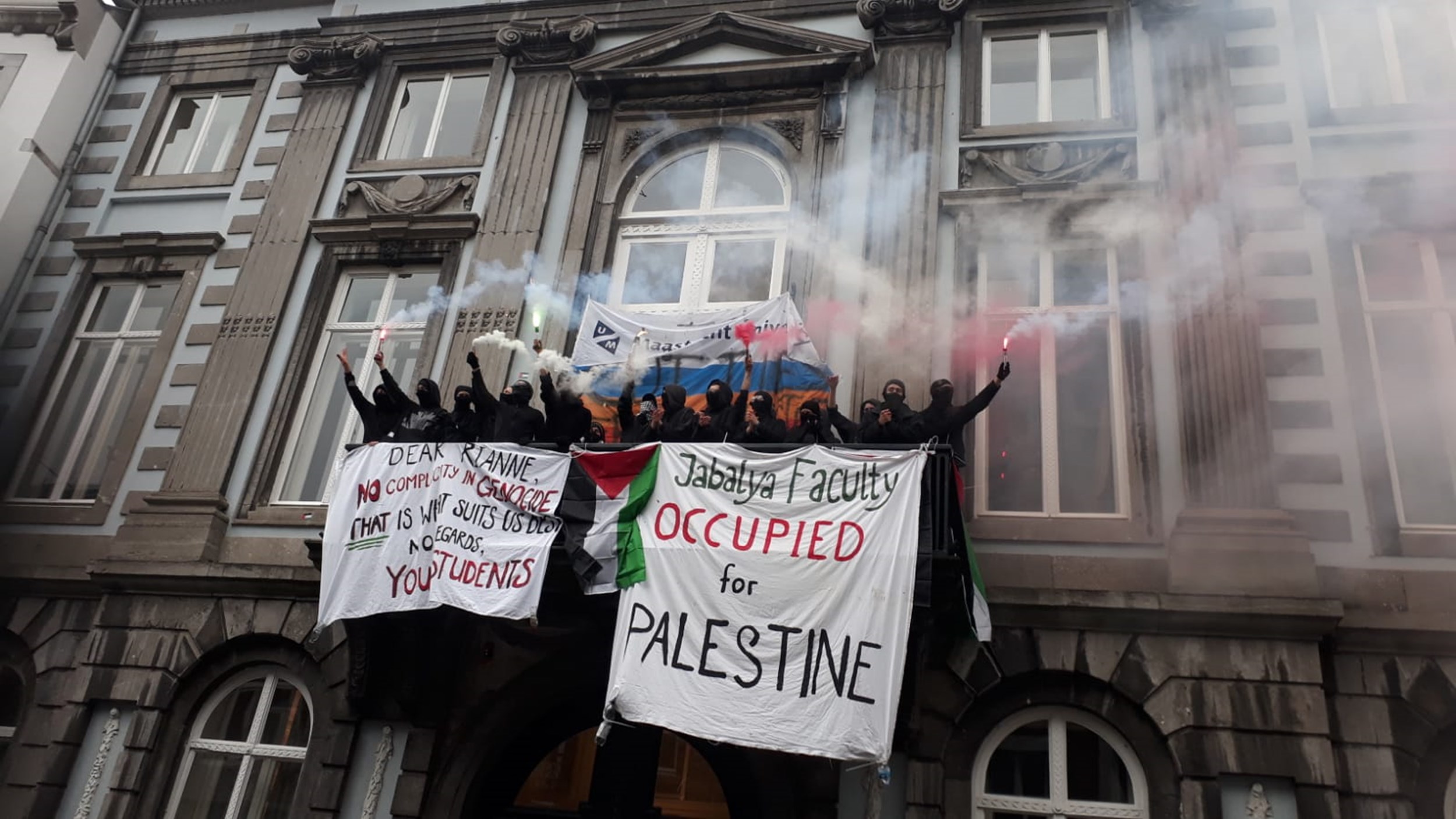 Dozens of students stand on the balcony of one of the FASoS-buildings
The building of the faculty of Arts and Social Sciences - where a group of protesters have been staying in a tent camp for over a week - has been occupied early this morning. According to UM spokesman Koen Augustijn, dozens of activists entered the building at an unknown time. Whether that was before the faculty opened up for the day, he does not know. Since a few days there is security at the door, because only people with a UM card are allowed inside. Whether and how that security has been bypassed is also unknown.
The building is now closed, the main gate is closed. All teaching has been canceled and it is no longer possible to park in the back. The Executive Board is in a crisis meeting.
On the Grote Gracht, demonstrators are standing on both sides with banners reading, among other things, "Students rise against genocide". They are chanting and clapping. Some twenty students - dressed entirely in black, unrecognizable - stand on the balcony of one of the FASoS-buildings with texts such as: 'Jabalya Faculty occupied for Palestine', and 'Dear Rianne, no complicity in genocide. That is what suits us best. No regards, your students.'
Yesterday, UM-President Rianne Letschert mentioned in a blog to staff and students that "maintaining boundaries" in the protests is important and that they are applying "where possible and desirable the existing sanctions for violation of our house rules". Whether and how the university officials will intervene today remains to be seen. In any case, there is no talk of an eviction at present.
Tuesday 21 May - 4 p.m.
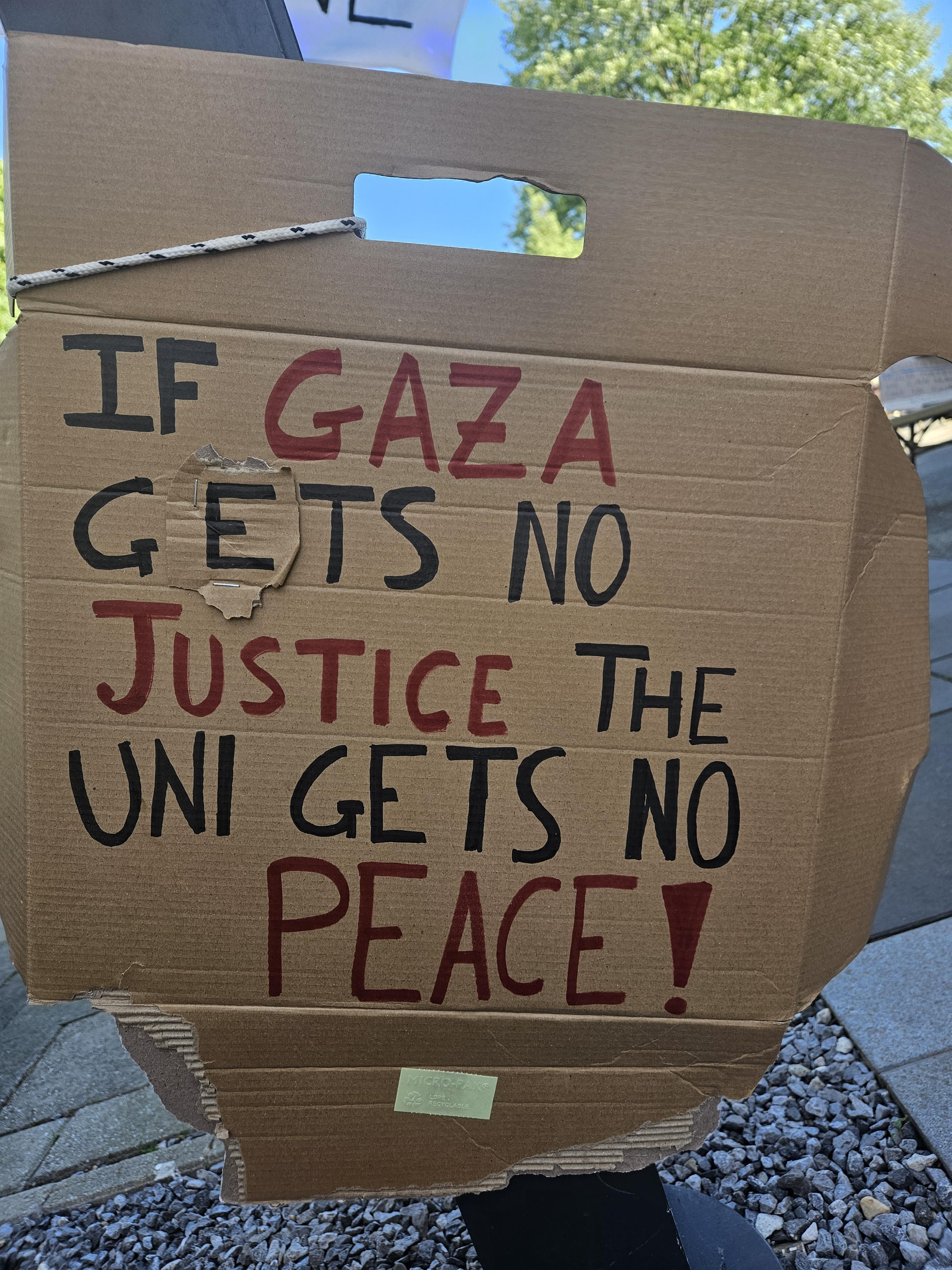 Described piece of cardboard at the tent camp
Yesterday a second hunger striker stopped, today a third. The three remaining hunger strikers told Dutch news agency ANP that they have no energy left and can barely stand up and walk around. They blame UM for lowering their morale. That would also be the reason why yet another student dropped out.
Tuesday 21 May - 1 p.m.
In the hall of the Faculty of Law at the Bouillonstraat, pro-Palestinian students demonstrated briefly in the early afternoon. The group of over 20 protesters hung a banner and shouted Free Palestine. After being addressed by security guards, the students removed the banner and went outside, where they remained on the pavement in front of the building. That's public property, so you can't send them away, says a faculty employee shrugging his shoulders. He adds that the demonstration was peaceful. Some protesters spoke briefly to Observant in the faculty's garden. They want to know from the university when it will make a decision on their demand that UM cut all ties with Israeli institutions.
Monday 20 May - 6 p.m.
Of the original six hunger strikers, four remain. On Thursday, a few hours after a group decided not to eat any more, the first one dropped out. One more student quitted today. This is the one who is said to be "seriously ill", as the students reported earlier on their Instagram account. The Dutch news agency ANP - after L1 had also covered it on their site and in a TV broadcast - writes that it concerns a French cultural studies student who was already advised by a doctor to quit yesterday. Nevertheless, he continued. Until today. He was reportedly suffering too much from palpitations and vomiting that prevented him from taking in fluids.
The four who did keep going, including two Jewish students, informed the ANP that they had also started to feel worse since yesterday (symptoms: fainting and a too fast heartbeat).
The Maastricht University administration is not involved or informed by the protesters about the condition of the hunger strikers. The students have expressed that they do not want any more conversation. All they want to hear is a date for the university council to vote on their demand to cut ties with Israeli institutions.
Monday 20 May - 5 p.m.
 The wall of University College Maastricht on the Zwingelput has been repainted
The university has already repainted the graffiti on the walls at Grote Looierstraat 17 and Zwingelput 4 (UCM). Those who do their best can still see the slogan 'UM causes genocide' shining through.
Monday 20 May - 12:00
Meanwhile, not only the School of Business and Economics building appears to have been covered with protest slogans this weekend, but also Grote Looierstraat 17 (university library), Tapijn X and Zwingelput 4 (UCM).
Seriously ill
On Sunday evening, the activists posted an Instagram message on their account saying that one of the hunger strikers "faced severe health problems". This intensifies the pressure on UM to come to a decision on their demand - ending collaborations with universities and other research institutes in Israel. According to spokesperson Fons Elbersen, the UM administration was informed of the signs of a sick hunger striker, "we have responded and offered medical assistance. A doctor is now on call, but we have no way of verifying ourselves whether and if so, what is wrong with this person. One does not allow that."
The occupiers still refuse to talk with UM officials, accusing the institution (on their Instagram account) of "bureaucratic ridiculous procedures" that are "proof of the fact that you have no humanity left in you". The university also shows "a lack of respect and care", according to a post by the hunger strikers. These accusations "affect us as a community enormously and the board in particular," Elbersen responded to Observant.
Vote
All the protesters want is a day of voting (by the university council) on their demand. They were supposedly promised this week, as they say on Instagram, that that vote would take place on Tuesday (tomorrow). But that day was never communicated with them, according to UM-spokesperson Elbersen. He too hopes it will happen as soon as possible, "maybe this week. The U-Council obviously has a very important voice in this timing."
In the meantime, UM does still want to engage in dialogue. Elbersen: "It is the protesters who unilaterally and ultimatively dictate the conditions for a conversation". For example, he says, they are demanding that president Rianne Letschert stands in front of the entire group. "We say: 'That won't work, let us speak to a delegation'. That is then rejected."
No consensus machine
On the TV programme Buitenhof, Robbert Dijkgraaf, Minister of Education, sat down on Sunday afternoon and discussed the protests at universities. And although Dijkgraaf praised the fact that students are involved in the world - yes, they are allowed to demonstrate - he was shocked by "the escalation and explosions of violence." A video was shown of the moment Utrecht University president Anton Pijpers tried to engage in conversation with protesters. He was standing downstairs, surrounded by an entire group of activists, and was shouted at from above by a student with a megaphone in his hand.
Dijkgraaf responded in Buitenhof: "You don't have a conversation with megaphones. You do that in a quiet environment. Those conversations should take place in the lecture halls with the Executive Boards." In doing so, he expressed his appreciation for university administrators who "bravely" stand there and try to have that conversation. "But you see it being rejected in a harsh way."
There is a demand from the students: break academic ties with Israel as a university. What does Dijkgraaf think? "I have seen that some institutions have frozen ties, so in principle that is allowed. But I pass on to universities, do that very carefully, do that with the consent of the whole university community, because there are a lot of different voices, do that carefully, use the avenues you have for that, for example ethics committees." He further called academic freedom "a great good", which is guarded by the academic community itself, "not by police. The discussion within the university should be substantive, based on knowledge that is out there. The university is not a consensus machine."
Sunday 19 May - 7.45 p.m.
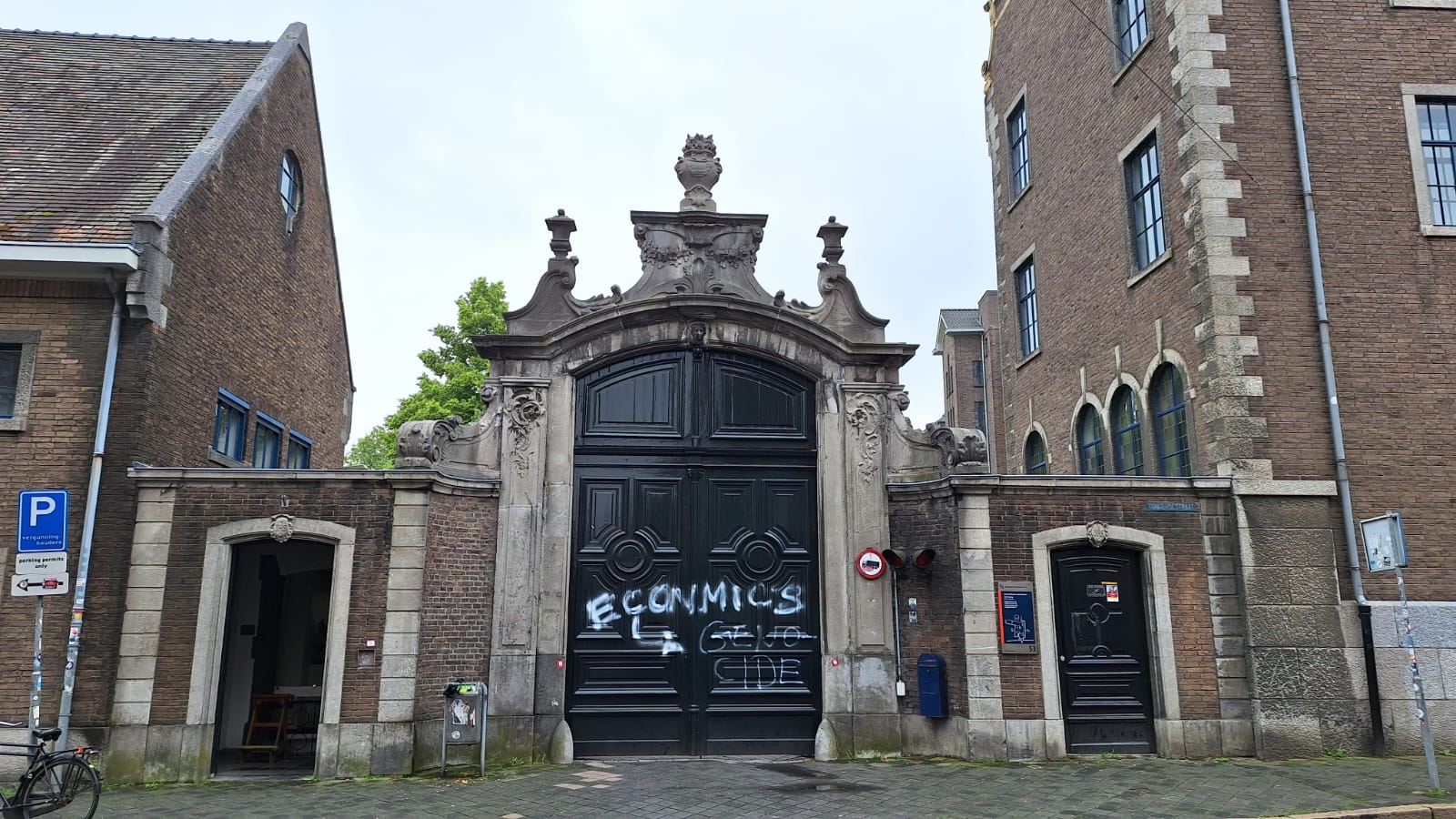 Grafitti on the SBE entrance gate
Protest slogans are also appearing at other university buildings. On the entrance gate to the School of Business and Economics (Tongersestraat 53), "Economics -> Genocide" has been painted.
Friday, 17 May - 9.15 p.m.
The occupiers in the tent camp in the FASoS garden will be allowed to stay there this weekend. So says the Executive Board in an update. This is on condition that the students abide by the agreements made. Think: no new people in the camp, no nuisance to the neighbourhood.
The building will remain closed as normal during the weekend, including this longer Pentecost weekend.
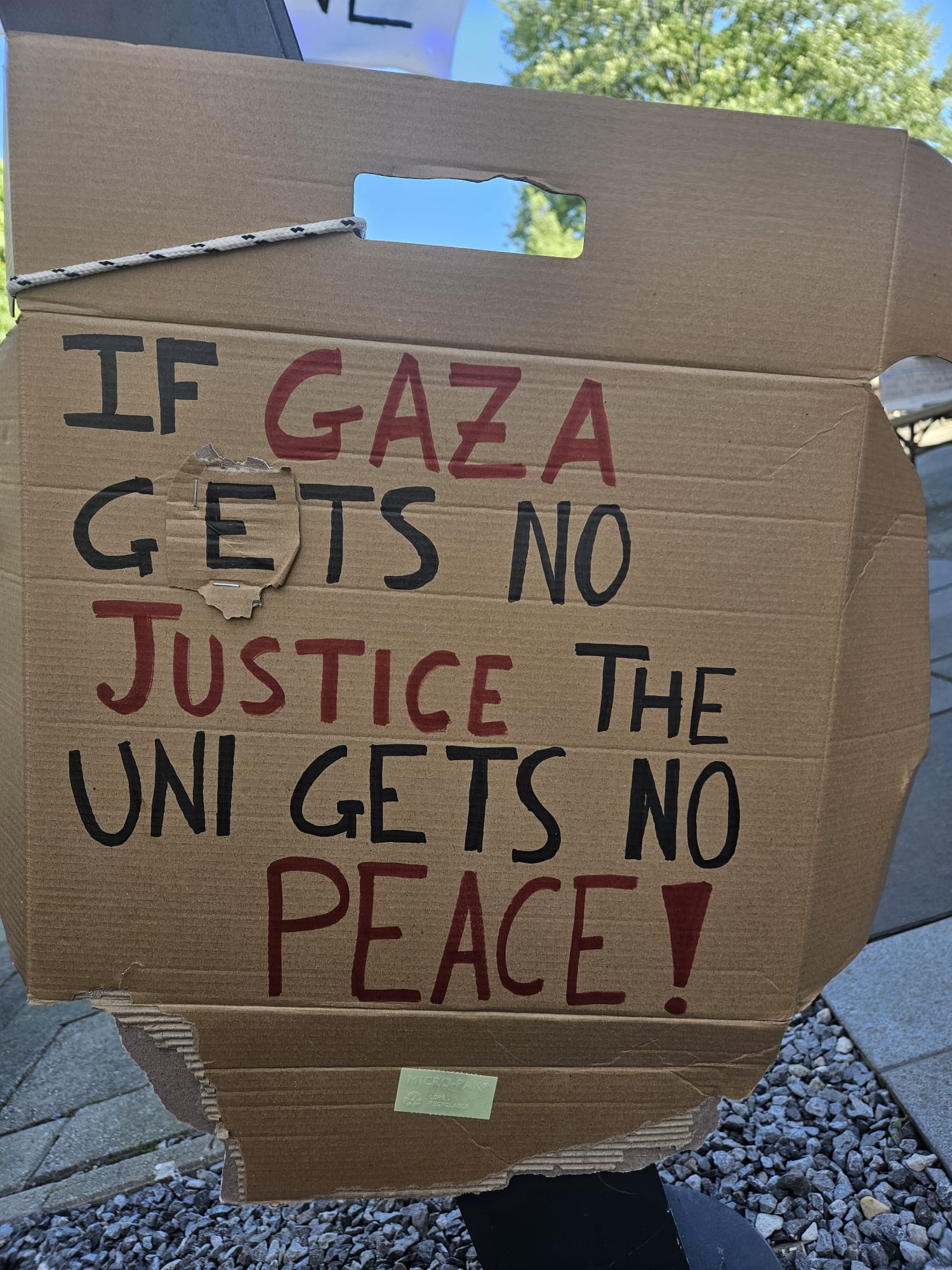 Described piece of cardboard at
the entrance of the tent camp
However, security guards will be present including some with first-aid certificates who can intervene should anything happen.
The university administration is concerned about the health of the five hunger strikers. However, it is a legitimate way to exercise the right to demonstrate, president Rianne Letschert believes. "I worry about their well-being, but they are engaged in a bigger struggle, it is an extreme expression of their powerlessness."
She reiterates how important it is to stay in conversation, not only with the students in the tent camp, but also with people who cannot appreciate this action. "I also spoke to Jewish students several times these weeks, which was very poignant and very emotional."
To end with: "I don't want to escalate, but de-escalate. I don't want to involve the police, these are our students. I don't want violence, I want to stay in conversation."
Friday, 17 May - 9 p.m
The Executive Board is not yet clarifying whether the university will sever ties with Israeli institutions, as the occupiers at the tent camp in the FASoS garden are demanding. During consultations this afternoon, a "line of thinking" on how to deal with collaborations with institutes in conflict zones was presented, according to a just-published statement by the board and university council. Individual scientists do not have to stop their contacts with colleagues elsewhere. At the institution level, the university wants to "engage" with partners who may be involved in violations of international law.
President Rianne Letschert realises that the decision-making process for the students in the tent camp is not fast enough, but she stressed this evening: "I want this process to proceed carefully, so with the deans and with the University Council and other members of the university. That group is much broader than the protesters in the tent camp, so I won't be rushed by them. Though I understand their frustration with the slow democratic processes. The members of the University Council today put different perspectives on the table and asked very good and critical questions. I am going to reflect on that and we will come back to the Council as soon as possible with a final proposal. That review framework, that's what it's about, will soon not only apply to Gaza, but must be valid in all international conflict situations."
Friday, 17 May - 8.30 p.m.
The University Council had a meeting with the Executive Board for over two hours this afternoon, confidentially and online. But this was not, as had been repeatedly announced earlier, solely about the demands of the group of pro-Palestinian protesters in the garden of the Faculty of Arts and Social Sciences (FASoS) who say they will not leave until UM cuts all ties with Israeli institutions.
The meeting focused on a policy plan on global engagement. So the discussion was drawn wider, to university partnerships with institutions in conflict zones in general. That plan has been in the works for a while, but not yet official.
U-Council president Teun Dekker could not go into detail about any suggestions, pros and cons the council might have. For that, he has "too little mandate" from the members. He did say, however, that there were different views. "For example, there is tension between academic freedom and enabling research on the one hand and not wanting to be associated with... on the other."
There was also discussion about the tent camp at FASoS and how to proceed. What the council thinks about this will also remain indoors.
The inserted U-council meeting was confidential at the last minute and was held online. Dekker said this morning that the "psychological and physical safety" of U-Council members could otherwise not be guaranteed.
The protesters had a solidarity protest on the agenda, according to their own Instagram posts, most likely in or around the Universiteitssingel where the U-Council usually meets. When it became known that the meeting was going online, that protest was called off and a silent walking vigil through the city centre followed.
Dekker regrets that the meeting could not be public. "From the beginning we said: everyone is welcome. But under the current conditions it was not justified. I don't regret that decision."
Friday, 17 May - 14.30 a.m.
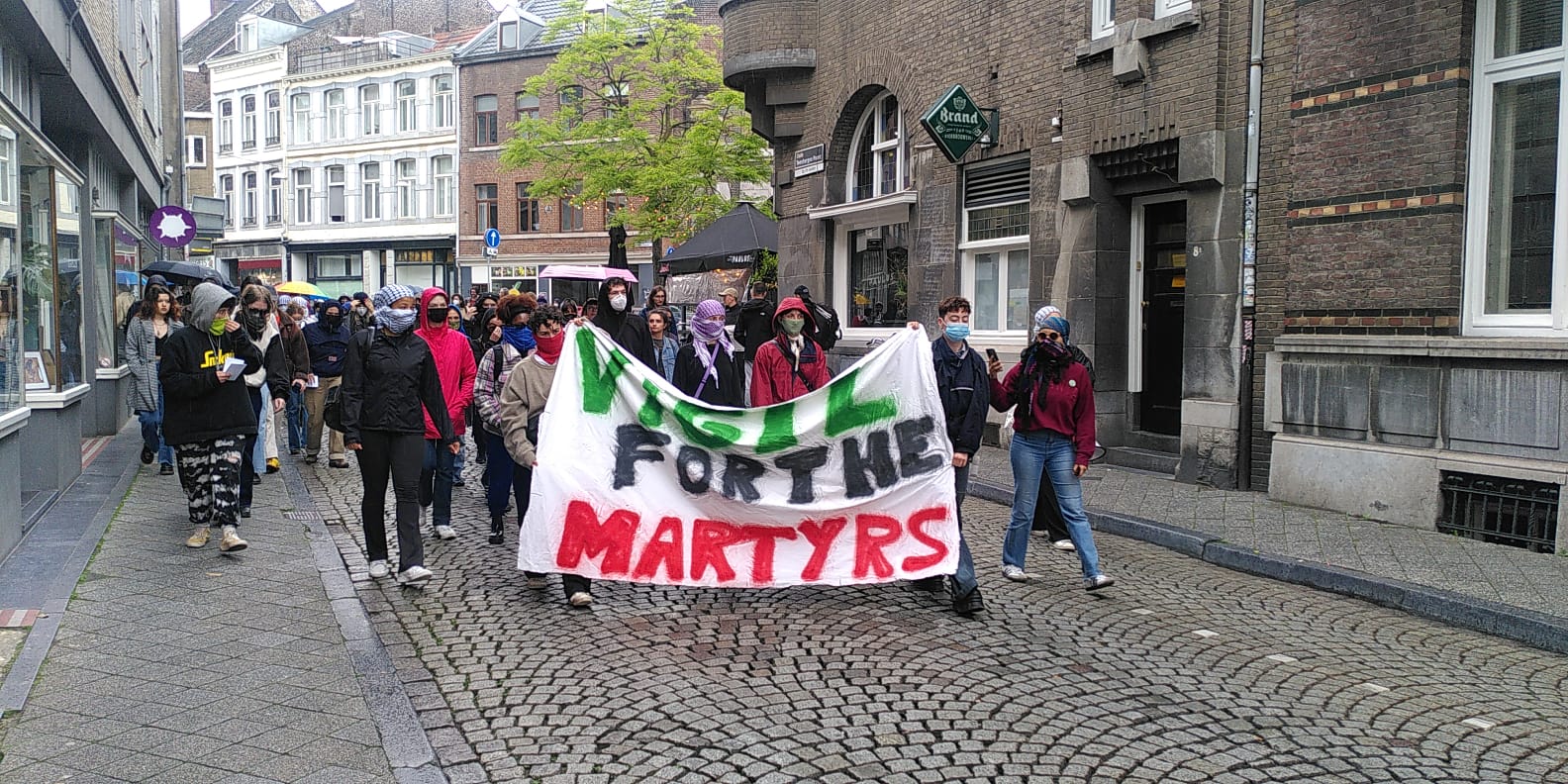 Silent walking vigil in centre of Maastricht
A silent walking vigil started from the FASoS building; 40 to 50 people walk through the streets of Maastricht in support of Palestine (and the activists who have been staying in the garden of FASoS since Monday). Flyers are distributed with the message: "Hunger strike, day 2 update: University Council meeting is moved online because they do not want to face their starving students, or the more than 1.1 million people who are facing famine in Gaza."
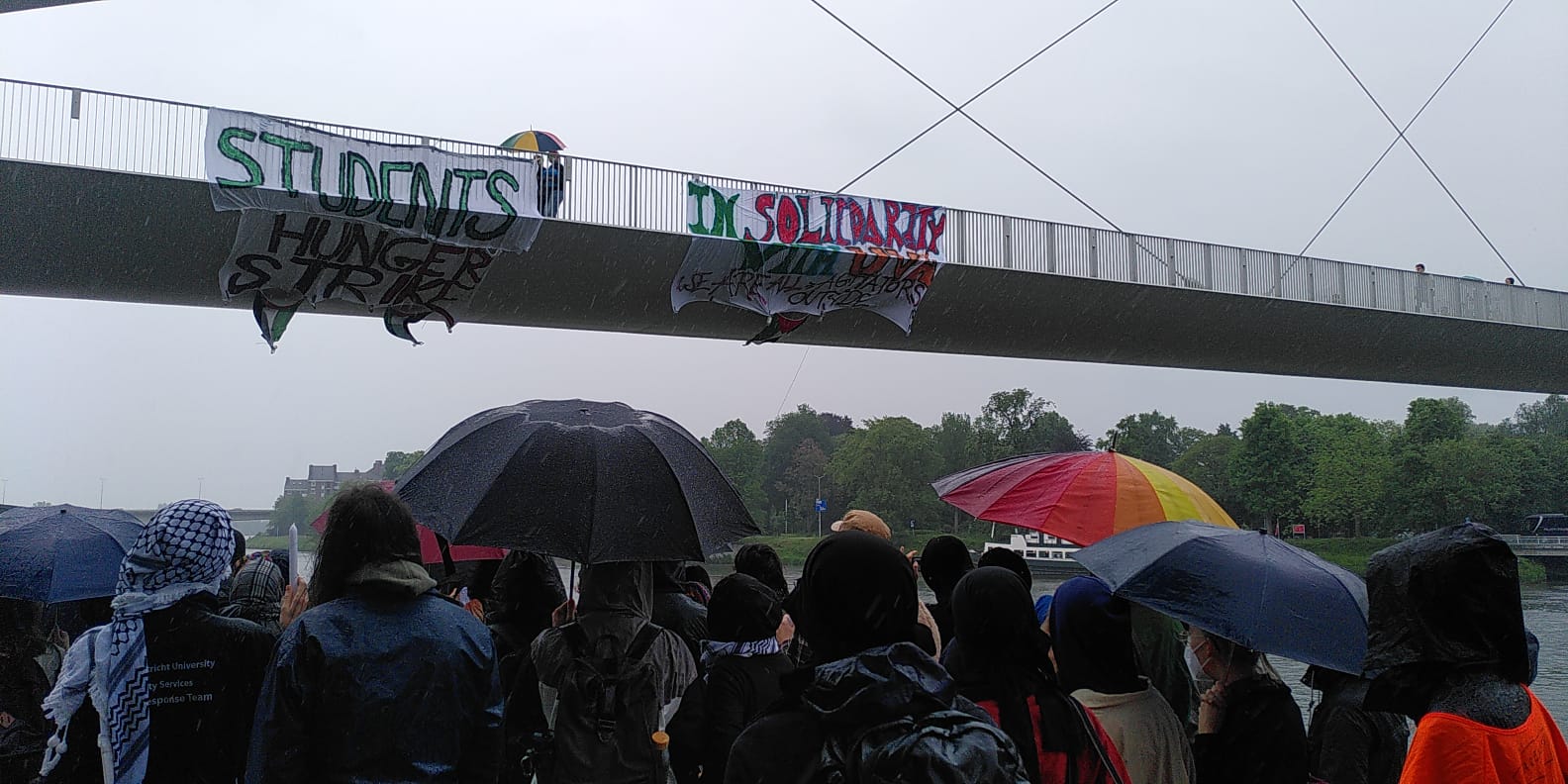 Banners on the Hoge Brug
Banners hang at the Hoge Brug; vigil participants pause for a moment.
Friday, 17 May - 10.30 a.m.
The extra meeting of the university council, which was to take place at 12:00 PM in the Co Greepzaal in the Faculty of Health, Medicine, and Life Sciences (FHML), concerning the demonstrators' demand to sever all ties with Israeli institutions, will no longer be held there, chairman Teun Dekker announced this morning. Outsiders, including the press, are also not welcome. "We cannot guarantee the psychological and physical safety of the U-council, and actually of the entire FHML." He did not elaborate on whether any signals had been received leading to this decision. "This is a decision we have made." Yesterday, the U-council was still considering a larger location because the Co Greepzaal has limited capacity.
Solidarity Demonstration
Yesterday, a noisy solidarity demonstration took place at the Grote Gracht, in front of the Faculty of Arts and Social Sciences (FASoS). According to the activists' Instagram account maastricht.encampment, another demonstration was planned for today at 12:00 PM, coinciding with the start of the rescheduled U-council meeting. It is not unlikely that the protest would have taken place in front of, or even inside, the building at Universiteitssingel 60, as that was the planned meeting location. Earlier this week, a FASoS staff member mentioned that the university administration is "terrified" of demonstrations at the FHML because of the various labs and expensive research facilities there.
Instead of the 12:00 PM solidarity demonstration, the activists are now calling for a silent walking vigil starting from the FASoS building at 2:00 PM. They will walk through the city with candles.
U-Council Advice
A public meeting of the U-council was one of the agreements made with the activists last Monday. On Wednesday morning, a delegation of the U-council even visited the demonstrators in the garden of the Faculty of Arts and Social Sciences to be informed about their demands. This was done so that the members could prepare to formulate advice to the board of governors. On Wednesday morning, board chair Rianne Letschert stated that she would take that advice "very seriously."
However, in the email the university sent out this morning, there was no mention of advice but rather "an initial reflection of the council on UM's collaborations at the institutional level with institutions in conflict areas." According to Teun Dekker, this is a "small semantic" issue. "The board members will explain what they are working on, present their ideas, and discuss the way forward. Formally, there is no request for advice from us as the U-council, but we hope to provide the administrators with some input."
Friday, 17 May - 10 a.m.
Meanwhile, the tone is hardening on the Instagram account maastricht.encampment, the page from the tent camp in FASoS's garden. The encampment should no longer be called a 'peace camp', "peaceful protest is within itself a discourse that serves the state, in order to create division within the movement"; that “narrative” is " a liberal psychological indoctrination". Conciliatory words, as for example used by president Rianne Letschert in internal UM communications, are met with cynical commentary. They are “against the peace police".
The occupiers feel that all forms of protest against genocide are “legitimate (…) there is no need to be nice or civil (….), we will always have the moral upperhand, no matter the tactic, over the people sitting in the rooms of the boards of universities (…)." And: "We will disrupt this quietude until there is justice." If quietude is considered more important, they go on to write, than the right to protest and people are "persecuted for causing disruptions, they must resort to other strategies". Which ones they are, it does not say.
The choice to engage in a hungerstrike is being defended by stating that the university put nothing but “bureaucratic options” on the table that amount to “a continuity of delays, cancellation of meetings and so on”.
Thursday, 16 May - 7 p.m.
The university leadership will not make a decision tonight after all on how to proceed with the pro-Palestinian tent camp in the garden of FASoS, where students have been on hunger strike since Wednesday night. That fact complicates the situation. Moreover, an extra-long Pentecost weekend is approaching, during which faculty buildings are normally closed.
"We are taking some more time to carefully determine how to handle this," said spokesman Fons Elbersen. A decision will probably follow tomorrow. That is also when the University Council is scheduled for an extra meeting on the matter. It must come up with an advice to the Executive Board. That will be about the protesters' demand that UM sever all ties with Israeli institutions.
Thursday, 16 May - 5.30 p.m.
At the psychology and neuroscience (FPN) faculty council meeting, two student members, Dominik Eberle Martinez and Alex Lemberg, read out loud a personal statement. They expressed their support for the tent camp protesters and called on dean Harald Merckelbach to seriously consider the arguments for severing ties with Israeli institutions. He, along with the other deans, will confer with the Executive Board on Friday about this demand by the protesters and the advice on it that the University Council will give at an adjourned meeting. "This is not about Jewish people personally", Lemberg - himself Jewish - added. "Or about taking sides. What is happening in Gaza is not an ambiguous situation."
Thursday, 16 May - 3.00 p.m.
One of the hunger strikers in the tent camp has decided to start eating again. The pro-Palestinian protesters report this on their Instagram page. According to the statement, the other five "remain steadfast and are even more determined in their decision to pursue this hunger strike. They are not willing to let it go until [Maastricht University's] ties [with Israeli institutions, ed.] are severed."
Thursday, 16 May - 12.00 p.m.
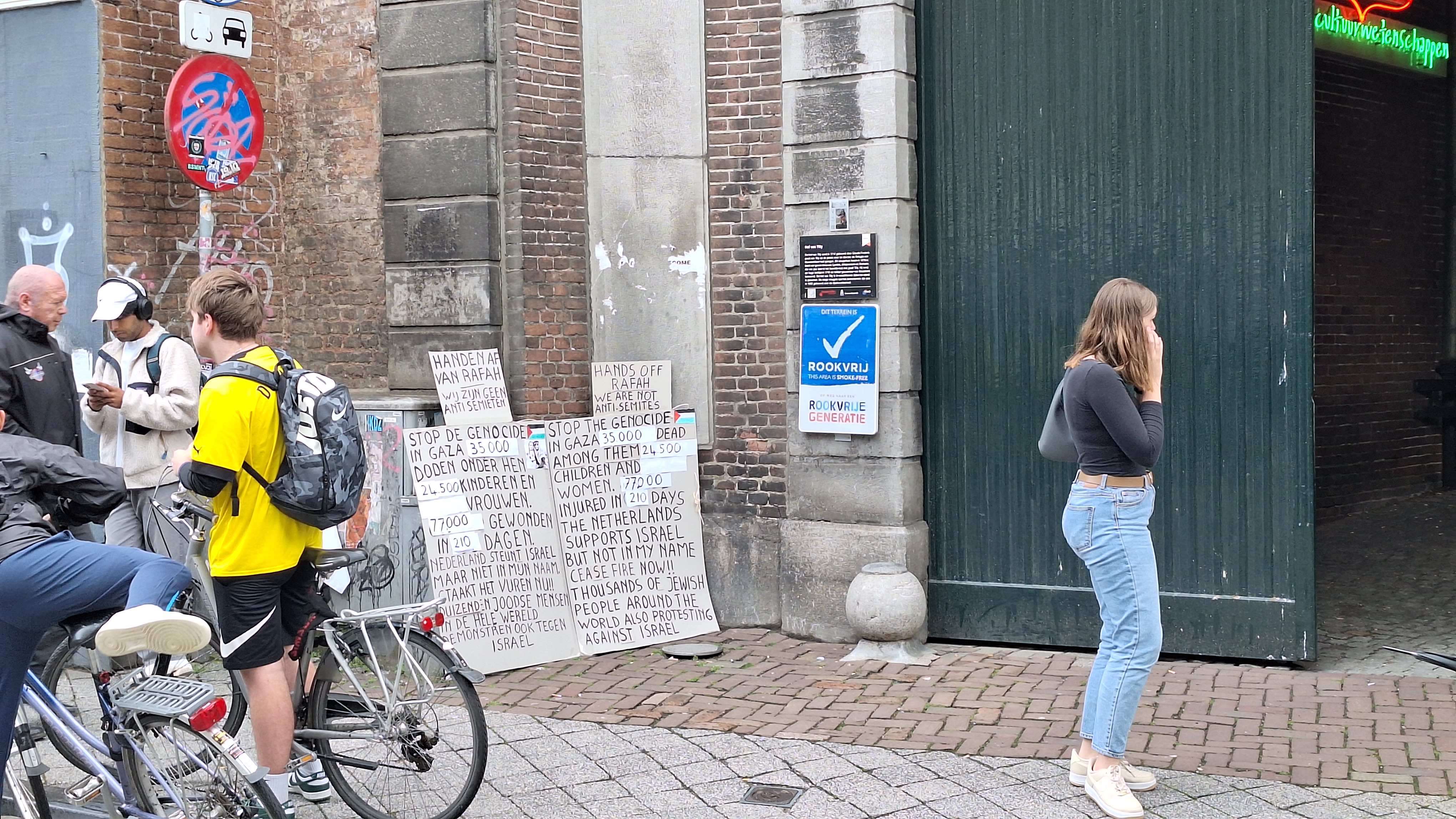 "Hands of Rafah. We are not anti-Semites"- a new sign was left at the FASoS-entrance.
The Maastricht University administration will decide today how to deal with the six hunger-striking protesters in the garden of the Faculty of Arts and Social Sciences (FASoS), spokesman Fons Elbersen announced. Whether the hunger strike has consequences for yesterday's decision that the protesters will be allowed to spend the night in their tent camp "for the time being" is one of the questions on the agenda.
Pressure
The students aim to reinforce their demand that the university sever all ties with Israeli institutions with the action. On the Instagram-page Maastricht Student Encampment, they write they are resorting to this means because, they claim, UM would respond to the ongoing pro-Palestinian protests with delaying tactics. "Hopefully, knowing that their students are waiting for their decision to begin eating again will put the necessary pressure to speed everything up."
Whether the hunger strike will have an effect remains to be seen: the boards of some American universities previously did not yield to similar actions, at Princeton just this week a pro-Palestinian hunger strike ended without result.
Communication
Meanwhile, communication with the Maastricht protesters themselves - about twenty this morning - is not easy: they keep their jaws shut. Observant is referred to a spokesperson who is not present. However, the editor is allowed to leave his phone number. While that is being done in all kindness, some other "campers" chant "Media out, media out!".
Wednesday 15 May - 10 p.m.
According to daily newspaper De Limburger, six of the pro-Palestinian protesters in the tent camp behind the Faculty of Arts and Social Sciences (FASoS) are going on hunger strike. The newspaper just quoted two activists saying that the hunger strike will begin at midnight and aims to "increase pressure on the university administration." The protesters want Maastricht University to sever all ties with Israeli institutions.
Anonymous email
In response to the report, spokesman Fons Elbersen would only say that UM received an anonymous email today announcing a hunger strike, but cannot yet say how the matter stands. "We are taking this very seriously and are going to look into it carefully," he said. Why don't they know the details yet? "We can't just go over there, the contact goes through people who have the trust of the students." It's not the first time students have resorted to this measure: earlier this year, pro-Palestinian students at several American universities went on hunger strike.
Staying
The news of the announced hunger strike follows briefly after the announcement that the protesters will be allowed to stay overnight in the FASoS garden "for the time being," "as long as they abide by the agreements made and the protest proceeds peacefully." If they do not, "it will not go on." This is what the Executive Board and the deans decided tonight. Until now, it was decided on a day-by-day basis whether students would be allowed to stay in camp. "If you then keep concluding that they should stay another night, you might as well say, 'Stay until it would possibly turn out that they can't'", Elbersen says. Whether a hunger strike will have consequences for the decision "we have to weigh tomorrow [Thursday, ed.]."
There is no insight into when the "occupation" - a term used by the protesters themselves - will end, according to him: "No university in the Netherlands where there are protests knows." On Friday, the university council will meet to discuss the protesters' demand: to sever all ties with Israeli institutions. It is still unclear what a hunger strike would mean for this meeting.
Wednesday 15 May - 6 p.m.
 The student from Zuyd (on the left) is standing in front of the FASoS-building, with security people up front
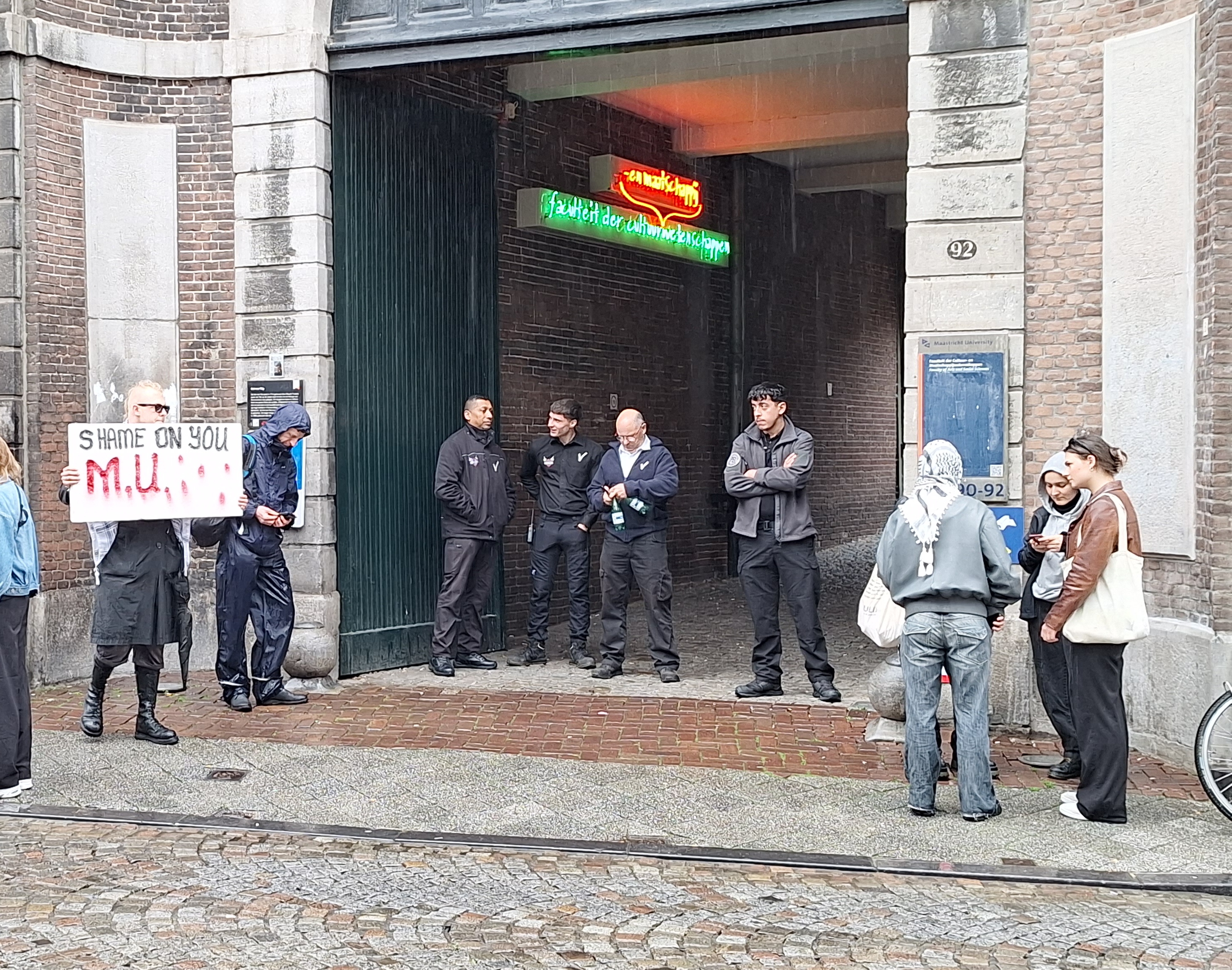
"I'm not made of sugar," says the friendly protester in front of the gate of FASoS, shrugging his shoulders. That’s just as well, because he has to stay outside on the sidewalk with his protest sign ("Shame on you M.U."): as a student of Zuyd University of Applied Sciences, he does not have a UM card - currently a prerequisite for entering the faculty grounds. And that stings the student, who is perfectly willing to talk to Observant, albeit preferably anonymously: a faculty, he says, is a public building; he would have preferred to join the tent camp of pro-Palestinian students in FASoS’s backyard. These have so far been mostly reluctant to speak to journalists. The Zuyd student can somewhat understand this - according to him, students in Amsterdam were arrested after journalists took pictures of them - but he would still have preferred to see it differently: you have to get your message across as widely as possible and therefore also speak to the press. When Observant asks if we can get in touch with the tent camp organizers through him, a regretful no is heard. When, at six o'clock, the gate at FASoS closes early, his evening is not over yet: "I think I'll be here until eight."
Wednesday 15 May - 4 p.m.
For three days now, there is a tent camp in the garden of FASoS. Observant toured the faculties and spoke to 21 randomly selected students. What do they think of the protest? By no means everyone thinks the same. Some sympathise, others are downright sceptical about the effect. Number three missed the news altogether, while his fellow student is again full of praise.
Wednesday 15 May – 3.15 p.m.
 The tent camp Wednesday afternoon
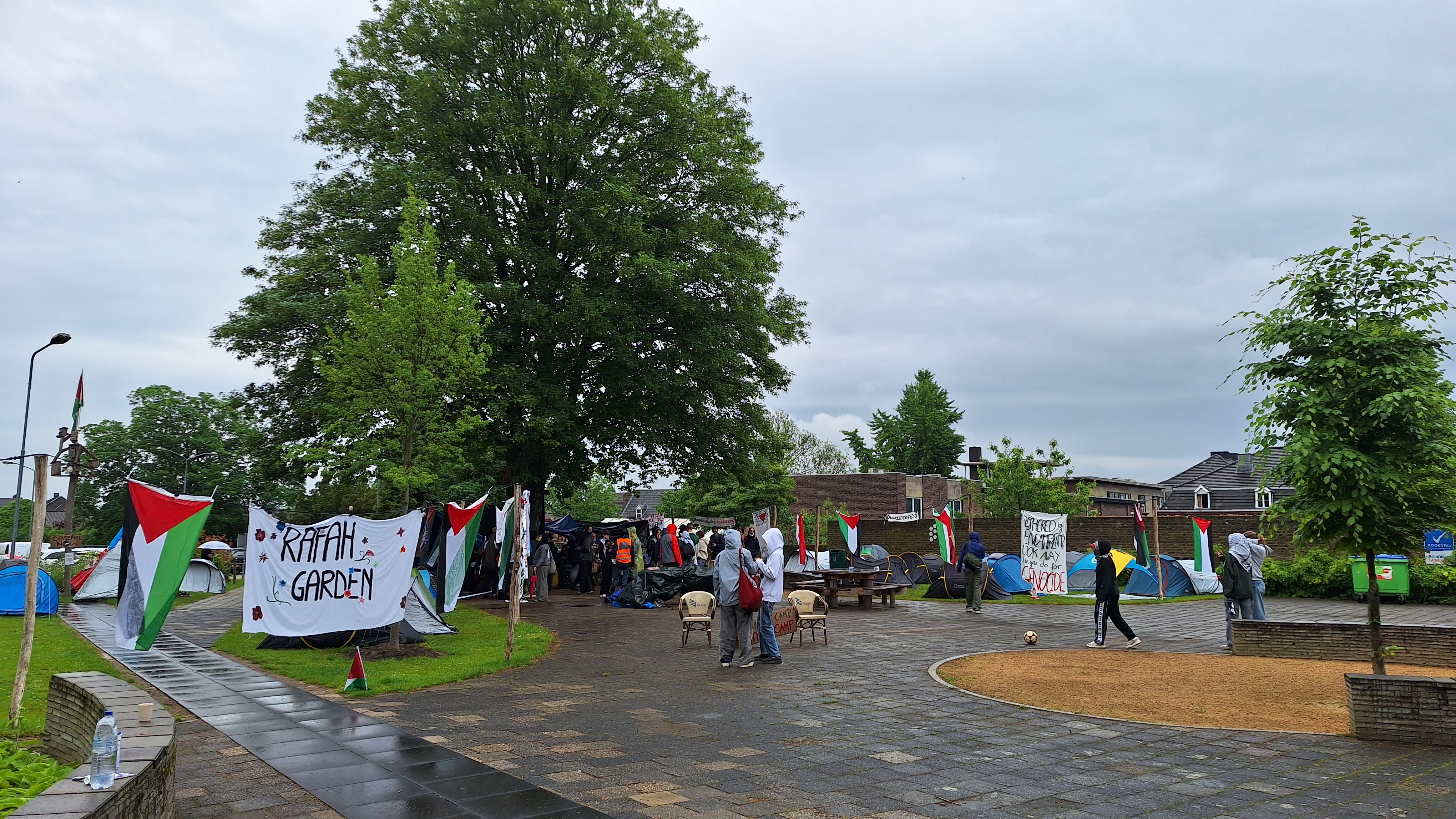
It is quiet in the tent camp in the garden of the Faculty of Arts and Social Sciences (FASoS), where, as in the rest of the city, rain has been falling steadily from the gray sky for several hours now. It looks a little less crowded than yesterday, when the sun was shining in its full force, but otherwise the protesting students don't seem to care much about the gray weather: they are protected from the drops by the large tree under which they stand, while some brave the rain and kick a ball around to kill time. “No peace camp, but protest camp”, announces a soaked sign. At any rate, the afternoon's agenda, on the protesters' Instagram page, looks peaceful: Palestinian embroidery, poems and stories, music.
Wednesday 15 May - 9.00 a.m.
The university council's Strategy Committee met confidentially this morning. The only topic on the agenda: the pro-Palestinian protest in the FASoS garden. "We want dialogue. Our policy is to de-escalate", was all UM President Rianne Letschert wanted to say. Around 10.00 a.m., a delegation from the university council left for the tent camp to talk to the protesters about their stated demands: severing all ties with Israeli institutions. This meeting, too, is confidential. So without press.
Friday, these demands are on the agenda of an extra public meeting of the university council and the Executive Board. The council will then advise the Board. Letschert added that she will take that advice "very seriously".
Wednesday 15 May - 8.30 a.m.
 The banner at the Grote Gracht, near the FASoS-building
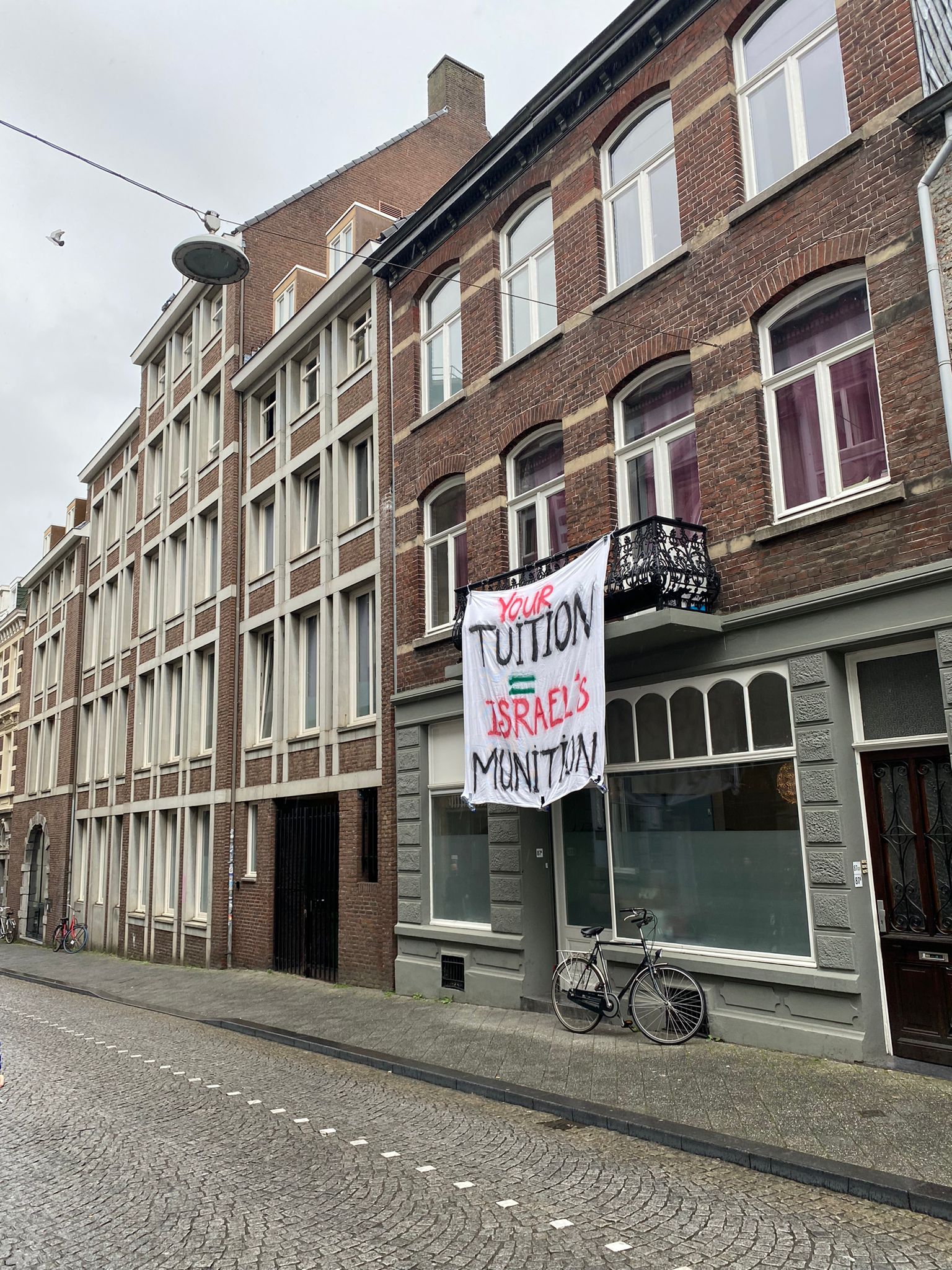
Near FASoS on the Grote Gracht hangs a written sheet, referring to universities' collaboration with Israeli institutions that 'contribute' to the military industry.
Tuesday 14 May - 8.30 p.m.
The protesters are allowed to stay a second night in their tent camp in the garden of the Faculty of Arts and Social Sciences. That is what the Maastricht University management team - Executive Board plus the deans - has just decided, said spokesman Fons Elbersen. This afternoon's noisy demonstration in the faculty building came up for discussion, but was not a breaking point: the policy remains focused on de-escalation, "although we do regret that some of the demonstrators did not keep to the agreements made".
The conditions under which they may sleep on UM-ground are the same as yesterday: for security reasons, not too many students and staff are allowed to stay, and everyone must be connected to UM. Last night, about twenty people slept in the tent camp. Tomorrow it will be reviewed again whether they will be allowed to stay any longer. The current decision "is not a blank cheque", Elbersen said.
Tomorrow morning, a university council delegation will meet with the protesters on 'location' (the tent camp). A called-in plenary university council meeting will follow on Friday; the U-council members will give their advice on the demand to sever ties with Israeli institutions.
Tuesday 14 May - 7.30 p.m.
 Maastricht people came to encourage the students
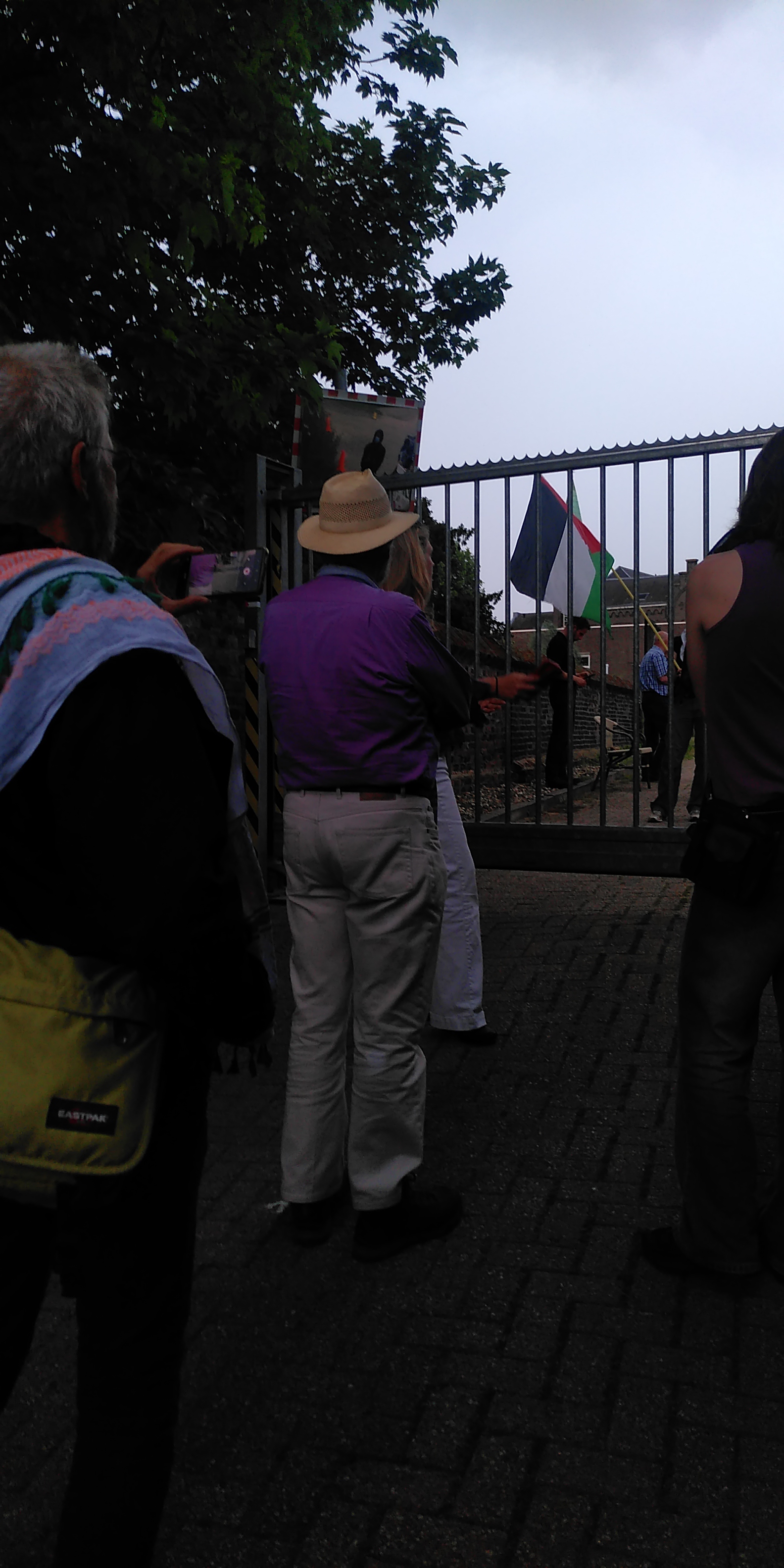
A group of people has gathered in front of the gate to the parking lot and garden of FASoS. Maastricht people - some are members of Extinction Rebellion or the International Socialists - who want to show their support for the students. Initially by shouting, but at the request of the students they are adjusting their plans. The students are happy with the agreements they currently have with the Executive Board and do not want them disrupted if the shouting were possibly too loud.
Inspiring
Instead, students come to the gate to listen to the speech of Janneke Prins, a member of the International Socialists and one of the organizers of the support protest. "Students were the first to take action when Israel invaded Gaza and started bombing", she begins amid cheers. She praises students: "What we are seeing this week - that tent camps are being set up at universities everywhere - is super inspiring." And criticizes the UM: "All they wanted to organize was a meeting between Zionists and Palestinians. You're not going to put the invader and the victim together at the table, are you? When Russia invaded Ukraine there wasn't a meeting between Russians and Ukrainians either, was there?"
Sanctions
Meanwhile, the rain is coming down heavily, but that doesn't bother anyone. "Thank you for staying", Prins tells the students. After condemning police violence against protesters and calling on the Dutch government to impose sanctions against Israel, she closes with "Judaism; up, up, Zionism; down, down." The students fall in and after a few "Viva Palestina," thank yous back and forth and a cheerful "see you tomorrow," the groups on both sides go their separate ways again: the students back to their tents and the Maastricht people home.
Tuesday 14 May - 2.45 p.m.
Several dozens of pro-Palestinian students entered the Faculty of Arts and Social Sciences building in the early afternoon. Their very vocal march through the hallways was not allowed, but no intervention was made. Since then, the protesters are back outside and it is quiet again in and around the building.
The students who went inside violated the agreements made last night between UM's Executive Board and the protesters, agrees spokesman Fons Elbersen. "We blame them for that." UM President Rianne Letschert already drew a red line after previous pro-Palestinian demonstrations in faculty buildings: demonstrations should not disrupt education.
So why was no intervention taken? "We are still on the track of de-escalation," Elbersen said, weighing "moment by moment" what to do. When asked what needs to happen before intervention, he did not elaborate.
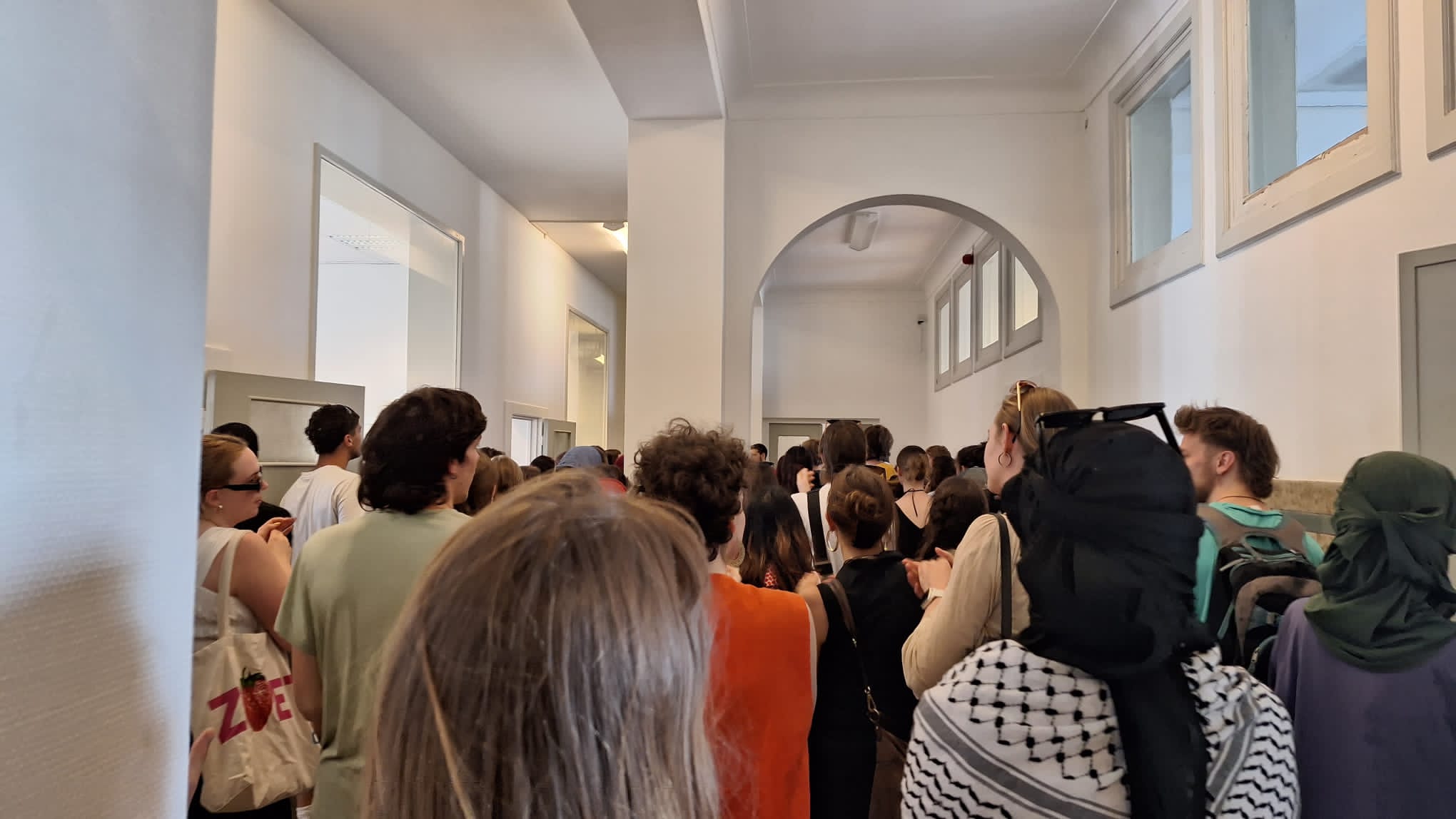 Protesters are walking the halls of the FASoS-building
The leaders of the protest have been reminded of the agreements again, Elbersen says. "But I don't know if they have everyone under control." The agreements will be brought to the attention of the protesters again this afternoon: the group has grown in number again during the day.
Tuesday 14 May - 1.30 p.m.
The protesters have moved inside. While shouting slogans, they walk the halls of the FASoS-building. They chant slogans like: "Viva Palestina," "He ho, he ho, the occupation has to go," "Intifada, intifada" and "Israel is a terror state". When they pass educational rooms, people calmly observe them and sometimes greet an acquaintance.
Tuesday 14 May - 11.00 a.m.
The legitimacy of violence: the theme of his planned lecture, according to philosopher René Gabriëls fit so well with the pro-Palestinian demonstration in the garden of FASoS that he gave it there this morning. At an appropriate distance, admittedly: Gabriëls' tutorial group was kindly asked to sit a bit further away, the protesters had their own meeting that apparently had to remain private.
Tuesday, May 14 - 10.00 a.m.
"May I see your UM card?", asks a security guard. The Observant editor is stopped at the entrance of FASoS at the Grote Gracht. At that moment, an employee of the Faculty of Law, parking his car at the back of the FASoS building, walks out. "UM card? We haven't had an email about that, have we? I get the rule, but by no means does everyone have that card in their pocket."
The access policy is paying off, says Internal Services Assistant Armand Schoonbrood, who observes the protesters in the garden a little later. "Just a few minutes ago; two people with tents, but without a UM card. Then you don't get in."
The tent camp is quiet. About 30 students sit here and there, some are having breakfast at the picnic tables, others are hanging around, still others are trying to fix a new banner at the entrance to the garden. "Don't block the passage!", Schoonbrood shouts shaking his head. "That one has to stay clear. For emergencies."
Ropes are taken out of the tent, one of the students - standing on a chair - attaches the sheet reading "You support occupation? Here's one". It doesn't work the way he wants. "Maybe attach it up there?" "No, then I'd have to climb on the wall. We won't do that."
They still prefer not to talk with the media, but they do say that they slept "well". The weather was fine, with the sun shining early.
Spick and span
An employee of Facility Services keeps an eye on them. The students are behaving quietly and decently, he concludes. "Just now, another one came to ask if I had a key for the bin. They clean up their own mess neatly." Even the toilets - one of the buildings, adjacent to the garden, was left open so that they could use it overnight - are spick and span.
Masks, face masks, scarfs twisted around heads to remain unrecognisable: nothing of the sort. Unlike the day before when an incident occurred with the Maastricht medium Wat is loos in Mestreech. Internal Services Assistant Schoonbrood: "There was so much media, so many cameras. They didn't want any of that." What's the plan for today? They will want to stay a while longer, Schoonbrood guesses.
Statement
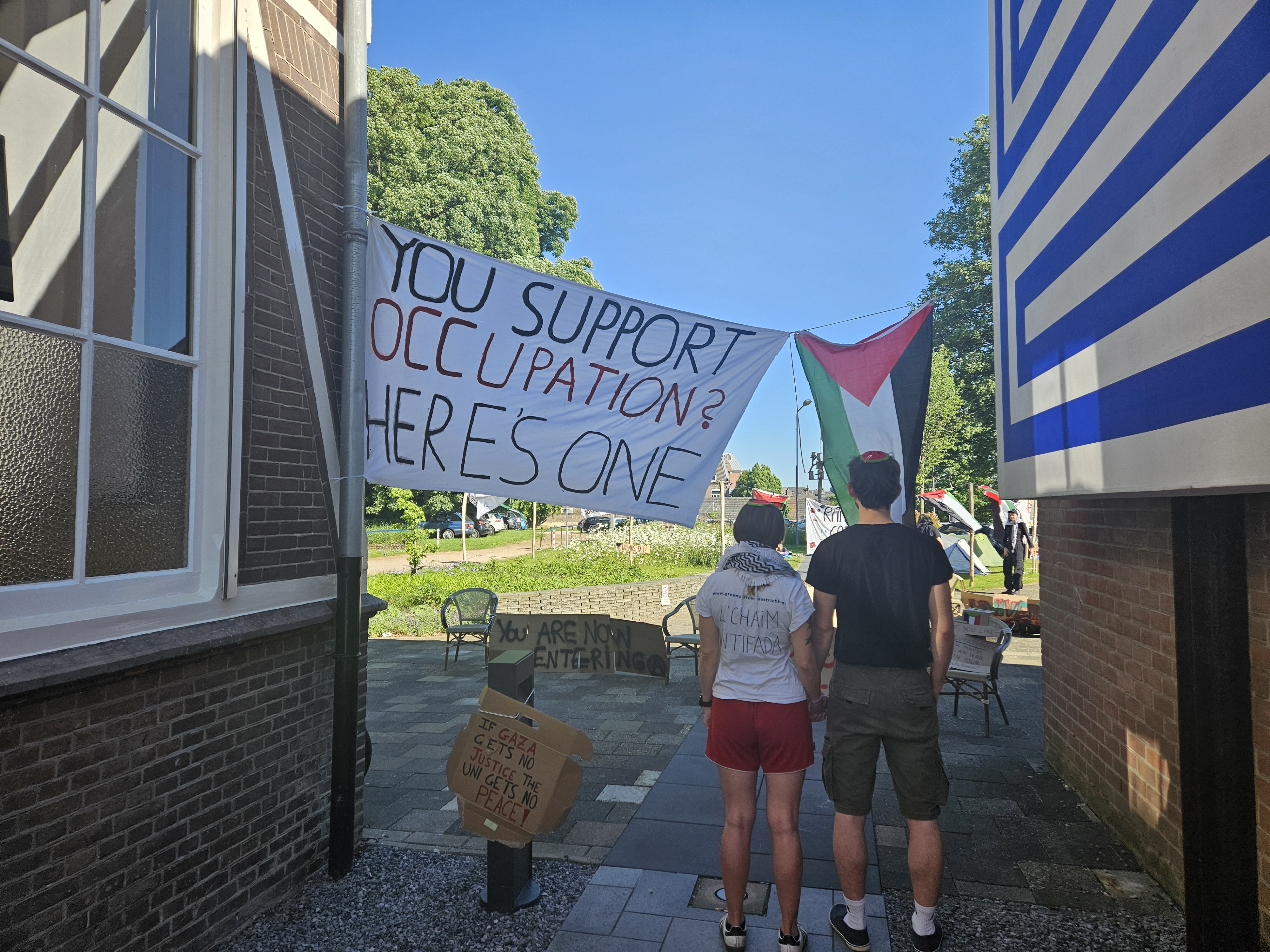 Two students want to make a statemant: "Don't lump all Jewish students together"
A picture of the banner? "Yes", but the question of Observant is first put to one of the 'leaders'. She is fine with it, but has another idea: two students will stand there - unrecognisable. They want to make a statement. They are critical of Observant's article interviewing Jewish students about the war in Gaza and the turmoil these events are also causing at Maastricht University.
"Jews against genocide", it says on the front of the white t-shirt. On the back: "L'chaim intifada" (Long live the intifada). Both are among the protesters, have also spent the night in the garden, and yes, are Jewish, born in Germany. Their thought: don't lump all Jewish students together. As if they are all reticent, fearful, don't want to be openly known as Jewish, have the same mindset. There are so many different perspectives, opinions. "You wouldn't say that all Dutch people voted for Wilders either, would you?"
Tuesday 14 May - 09.30 a.m.
 Rianne Letschert Photo: Loraine Bodewes
Just under twenty pro-Palestinian protesters - UM students and staff - spent the night in the tent camp behind the Faculty of Arts and Social Sciences. The remaining seventy to eighty protesters quietly left the grounds Monday evening, after hours of talks between them and, among others, UM President Rianne Letschert and University Council chair Teun Dekker. How long they will be allowed to stay, will be looked at from day to day.
The camp has been renamed 'Forum for Justice and Peace' and has been designated as an "internal event" so it is not necessarily open to the media, Letschert told Observant by telephone on Tuesday morning. In the tent camp, "dialogue sessions" will be held this week. The protesters are speaking with delegations from the University Council, deans, students and staff.
Collaborations
The central issue is the demand that UM suspend or sever formal institutional-level collaborations with Israeli educational institutions. That would be "quite a step that the Executive Board cannot decide on its own", Letschert said, stressing that it is not a matter of individual scholars collaborating with Israeli colleagues. The sessions are the run-up to an additional meeting of the University Council, most likely at the end of this week, where the protesters' demands will be on the agenda.
According to Letschert, UM has a complete list of the collaborations mentioned. That is "a very short list" about which she does not want to say anything more at this time. She also does not want to comment at this moment on whether the decision not to send the protesters away violates UM house rules - which say no overnight stays in university buildings.
Protocol
How do comments made by the interim president of the Dutch assembled universities, Jouke de Vries, last weekend on the Dutch TV program Buitenhof, square with UM's actions? He said that the universities are working on a demonstration protocol. Two things are clear as far as De Vries is concerned: university administrators will not negotiate with demonstrators who cannot identify themselves and no overnight stays are allowed in university buildings. Letschert: "Those are draft rules."
Monday 13 May - 8:50 p.m.
Anyone not staying overnight is asked to leave the faculty. Observant is also leaving. How many students remain behind is not known. Two people from security are keeping a watchful eye, as are some teachers, including René Gabriëls of FASoS who also sat at the negotiating table.
Monday 13 May - 8:40 p.m.
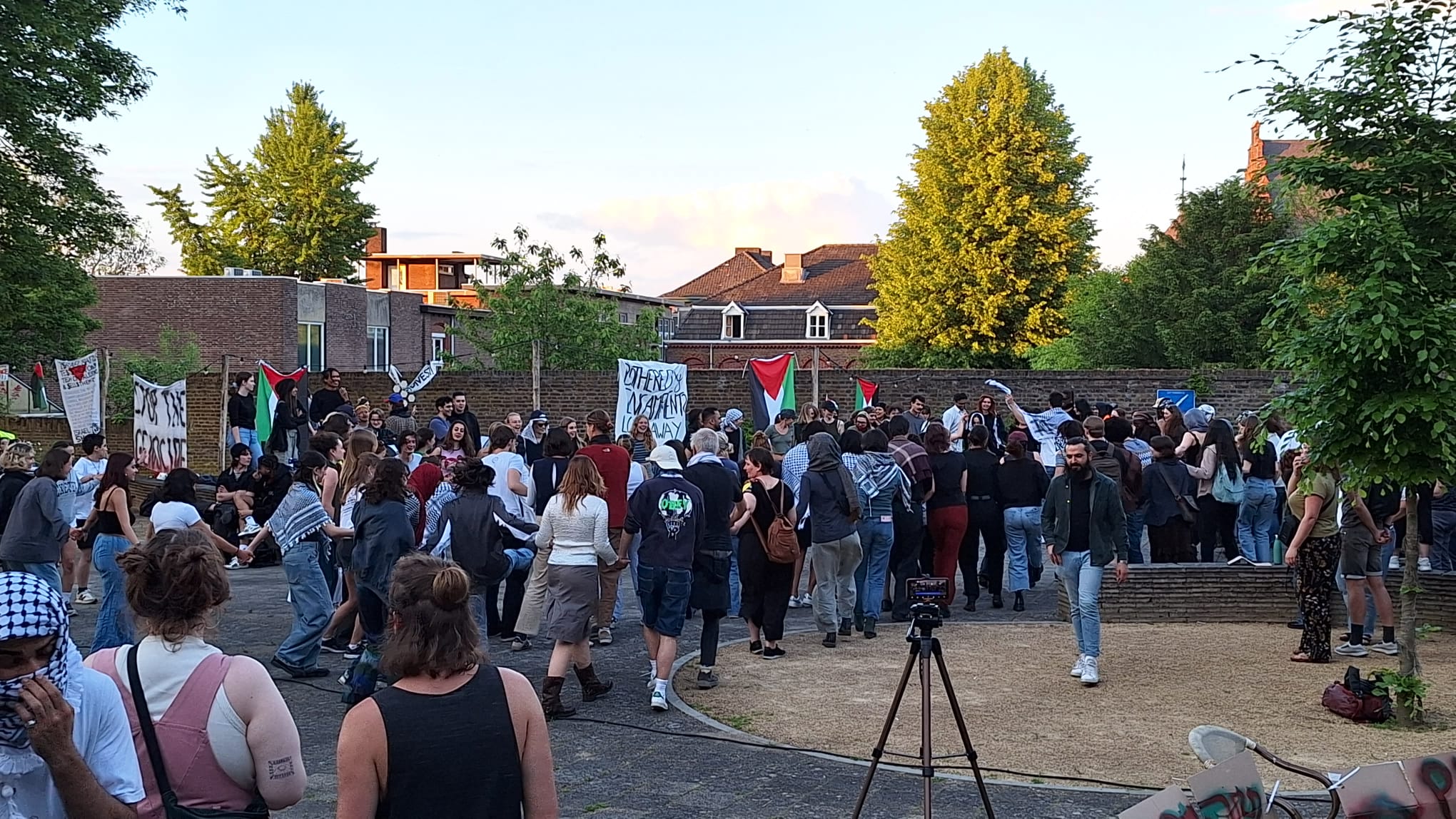 Protesters celebrate that they may stay the night
Protesters are celebrating because they have the green light from the executive board to camp on UM grounds tonight. The idea, though, is that as few students and staff as possible are allowed to stay for safety reasons, explains assistant professor René Gabriëls, who has been at the negotiations with the executive board all along in support of the pro-Palestinian protesters (UM-president Rianne Letschert will comment to Observant later today or tomorrow).
- People staying overnight must be affiliated with UM. Students agree to show their UM student ID. A maximum has not been mentioned.
- There is no occupation, but a Forum for Peace and Justice, says Gabriëls. That's part of the agreements. Everyone, he says, is convinced that it must be resolved peacefully. "They could learn a thing or two from that in the north," he says. "An example for the rest of the country."
- How long camping will be allowed is unclear.
- Tomorrow, members of the university council will meet with the students.
- Pro-Palestine protesters still do not want to speak to the press at this time.
- Whether UM will also cut ties with Israeli institutions is unclear.
8 p.m.
The atmosphere is relaxed, music is heard, people are talking, food has been handed out by the protesters.
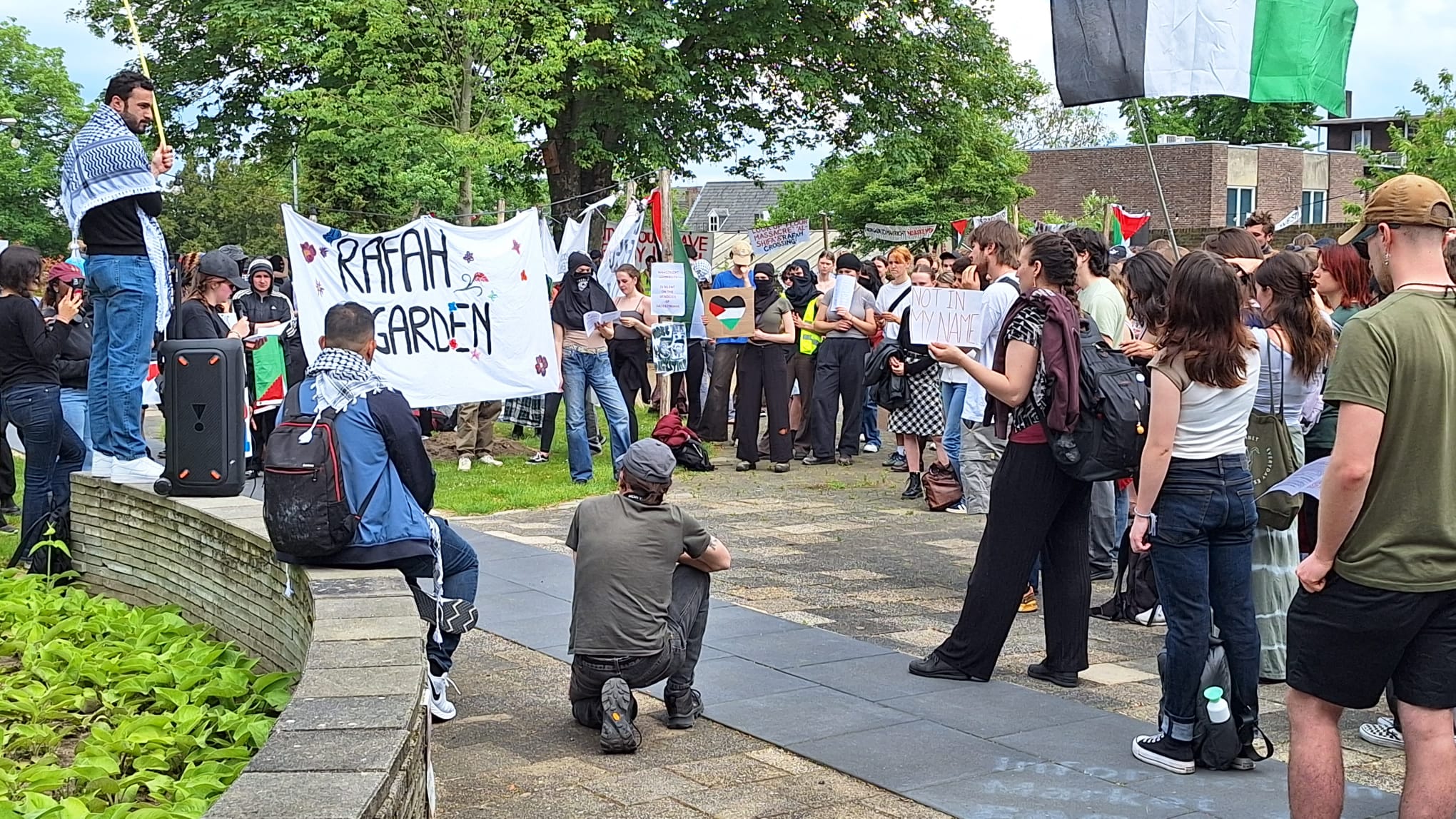 People listening to speeches earlier that day
- The first negotiations between the executive board and pro-Palestinian protesters started around two o'clock. With the necessary interruptions and proposals back and forth, these are not yet over. Joining them are at least UM-boss Rianne Letschert, as well as Valentina Mazzucato, professor of Globalization and Development, Teun Dekker, chairperson of the University Council, René Gabriëls, assistant professor at FASoS (he is on the side of the protesters) and three students whose names are not shared (or not known) by the UM spokesperson.
- The faculty building on the Grote Gracht usually closes at 9 p.m., but due to rumors of people from outside the university on their way to FASoS to join the protest, UM has started closing doors since 6:30 p.m.
- May (some of) the attendees spend the night in their tents on UM grounds this night? This is still being discussed. In any case, UNL, the umbrella organization of the universities, is working on a demonstration protocol and one of the principles is: no staying overnight in university buildings. The interim president of the UNL said that last Sunday in TV program Buitenhof. So whether UM will now go its own way after all and let the demonstrators sleep over remains to be seen.
- About the main stumbling blocks in the talks, the UM spokesperson cannot or will not say anything.
- The university is compiling a list mapping out formal cooperation projects with Israeli institutions, but it is "not yet set in stone," says a UM spokesperson. Moreover, it is difficult to gain insight into the informal, 'regular' network of individual scientists with Israeli colleagues, it sounds. Posters from the protesters do mention some projects including those of Young Universities for the Future of Europe. YUFE is said to be a partner of Adecco, a company operating in Israel.