“Remembrance is important to us, not necessarily for the past, but because every memory is essentially an indicator of who we are and who we want to be. There’s an implicit message: ‘We have learnt lessons from the past’, ‘we have seen what went wrong’, and ‘we don’t want to make the same mistakes as those who came before us’,” says Georgi Verbeeck, Associate Professor of Modern History at Maastricht University and professor at KU Leuven.
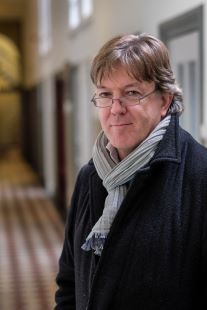 Georgi Verbeeck/ photo Joey Roberts
“World War Two continues to be remembered everywhere, because it’s still such an important benchmark. A Nazi dictatorship, foreign occupation and violent warfare, all as a result of disruptive nationalism, and we don’t want that anymore.”
Greatest victim
Verbeeck says it is a “naive thought” that remembrance is by definition always “good and healing”. “Remembrance is almost always a choice between remembering someone or something and paying less attention to someone or something else. And that can lead to tension.” He is referring to the National Remembrance on 4 May. “It started as a private initiative, which the government subsequently systematically took over. There was immediately disagreement over who we should even be remembering. It started with Dutch military personnel and political resistance fighters who perished in World War Two. Later on, soldiers who died fighting for the Netherlands in other conflicts, including those who died in the war of independence in Indonesia, felt they also deserved to be remembered.
“It wasn’t until much later that the largest group of victims of the Second World War was added, such as the more than one hundred thousand Dutch Jews who were transported and killed during the German occupation. Yet another expansion followed with more Second World War victims, such as the Roma and Sinti, and Dutch citizens and soldiers who died in more recent violent conflicts. There is now a long list of people who are remembered one way or another. Some people celebrate this inclusivity, but others object, saying: ‘Hang on, I’m the greatest victim, aren’t I?’”
Minorities
Another aspect that leads to tension is clashing cultures of remembrance. “In Europe, in the ‘global north’, World War Two is important, but there are minority groups or people with a migrant background for whom it is of less or even no importance. And they say: ‘Why don’t we have a right to our history and culture of remembrance?’ Look at Palestine and Gaza, for example. Many people there feel that we essentially pay too much and exclusive attention to the Holocaust.”
Until recently, Verbeeck believed that remembering the Holocaust would “continue to be the greatest moral benchmark in the Netherlands, in Europe”, but he has started to waver. “The loss of eye witnesses and the increasing diversity of our society may yet change that. As history continues its unrelenting march, new groups emerge, new traumas.”
He uses a brief diversion to the east to highlight the misuse and manipulation of memory. How Putin legitimises the invasion of Ukraine – Russia fought against the Nazis in World War Two and now claims to be fighting against the ‘new Nazis’ – is dangerous, Verbeeck says. “He’s mobilising people for new violence, new injustice.”
Far-right party
Under the banner of ‘80 years of freedom’, the south of the Netherlands will celebrate peace and freedom. “But if we continuously emphasise that we have been living in a free and democratic country since 1945, we may overlook the dangers we face here in the Netherlands and in the rest of the world. If you focus too much on the past, you forget what lies ahead of you.” Such as the significant victory of the far-right AfD (Alternative für Deutschland) party in the German states of Thuringia and Saxony? “It was always said that Germany moved on from its history so neatly.” After the Second World War, the promise of ‘Nie wieder’ dominated, never again would there be a Nazi dictatorship or a repeat of the Holocaust. “Acknowledging that legacy would make it much harder for far-right and populist parties to succeed there – compared to other European nations. However, that no longer seems to be the case.”
Cultural memory
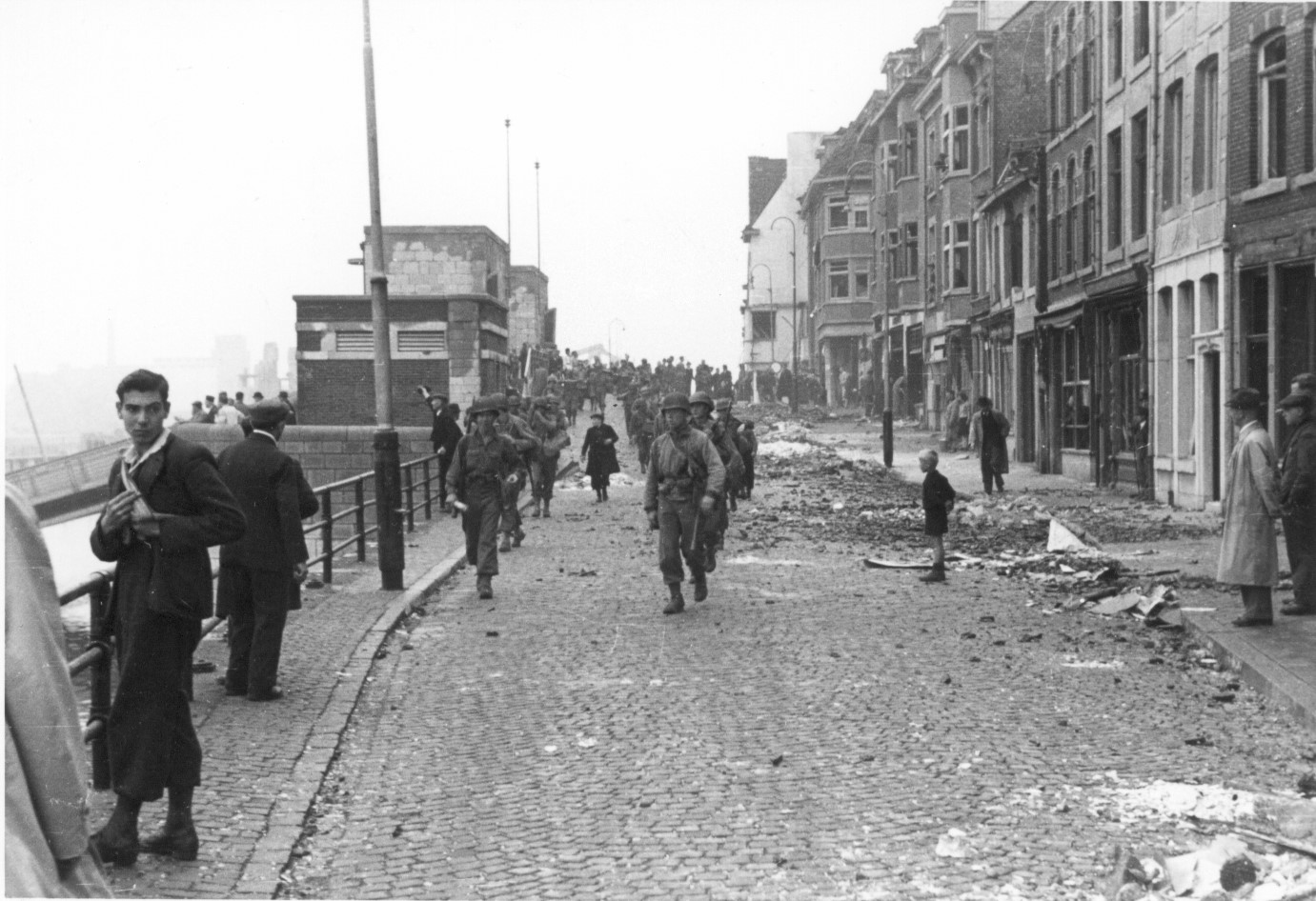 Liberation of Maastricht, Cörversplein, september 1944 / Historisch Centrum Limburg, Jef Naseman- photocollection GAM [3411]
It’s getting harder and harder to find people who experienced the war first hand, but those eye-witness accounts are the most impactful stories we have. What do we do when there are no more survivors? “Communicative memory is everything you can still share with each other, with surviving generations. But that’s shrinking. It’s becoming cultural memory, a more institutionalised memory, in books, museums, movies, and the like. That shift from one to the other, and that tipping point is where we are now, is important, because you have to ensure that the cultural memory is nuanced and balanced enough, takes as many different perspectives into account as possible. Because there will come a time when there are no contemporaries to call us out. Just a few more years and this will all be consigned to the history books.”
According to Verbeeck, “small, individual stories” can help. One example is the Stolpersteine project in Europe – including in Maastricht – which places memorial stones in front of houses where people who were deported and killed by the Nazis once lived. “You get that sense of, ‘This is what happened to that family, on that day, on my street’. It speaks to you directly.”