“It’s roughly 70 square metres, I’d say.” Peter Alblas from the Centre for Natural and Environmental Education (CNME) squints in the bright morning sunshine as he quickly works out how large the piece of land on Oxfordlaan is that is now so popular with insects and other creatures. “We’ve got earworms and caterpillars too, but people don’t like them as much as the wild bees.”
The flying insect is having a hard time in the Netherlands, but seems to be doing well in Maastricht. Recent research carried out on behalf of the council shows that 148 wild bee species have been spotted at the twelve CNME hotspots dotted around the city: little mounds of different types of soil sown with a variety of native plants and flowers. Randwyck’s count of 64 species of bee means it has an above-average biodiversity.
“I think there are more than fifty different species of flowers here,” says Alblas, explaining that they are all flourishing in soil that he very carefully compiled, and which was also taken from Maastricht and the surrounding area. “Marl and loam, for example, and a mix of gravel, sand and silt, such as that once left behind by the river. These types of soil dry out easily, which prevents grass from growing rampantly. Bees like heat and nest underground, so the sun needs to be able to reach it.”
What it looks like below remains a mystery, but at the surface this paradise looks a bit of a mess. “It does look wild,” Alblas admits, as he pulls up some plants with long roots, “but that is entirely deliberate. You can’t just let everything grow either, maintenance is necessary.”
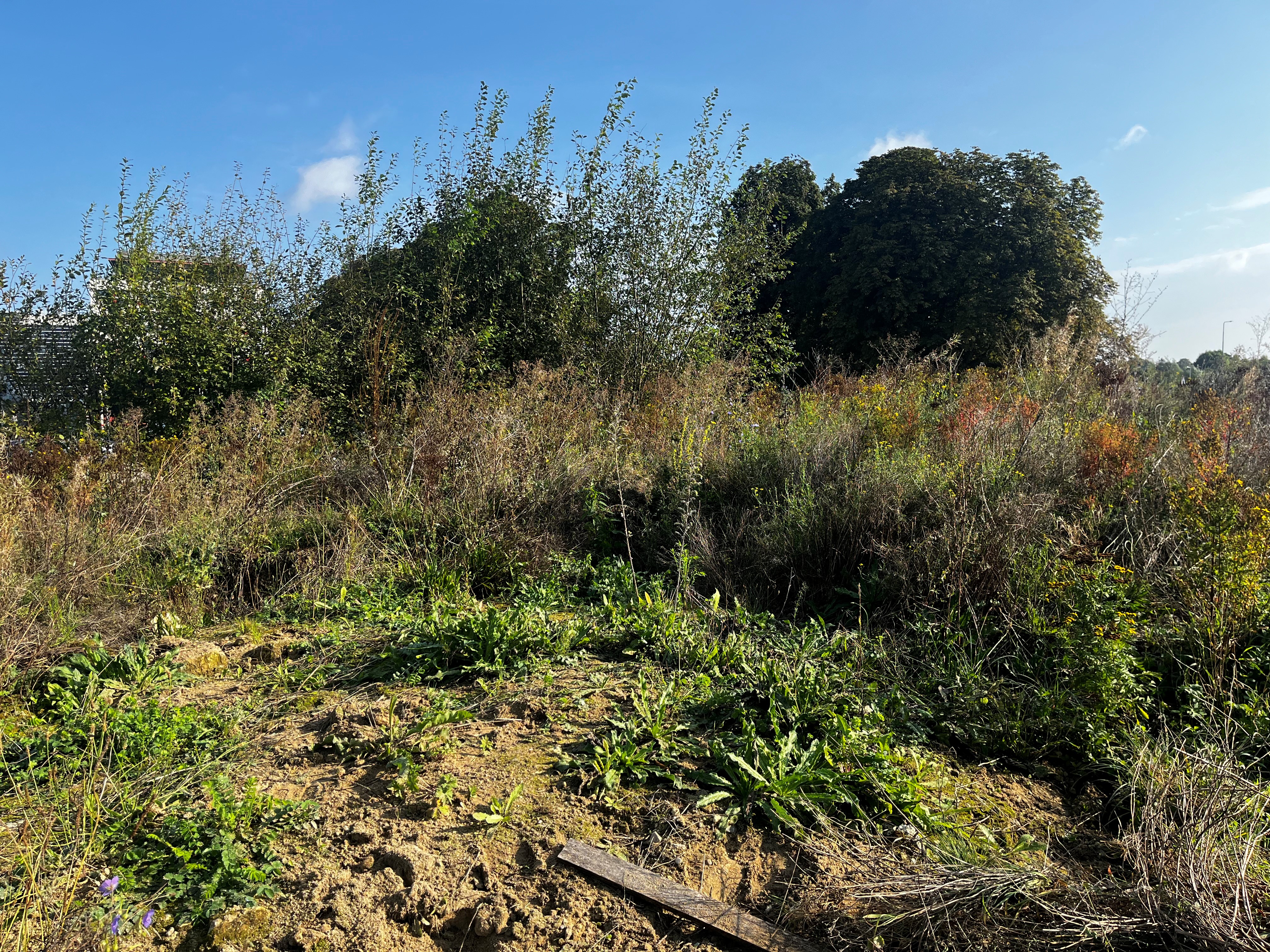 The bee hotspot behind Oxfordlaan 55, with bare spots where the sun has good access to warm the ground / photo: Observant
Involvement
He’s also trying to get the staff and students at the university more involved with that. For example, the nanoscopy team from the M4I institute (Faculty of Health, Medicine and Life Sciences) helped sow the first flowers, and the Faculty of Psychology and Neuroscience (FPN) has plans to start a separate flower meadow behind the hotspot in the autumn. The posts marking it out are already in the ground. “It would be nice if there could be a bench, so students can sit down and enjoy a cup of coffee.”
It’s an image that also appeals to Rabbe Dormans, advisor for environment and sustainable operations management at Maastricht University, for starters. “The bee hotspot is an CNME project that doesn’t cost us anything – we’re just facilitators. But it is an excellent way to change how we look at our environment and to work towards more change.”
And that change is coming. Since 2020, the university has stimulated more nature on and around campus. “This came from the idea that more biodiversity is also good for people’s wellbeing. So we asked students and staff how we could make our facilities more attractive.”
Grounds outside
This led to a partial removal of the tiled courtyard by the Faculty of Arts and Social Sciences (FASoS), replaced by a native garden, and more flower beds and hedges planted at Universiteitssingel 40, amongst other things. There are also new plans and an even greater focus on biodiversity.
“For example, the Faculty of Science and Engineering used the grounds outside for fieldwork last year,” says Dormans. “The flower meadow at Duboisdomein yielded 30 beetle species.” Also, the students of faculty have been working on a proposal to use the grounds outside more often anyway, also by other faculties, as an alternative to the classrooms indoors.
Dormans also points out that students of the Maastricht Sustainability Institute have been asked to research how the university can develop a green vision for the grounds. “There are so many possibilities, but it all depends on money, time and workload. Culture change is a long game.”
Bee capital
The bee hotspot, which boosted the biodiversity in Randwyck in a short time, is a positive result. “And should this spot ever disappear, because of future construction, for example, new places will pop up for the bees to discover,” says Alblas. “They’re smart animals, pioneers, who are also concerned with the next generation.”
Those descendants will continue to be numerous in Maastricht, Alblas thinks. “This is the bee capital of the Netherlands, with 240 species. Why? It’s warmer here, we’re in the Maas valley, there are slopes, and the soil is perfect. That combination makes this a unique place for biodiversity. What we have achieved here wouldn’t be possible anywhere else in the Netherlands.”