Say the word “Maastricht” to a geologist or palaeontologist, and their eyes will likely light up. This is certainly true for Leon Claessens, professor of Vertebrate Palaeontology and Evolution at UM since 2019. After enjoying his time in the United States, conducting research at prestigious universities like Harvard, he couldn’t resist the opportunity to return to the region where he grew up. “Maastricht is world-famous in my field.”
Open any textbook and you’ll see that the period from roughly 72 to 66 million years ago – the last age of the Cretaceous period – is called the Maastrichtian. And this isn’t a mere footnote in Earth’s history, Claessens explains. “It ended with the meteor that wiped out the dinosaurs – an iconic event everyone knows about, from scientists to young children.”
Maastricht owes this distinction to the typical limestone (locally referred to as mergel, marl) deposited in this age in the substrata of Sint-Pietersberg (Mount Saint Peter hill). At the time, what is now South Limburg was a shallow subtropical sea, “similar to the Bahamas”, with a rich marine ecosystem. As a result, the ground is replete with fossils.
Revolutionary idea
One of the most significant finds is the mosasaur, a giant marine predator that ruled the seas during the Maastrichtian. In the 18th century, the first fossils of this species were discovered in the underground tunnel system in the hill. Especially the discovery of a nearly intact skull in 1778 (see box) drew a lot of attention. Scientists puzzled over the identity of “Le Grand Animal de Maestricht”. Was it a whale? An oversized crocodile?
Eventually, in 1808, naturalist Georges Cuvier concluded that the creature was a previously unknown extinct species. This was a revolutionary idea: the concept of extinction was virtually unknown at the time. “It was largely through the mosasaur that extinction was ‘discovered’”, says Claessens. As a nod to the find near the Meuse River, the sea creature was later named “mosasaur”, “Meuse lizard”. It put Maastricht on the scientific map – a position that was cemented in 1849, when the Belgian geologist André Dumont introduced the name “the Maastrichtian” for the period when mosasaurs thrived.
Time pressure
Two centuries later, the fascination endures stronger than ever. Earlier this month, a conference marking the 175th anniversary of the Maastrichtian drew dozens of scientists from all over the world to the city. “And after that, Maastricht hosted the triennial Mosasaur Meeting for the first time since 2004, with about fifty participants”, says Claessens. “It’s more than just dusty old facts. There’s still a lot of research being done on the period.”
This research includes fieldwork at the ENCI quarry. Over the past century, limestone mining for cement production uncovered several rare fossils of mosasaurs and other exotic creatures. The ENCI company’s industrial activity at the site was a blessing in a way, says Claessens. “Without it, these fossils would probably never have been found. But it was frustrating at the same time. Researchers were always working under immense time pressure. The ENCI diggers were always breathing down their necks. After all, time is money. And yes, there’s a good chance that a number of mosasaurs were ground into cement.”
Sea turtles
Since ENCI stopped limestone mining in 2018, a “new era” of research has begun, says Claessens. “We can finally conduct research without pressure, with the full cooperation of the new quarry owner, [nature conservation organisation] Natuurmonumenten.” This has opened up new avenues of research. “Instead of rushing to find the best fossils, we can take the time to understand the whole context. What was the ecosystem like at the time of the mosasaurs? How did it evolve over millennia? Which animal and plant species appeared and disappeared due to migration or extinction, for example?”
A new multi-year study aims to answer these questions. This summer, researchers and students of the Maastricht Science Programme (MSP), along with volunteers, conducted the first fieldwork at the ENCI quarry. “This is UM’s first proper palaeontological research at the site”, says Claessens. “It’s very exciting because of the rich diversity of fossils – squids, sharks, sea turtles, oysters, sea urchins, and even plankton and microfossils.”
Surprising discoveries
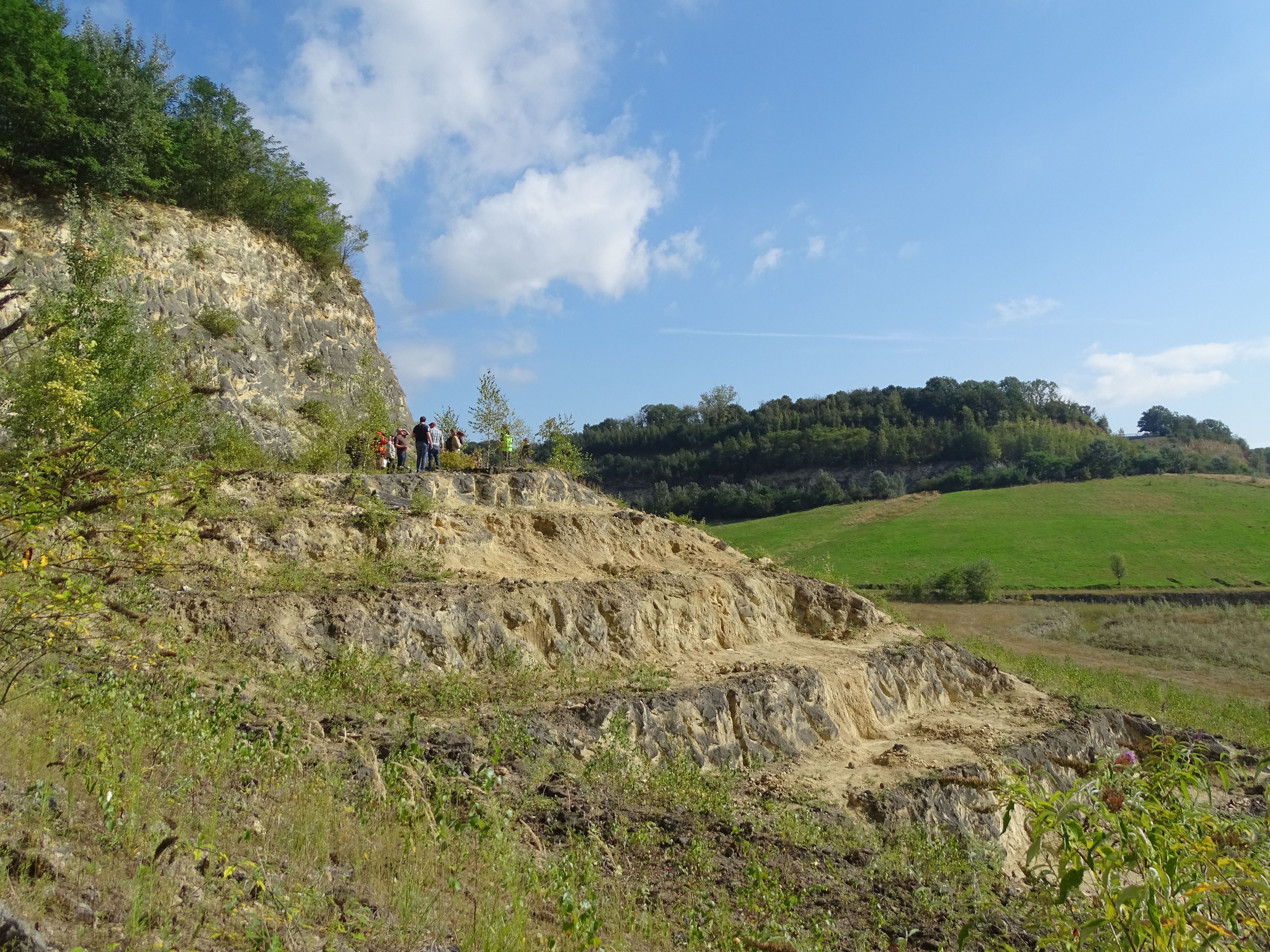 Wall of 'stairs' in the ENCI-quarry: the location of UM-fieldwork
The work takes place on an imposing wall of terraced steps, “almost like a Mayan temple”, carved out by ENCI specially for research. “With each few centimetres you dig, you go back thousands of years in time. This allows us to study ecosystem changes layer by layer.” The researchers use traditional palaeontological tools – chisels and brushes – but also a 3D scanner. “The scanner maps the top layer with millimetre precision. We do this for every layer we uncover. The end goal is a digital ‘book’ that lets you flip through time. It’s an unprecedented wealth of data.”
In the coming months, students will work on the fossil finds and 3D data. Fieldwork will resume next summer, as soon as the weather permits. “In a few years, we hope to have a clear picture of how the Maastrichtian ecosystems evolved.”
Despite the focus on the broader context, surprising discoveries are still possible. Claessens points to a bird fossil found in the quarry by amateur palaeontologists a few years ago. “It had an advanced jaw with teeth, which was previously thought to have evolved much later. The discovery overturned a century of consensus on bird evolution. And the great thing is, the next unknown species or mosasaur skull could be just a few centimetres beneath your feet. You’re never done exploring here.”