For example, in terms of security. After all, Trump already reproached his European NATO allies during his first term as president for not spending enough on their militaries. While this has changed somewhat since then, Europe still can't manage without America's military support, several speakers emphasize. Will the US continue to provide that support, now that its attention seems to be focused primarily on China?
A challenging reality
In theory, Trump’s victory could bring European countries closer together and encourage them to manage their own security, panel members say. But the reality is challenging in the EU: political will is sometimes lacking, and right-wing populist leaders like Viktor Orbán (Hungary) and Robert Fico (Slovakia), who sympathize with Trump, are already frequently slowing down Brussels’ efforts.
The American dream
Ukraine also faces bad news. “That country needs to fasten its seatbelts,” says Bram Boxhoorn, associate professor at Webster University Leiden. “I fear the worst." Trump has said he wants to "bring peace there within a few days", but does not explain how. “Irresponsible,” Boxhoorn judges - although he stresses that the president does not determine foreign policy alone: a Secretary of State is yet to be appointed.
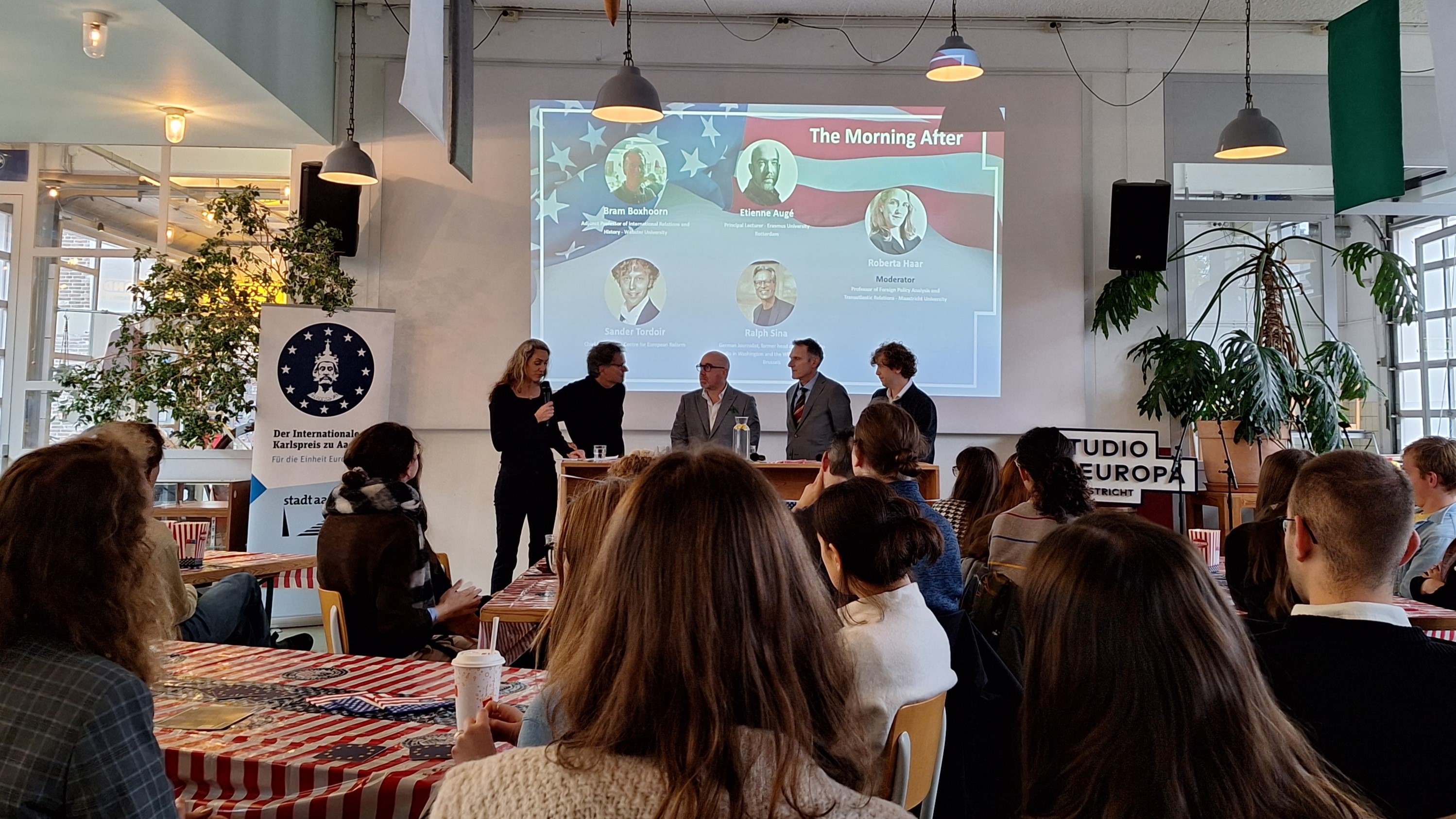 The event took place at the 'Brandweerkantine' on Capucijnenstraat. | Photo: Observant
The attendees clearly stand on one side of what moderator and UCM professor Roberta Haar calls the “diploma divide”. Like many well-educated American city dwellers, they had hoped for Democrat Kamala Harris, while many working-class Americans in rural areas preferred Republican Trump. He, “a billionaire”, somehow succeeds in presenting himself as a man of the people, according to Rotterdam professor Etienne Augé. Harris, on the other hand, is seen as elitist, even though she, a woman of color with a succesful career, is “the embodiment of the American dream”.
The Divided States
The United States, several speakers observe, now more closely resembles the Divided States. American UCM student Josephine Gould can relate. She is from swing state Georgia, where Trump once again claimed victory, just as he did in 2016. Back then, she was “disappointed”, now she says: “I am ashamed that we've let it happen again.” The divide cuts straight through her family: “All my relatives are Trump supporters. At home, I have to be careful about what I say; politics is a taboo topic.”
Is it all doom and gloom, then? “There is always hope,” says Ralph Sina, former US correspondent for the German broadcaster ARD. Moderator Haar points to the governors of individual states, who hold significant power and can offer a counterbalance. “Perhaps we’re being a little too grim,” notes Sander Tordoir, chief economist at the Center for European Reform. “Trump promises more than he delivers.” While he finds the situation concerning, “we’re not completely cooked.”
With contributions from Lena Reichel