Maastricht and Heerlen take pride in their Roman origins – Mosa Traiectum and Coriovallum were important settlements in the northern reaches of the Roman Empire some 2000 years ago. A lesser-known fact is that the entire region of South Limburg has a rich Roman past. “Rich in two senses of the word: not only because of the sheer number of archaeological finds, but also because a lot of wealthy Romans lived here”, explains Jasper de Bruin, an archaeologist and curator of the permanent exhibition The Netherlands in Roman Times at the National Museum of Antiquities (RMO) in Leiden.
In the heyday of Roman South Limburg, the river Meuse was an important thoroughfare and a major road, later called the Via Belgica, ran through the region as well. Legions marched along this road towards the limes, the northern frontier of the Roman Empire along the Rhine River. This was where Roman expansion into Europe was halted by fierce resistance from Germanic tribes east of the river. To defend the border, Rome stationed troops along the entire length of the Rhine, from Cologne to Katwijk – and all these soldiers needed food.
With its fertile soil, on which grain grew abundantly, and proximity to the Rhine basin, South Limburg was ideal for meeting this need. The demand was so great that many farms in the area grew into villae rusticae, sprawling estates with fields, vegetable gardens, workshops, stables and storage buildings. In addition to the wealthy estate owners’ luxurious villas, often featuring bathhouses and modern conveniences like underfloor heating and glass windows, there were accommodations for (sometimes enslaved) farm labourers and their families.
Schoolmasters and chaplains
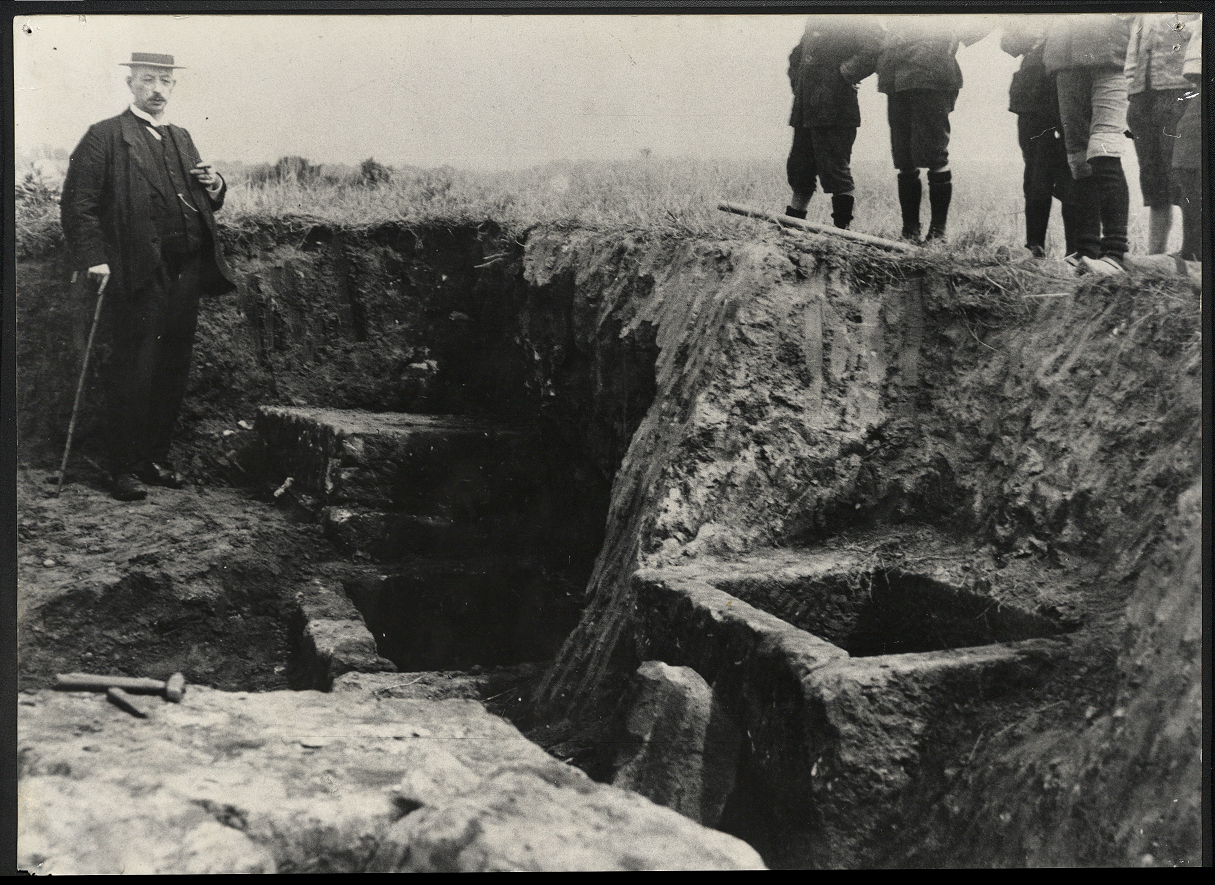 Excavation of Roman remains in Heerlen in 1920. Photo: Thermenmuseum
De Bruin estimates that South Limburg once boasted hundreds of these Roman villas, yet relatively little is known about them. “Only about 25 have been excavated, often without modern techniques, which limits our knowledge.” The majority of these excavations took place in the second half of the 19th century and the first half of the 20th century, when there was a surge of interest in the region’s Roman heritage.
Initially, excavating villas was a hobby for affluent people like schoolmasters, chaplains and doctors, assisted by local youth. In the early 20th century, RMO researchers also got involved. However, little remains of their efforts today: all sites were reburied to allow farmers to resume using the land. What survives are old descriptions – some unpublished – gathering dust in archives, while many of the finds have disappeared into museum storage.
By the mid-20th century, most of this (often expensive) research had come to a standstill. An exception occurred in 2002, when an entire villa was excavated at Holzkuil in Kerkrade. “But that was the last large-scale excavation. Virtually no fieldwork has been conducted since”, says De Bruin, who participated in the Holzkuil excavation as a student.
In recent years, however, there has been a resurgence of interest in this kind of research. For example, the RMO, Limburgs Museum in Venlo and Roman Museum (formerly Thermenmuseum) in Heerlen, together with the Cultural Heritage Agency of the Netherlands, brought together thousands of artefacts and historical documents for extensive analysis. This unique collaborative project resulted in several publications and a travelling exhibition (see postscript).
 Fragment of a mural painting from the Maasbracht villa. Photo: Provinciaal Depot voor Bodemvondsten Limburg
Unexpected finds
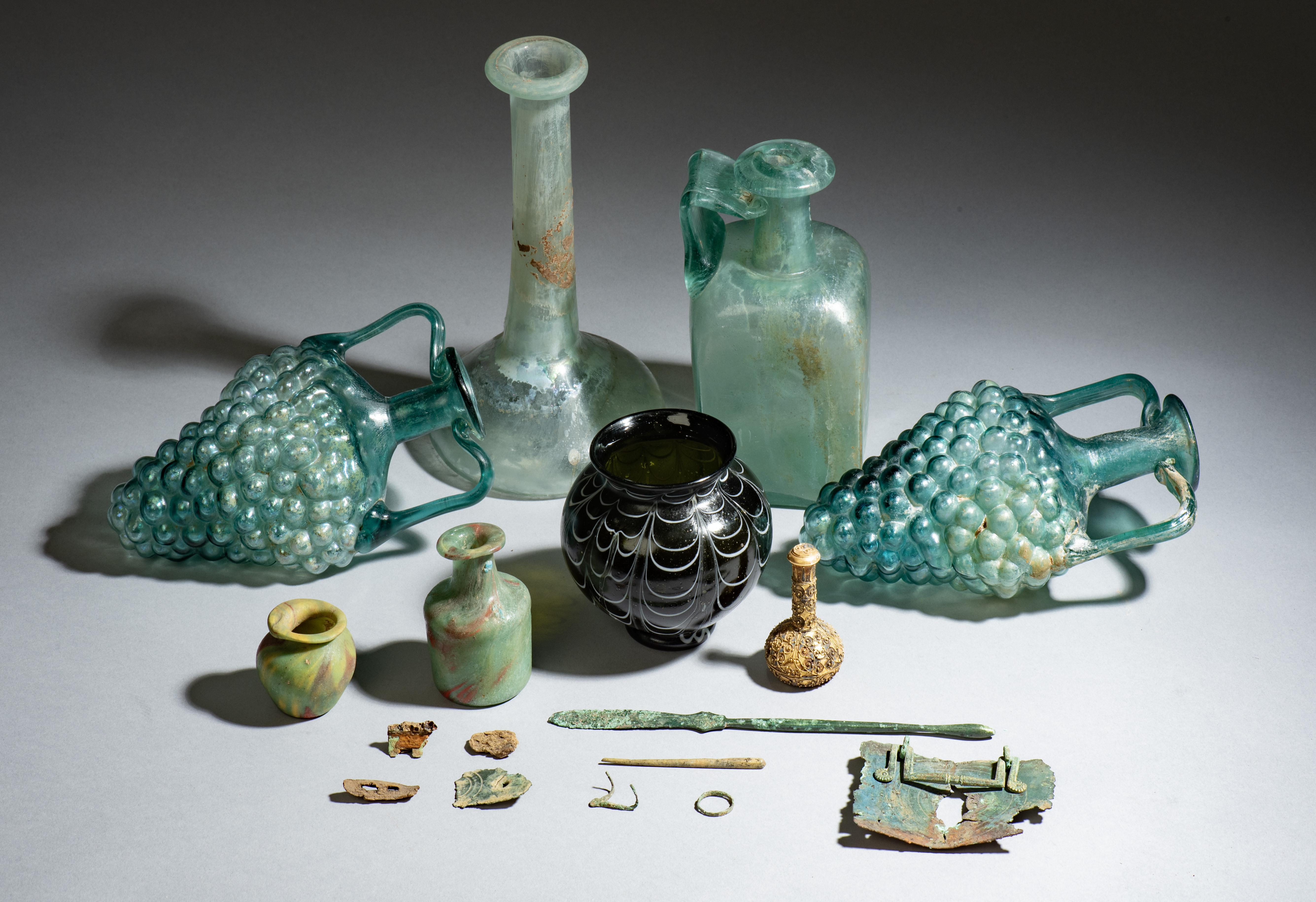 Luxury objects found in Roman graves near Heerlen. Photo: RMO
De Bruin hopes this is just the beginning. “There’s still so much to discover. Modern techniques can yield far more information. And there are hundreds of sites where we suspect villas are buried.” Abundant archaeological finds in the nearby lignite mines across the German border show how densely populated this region must have been. “There’s so much potential for new research. You’re guaranteed to find something, and it could be something truly unexpected.”
Previous excavations have already revealed the expensive tastes of the wealthy villa owners who lived here. They showed their social status through distinctive architecture, murals, sculptures and art. “Unique objects have been found here – fine glassware, amber jewellery, an Egyptian instrument… These people were on par with the richest in the empire.”
Perhaps the most striking finds are ash chests: large, elaborately decorated sandstone chests used for burying prominent individuals. “They’ve been found almost nowhere else in the Netherlands, but at least fifteen have been discovered in South Limburg”, says De Bruin. “It got to the point where people began to take them for granted and mostly disregarded them. Many of these ash chests have only recently been examined in depth, revealing that they often belonged to women. This tells us something about society at the time – it appears as though women held considerable status. There’s evidence that suggests they may have been villa owners in their own right, not merely ‘the wife of’.” De Bruin expects that further research will unearth many more ash chests.
Own backyard
But who will carry out this research? According to De Bruin, few archaeologists in the Netherlands focus on the Roman period. “And those who do often head to Italy to conduct research there. But there are so many riches to be found in our own country. And there’s actually a greater urgency here, where remains are often located in inhabited areas. They lie close to the surface, sometimes no more than a few centimetres deep, making them susceptible to damage, such as from ploughing.”
De Bruin sees an opportunity for Maastricht University. “A lot is already being done in Limburg to attract tourists by showcasing the region’s Roman past, like the Via Belgica walking routes. But there’s still so much potential from an academic perspective. No targeted research has ever been conducted. Establishing a chair at UM would be a great step and makes more sense in Maastricht than, say, Amsterdam. It’s part of the region, research in your own backyard – and just across the border, in Germany and Belgium, more treasures await.”
Besides, De Bruin points out, such research wouldn’t necessarily require ‘traditional’ archaeological tools like trowels and excavators. Why not leverage existing expertise at the Faculty of Science and Engineering, for example, like in the field of data science? “You could use drone and satellite imagery to locate villas in fields. Grass above buried structures dries out faster in dry periods and grows more slowly in wet periods, as the roots can’t penetrate as deeply. Over the course of a year, the resulting colour differences can reveal the contours of a building.”
Geophysical research methods could then provide further details. “You send electrical currents into the ground and measure how they bounce back from solid objects like walls, kilns and roof tiles. And in winter, after the harvest, you could look for pottery shards in ploughed-up fields, which can be used to date the site. Sometimes you can create full reconstructions without even putting a spade in the ground. It’d be a fantastic project for students.” And there are plenty of undiscovered sites to go around. “There’s enough to find here to keep researchers busy for decades.”