“There he is, in the red scarf.” It is 8:45 in the morning and dozens of students and staff members have gathered at Maastricht Station to travel to The Hague by train. The rest of them will be on the three coaches that the Faculties of Arts and Social Sciences and Psychology and Neuroscience, and the School of Business and Economics have organised, or will be catching the later train at 9:29. It turns out that last group is unlucky. Train cancellations and other delays mean that they won’t arrive until half an hour after the first speaker has taken to the stage.
That’s not a problem the early birds face. “Actually, I just wanted to grab a quick bite,” one of them says when they get to the Malieveld at 12:00 – an hour early. The group, made up mostly of FASoS folks, including dean Christine Neuhold, has a better idea. They walk to a small café where some colleagues who travelled independently are already seated, having lunch together.
Janosch Prinz, lecturer in social and political philosophy, doesn’t join them. As a member of WO in Actie, he is also involved in the national committee and so immediately goes in search of the stand that has just been put up on the Malieveld – organising unions AOb and FNV are also present, as is a chip van. He’s hoping for solidarity among all the universities and disciplines, he said on the train earlier. “Also from those hit less hard.”
Time for revolution
“The right time for revolution is right now,” come the words of singer Benjamin Fro on stage. However, the field is not yet ready. It’s almost 13:00, the speakers are ready to start and people are wandering about, calling their friends to find them, or quickly finishing their sandwiches. The UM delegation is also trying to find each other, with mixed results. “We’re to the left of the camera tower,” reads the message in the WhatsApp group, complete with a picture of the location. Head of FPN Cerien Streefland leads a group of psychologists in green AOb caps.
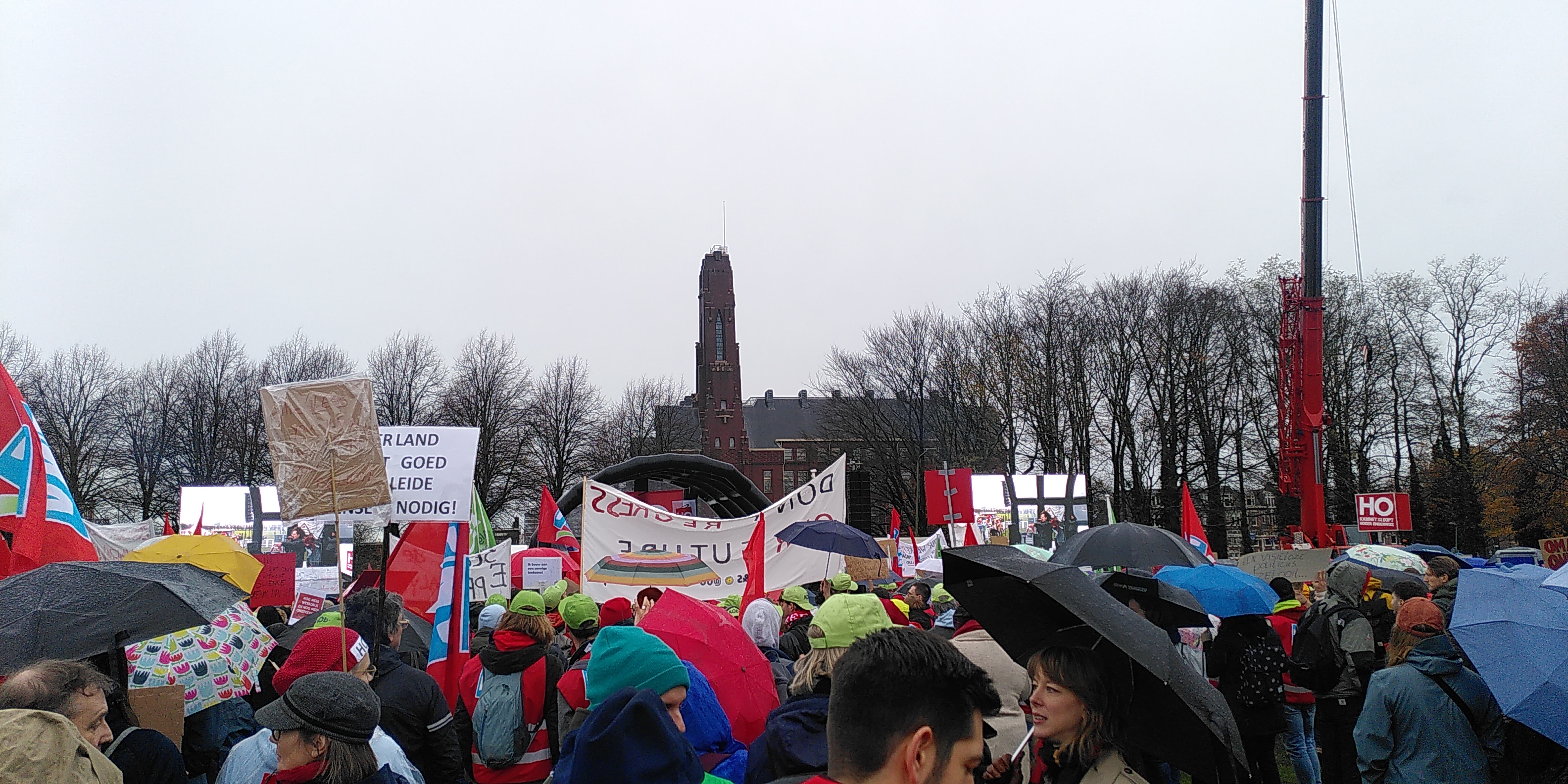 On the Malieveld
The fact that board members are demonstrating alongside teachers and students – such as Maastricht Executive Board members Rianne Letschert and Jan-Tjitte Meindersma – is highlighted by various speakers. It’s noteworthy, they say, as is the support of umbrella organisations Netherlands Association of Universities of Applied Sciences and Universities of the Netherlands. “That’s how you know you’ve really gone too far,” jokes presenter Jens Bosman.
It is great, thinks the Maastricht contingent, but that isn’t what draws the loudest cheers. Those are reserved for anyone who denounces the ‘langstudeerboete’ – the penalty incurred for taking too long to complete a degree –, for FNV director Bas van Weegberg, who is a champion of the right to demonstrate (“Stop casting suspicion on and criminalising peaceful demonstrators”), and professor Ingrid Robeyns (WOinActie), who bids international colleagues welcome in English.
Vote against
Astonished mumbling can be heard when Bosman announces that “there aren’t 10 thousand, nor even 15 thousand, but 20 thousand people gathered here today”. That announcement is subsequently drowned out by chants of “Vote it out” and “Stop the Eppocalypse”.
Party leaders of SP, D66 and GroenLinks/PvdA are the next to take to the stage and promise to vote against the education budget if the proposed cuts are left intact. Their alternative proposals – various amendments have been submitted to reduce the cuts across the education sector from 2 billion to 1.3 billion euros, or even to get rid of them completely – are met with loud cheers, although WO in Actie member Prinz remarks that they will need time to examine them in detail.
On to the ministry
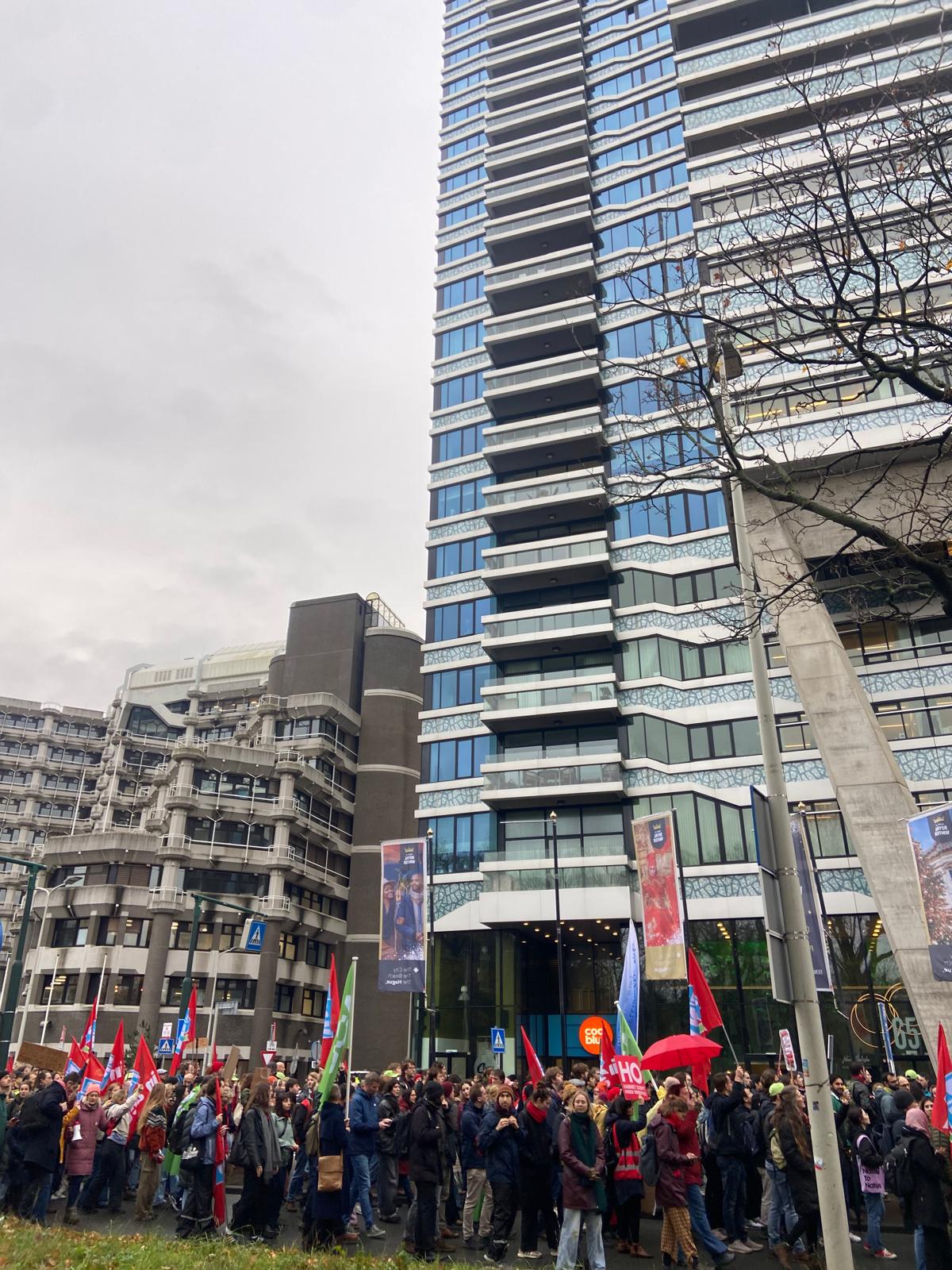 March to the ministry
At about 14:30, the protest march past the Ministry of Education begins. The UM’ers quietly join along with the mass of people. Two students, who were also at the demonstration in Maastricht at the Vrijthof on 14 November, are carrying a sign that reads ‘Without education we need a function elsewhere’, a reference to the scandal in 2021 surrounding then-CDA party member, now-NSC party leader Omtzigt and the phrase ‘functie elders’. “I have three thousand reasons to be here,” says one of them. If they can’t graduate before it is introduced, both would be hit by the penalty for delayed graduation. “Because I had some health issues and spent a year as a student board member,” says the other. They are angry that other young people might choose not to study at all as a result. “That’s why I was pleased to see a sign by students from vocational colleges. We’re all involved.”
When the march reaches the ministry building, there are police officers outside the entrance to prevent demonstrators from entering the building. Nobody even makes an attempt to. They do, however, chant as loudly as they can: “Fight, fight, fight, education is a right.” It doesn’t seem to have made an impression. Minister of Education Bruins is in Brussels today. In a reaction later he expresses that while he understands the frustration, “the financial decisions of the cabinet remain”.