At the beginning of the interview, Van de Luijtgaarden places a thick coursebook on the table. Leafing through it, the reporter – a Limburger herself – is intimidated by the pages upon pages of verbs, vocabulary and listening exercises. There’s a strong emphasis on phonetics, speech sounds like ao (as in waord, word) and ae (as in maedje, girl). Then again, this focus makes sense: Limburgish is a phonetic language.
For those raised in households where the local dialect was spoken at the dinner table, speaking Limburgish comes as naturally as speaking Dutch. Writing it, however, is a different story; it’s not something you’re taught. Anyone trying to master this skill, particularly non-locals, must surely either have a bit of a screw loose or be madly in love with the language and the province. For Van de Luijtgaarden, it’s the latter. That said, he admits to having once “almost compulsively” taught himself Russian: “Every morning for thirty minutes, using an app.” So it’s entirely possible he’s also got a bit of a screw loose. “I’m like a parrot – I love exploring new languages. If I hear people speaking Chinese on TV, for example, I want to know what they’re saying. I’ll repeat the words if I can, to get a feel for them.”
Mothers-in-law
Born in Maarssen, Utrecht, to parents from Brabant, and raised in Friesland, Van de Luijtgaarden moved from Zeist, Utrecht, to the Limburg village of Geleen a few years ago. Interacting with his neighbours, the baker, the butcher and other locals, he soon found himself eager to learn the language. He enrolled in the “immensely helpful” beginner’s course Leef Limburgs, ’t Smaalste Stökske – the name is a reference to the village of Echt in the narrowest part (smaalste stökske) of the province, where he attended eight lessons last autumn. Similar courses in Limburgish as a second language have since been introduced in cities like Heerlen and Maastricht.
“The method is traditional – classroom teaching, reading words aloud, guessing meanings – but it’s brilliant, and the teachers are very professional. They also pay attention to local culture, literature and history.” The same course was previously taken by none other than Emile Roemer, the governor of Limburg. And while the course material focuses on the dialect spoken in the course region, other Limburgish dialects are also covered. After all, there’s no single Limburgish language. The dialect in Venlo differs from those spoken in Kerkrade, Maastricht, Weert or Echt. “Still, with a few exceptions, they’re usually mutually intelligible. That’s never been much of a problem for me. It’s essentially Dutch with an accent.” He adds, more poetically, “It’s a language of the heart.” However, his class included a group of Randstad natives, mostly from Amsterdam, who couldn’t get the hang of listening and understanding, let alone speaking or writing. Of the thirty participants, about twenty completed the course, including several “women enrolled by their Limburgish mothers-in-law”.
Fibre internet
Perhaps unexpectedly, this interview wasn’t conducted in Limburgish. The reporter and Van de Luijtgaarden have known each other for some time and always speak Dutch together. Switching languages feels too awkward. “It’s the same with my Limburgish colleagues and friends. They actually tell me I sound a bit silly when I speak Limburgish. ‘You sound like the village priest’, they’ll say.” Does he have anyone to practise with? His partner isn’t from here, so he can’t practise at home either. For now, he relies on the local baker, though they can immediately tell he’s “neet van hie” – not from here.
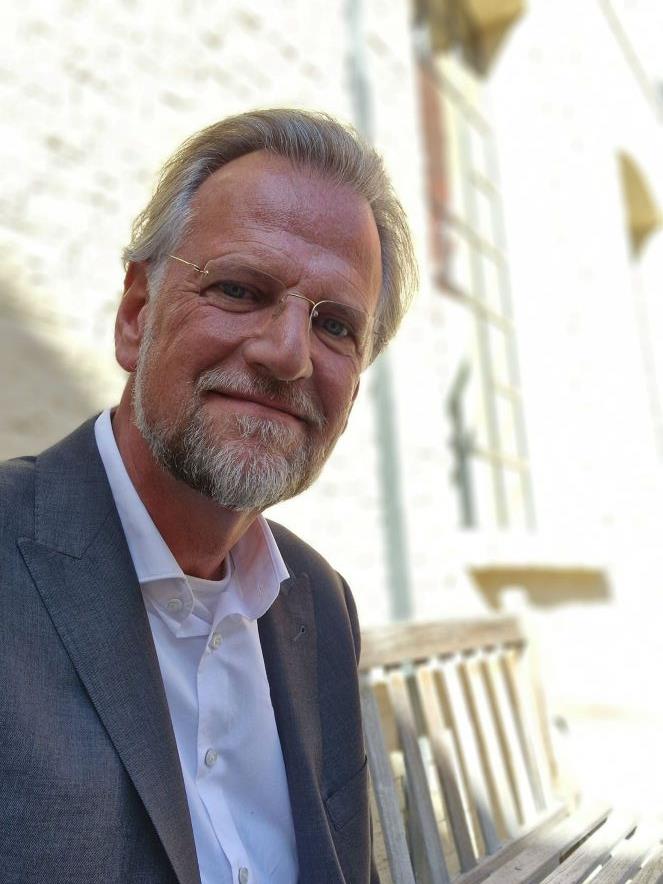 Eric van de Luijtgaarden, photo archive
People from outside the province often ask Van de Luijtgaarden when he plans to leave Limburg. He resents the common view among Randstad residents that Limburg is a “backward appendage” of the Netherlands – fine for a weekend of cycling or shopping, but little else. “People like to joke that we eat vlaai all day long, or ask if I can even understand the locals. When I’m in a Teams meeting with colleagues in the west and my internet glitches, someone will inevitably quip, ‘You lot probably don’t have fibre yet!’”
At the same time, he hopes that Limburgers will shake off the idea that they’re somehow less important. “Limburg is the communication province of the Netherlands. Dutch directness shocks people both here and in the rest of the world. Yes is yes, no is no, and it’s all said at full volume. People here sound softer, friendlier. There are call centres in the west that purposely hire people from Limburg to handle tricky cases. It has a de-escalating effect.” So, he argues, “If you want to learn international business communication, don’t head to Amsterdam. Come here instead, because the way it’s done here – making friends before getting down to business – is how it’s done in the rest of the world.”
European status
The Province of Limburg aims for Limburgish to achieve a higher European status by 2030. Currently, the language falls under Part II of the European Charter for Regional or Minority Languages. Frisian holds Part III status, allowing it to be used in public administration, courts and schools. This is what Limburg would like to achieve. But before the Province can submit an application to Brussels, various requirements must be met. These include for example introducing dialect education in primary schools and teaching Limburgish culture in secondary schools.
A higher European status would be fantastic, says Van de Luijtgaarden. “It could give local pride a tremendous boost.” He is tangentially involved in the application process, specifically concerning legal matters (such as copyright) related to the Leef Limburgs teaching method he followed. In the future, this could potentially become the officially recognised method for teaching Limburgish as a second language. Not a bad thing to have on your CV.
Language courses through Hoes veur ’t Limburgs (a collaboration between Limburgish language organisations)