“An analysis of a complex phenomenon from a legal and criminological perspective”, “theoretically refined, rigorously researched”, with “relevant conclusions and recommendations” and “written in an excellent and accessible style”. The jury’s report on Giulia Giardi’s PhD thesis Illegal Waste Management Activity in the Process of Bunker Fuel Production speaks for itself.
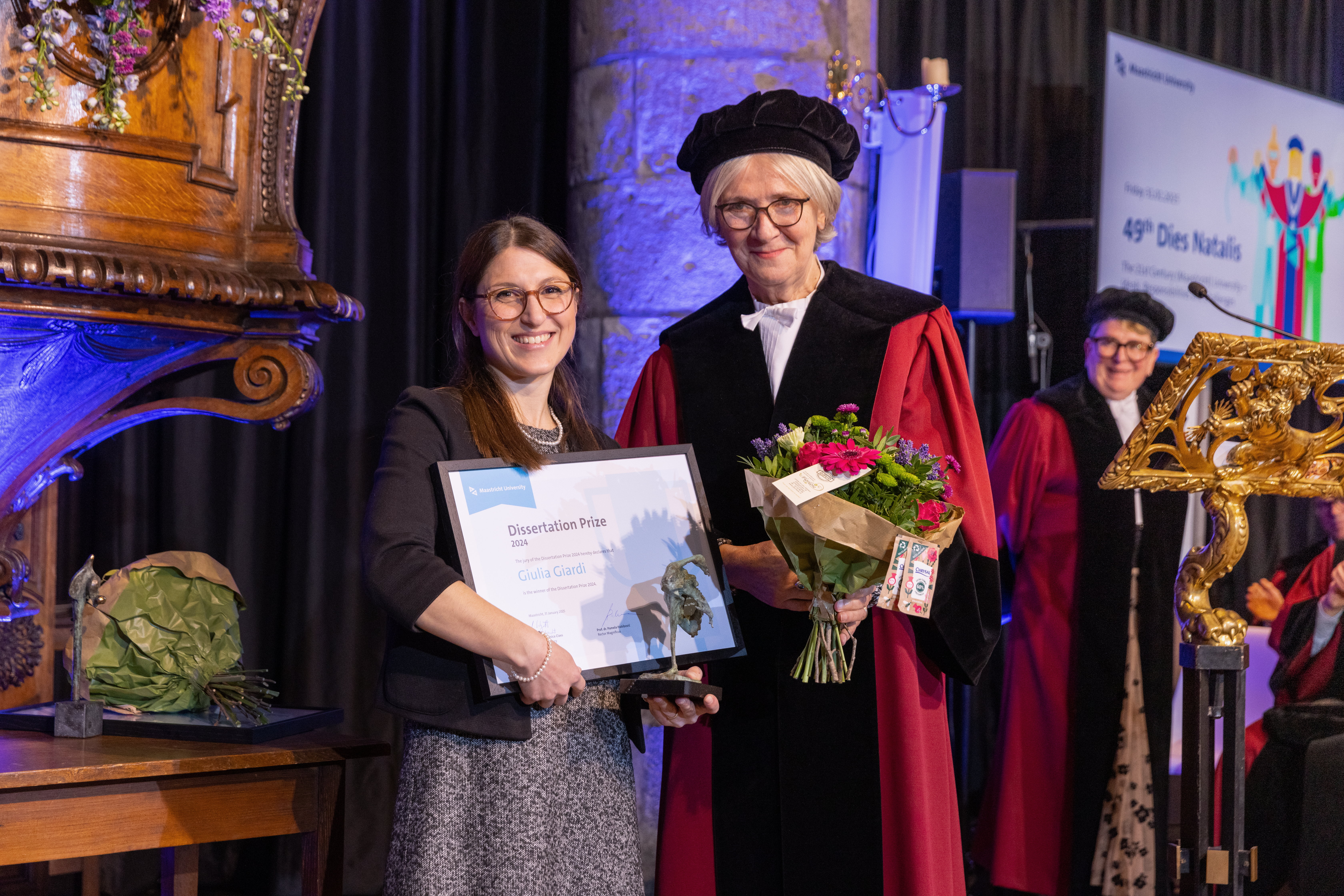 Giulia Giardis (on the left) with prof. Sally Wyatt who presented the award. Photo: Philip Driessen
In addition to praising her dissertation, the jury also noted that Giardi is an “excellent teacher”. This becomes evident as she explains her legal research to Observant. “Thousands of cargo ships travel to and from Europe every day, all running on a fuel known as bunker fuel.” There are no regulations specifying standards for the components that go into this fuel, explains Giardi. It’s usually a residual product of petroleum refining, such as waste oil containing two thousand times more sulphur than diesel, often mixed with waste substances from the petrochemical industry. And these substances are harmful to both the environment and human health.
Shipping companies
“We don’t know how many ships are involved”, explains Giardi, but several shipping companies in the Netherlands have been taken to court for this in the past. For her research, Giardi shadowed an Amsterdam-based police team that has spent the past ten years tracking down ships running on dirty bunker fuel. She accompanied the team on “action days” at sea and analysed a large number of police files.
The police team focuses its efforts on the waste management industry, which – unlike the bunker fuel production industry – is subject to EU rules. “At sea, they check certificates from waste management companies detailing the components of the fuel. It’s always a mixture of substances from hundreds of different companies. The fuel itself is very difficult to analyse; it’s hard to determine if it contains recycled substances.” From there, they follow the paper trail. “It’s not ‘follow the money’, but ‘follow the stream’. Where did a particular substance come from? Has the record of its composition changed during transport? The police team has used its extensive knowledge to build a system that helps them quickly spot trends and detect suspicious activity at specific waste management companies. For example, a lorry might leave a factory carrying a ‘code S’ product which is subsequently listed in the ship’s records as ‘code E’ (which is allowed in bunker fuel). But all this remains very difficult to uncover. Even if you pay the company a visit, it’s still difficult to check what’s in their barrels. It requires a lot of expertise, time and therefore money.
“I can’t disclose anything about the system the police uses – that’s confidential information. I also can’t disclose how many ships they’ve caught in recent years. That’s confidential, too.” It is clear, however, that there is criminal activity in the waste management industry. “It’s always about money. Dumping is cheaper than ‘recycling’.”
How to fix this?
So, how do we fix this? Giardi laughs. “The Netherlands can’t do it alone. It’s a global problem that will require a global solution. Ships travel and refuel everywhere, from Rotterdam to Singapore.” In addition to introducing regulations specifying standards for bunker fuel, “we need to strengthen enforcement in the waste management industry. Much more expertise is required. And then there’s the issue of documentation – it’s very easy for companies to commit fraud by manipulating certificates. We need to design a technological system that makes it impossible to tamper with the original documentation.”
Now an assistant professor at the Faculty of Law, Giardi is eager to contribute to solutions. She and colleagues from Avans University of Applied Sciences in Brabant have written a research proposal to improve enforcement. She’s also working on a project to strengthen regulations on the composition of bunker fuel.
Lottery
“I’m very pleased with the recognition”, she says brightly in her office at the Faculty of Law a few days before the Dies Natalis celebration on Friday 31 January. While she knew the Dissertation Prize existed, she didn’t realise she was in the running. “It wasn’t on my radar at all. It feels like winning a lottery I didn’t even know I could buy tickets for.”