The programme, financially supported by Maastricht University since February, offers scholars, artists and journalists from conflict zones a safe haven in the Netherlands to continue their work. While a previous talk at Tapijn Z by pro-Israel speaker Rawan Osman was disrupted by protestors just last month, this evening passes without incident. Hosted by the dialogue platform Omnium, Helles shares her story with a quiet and attentive audience.
Piles of dead bodies
She talks about how she, a young local journalist, became a war correspondent for the British newspaper The Times after Israel invaded Gaza in response to Hamas attacks, denying access to international reporters. She recounts what it was like to report daily on violence, devastation and immense human suffering. “The mothers who lost their children, the man who cried, ‘I have no one left’, the piles of dead bodies… I will never forget.” She speaks of the constant fear of becoming a target herself – in early April, several Palestinian journalists were killed when their media tent outside a hospital was bombed. One of them burned alive. “Our flak jackets marked ‘PRESS’, meant to protect us, became targets. We took them off so others wouldn’t be put at risk.” She explains why she eventually decided to flee: “It was the realisation that my own children could end up buried beneath the rubble.” And she describes what it’s like to be in the Netherlands with her two children, while her husband stayed behind in the Gaza Strip. “I live every day in fear of losing him.”
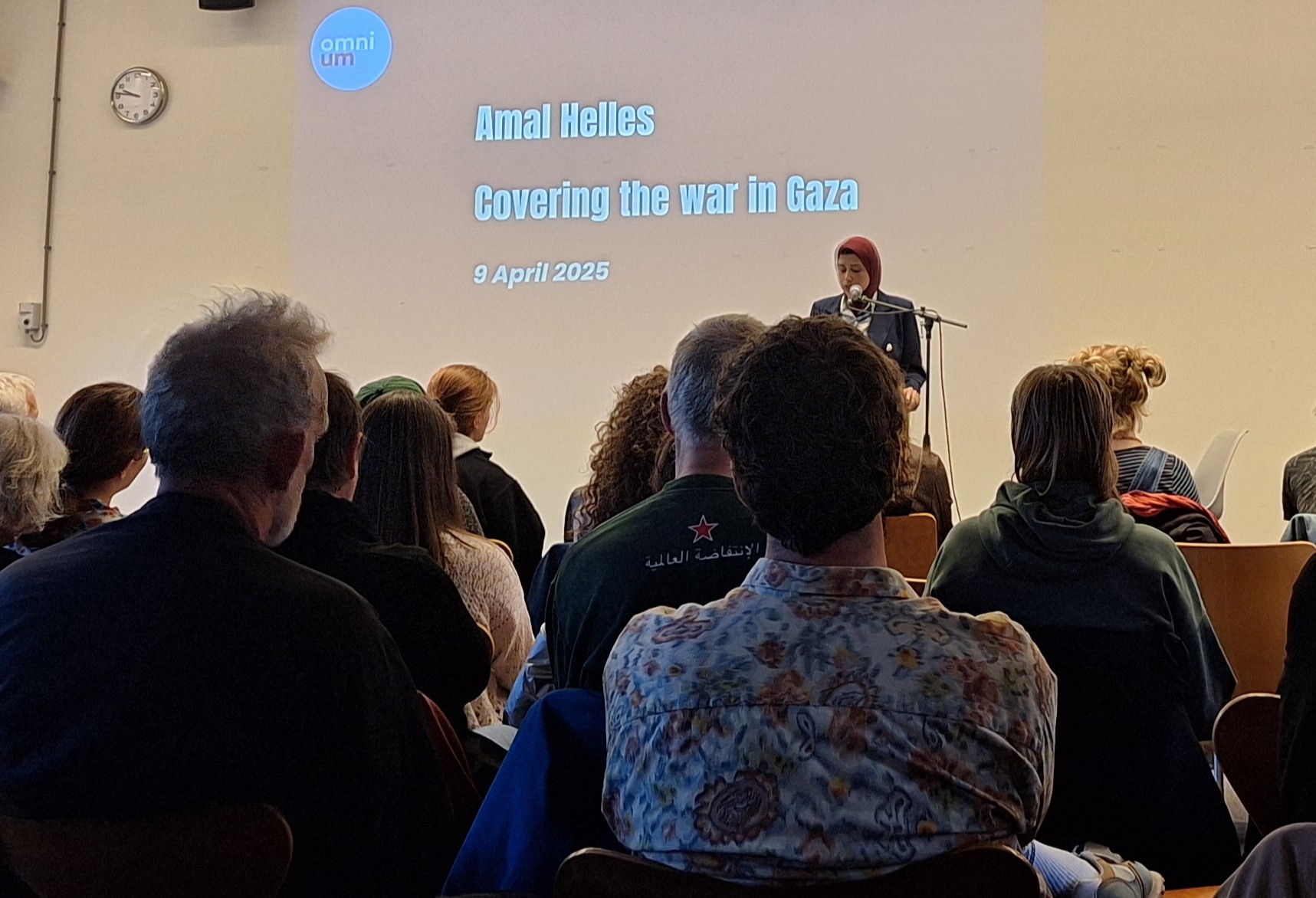 Amal Helles speaks at Tapijn Z | Photo: Observant
Helles also levels sharp accusations against Western democracies that claim to support human rights but turn a blind eye to what she calls “the best-documented genocide in history. You’ve watched it unfold in real time, and still you ask for proof. How much more proof does the world need to see that Palestinian lives are worth protecting?” And she accuses Western journalists of paying far too little attention to the suffering of the Palestinian people and their own Palestinian colleagues. “We were abandoned by the very media organisations that claim to stand for press freedom”, she says. “A journalist burns alive, and no one loses sleep over it.”
As a fellow at NIAS, Helles is currently researching the role of women journalists in Gaza, who must navigate the terror of war while also facing gender-based discrimination. What keeps her going? “I didn’t choose this”, she says firmly. “The war chose me. Speaking the truth is the only weapon we have left.”