Members of Maastricht’s student rowing association Saurus are not surprised to hear about rowers in the lightest category going to extremes to maintain their weight, said chair Joep Eijkens. There is the example of former top rower Marieke Keijser who, in an interview with de Volkskrant in 2022, admitted to weighing her food with extreme precision and not going out for a meal even though it was her brother’s birthday. “I’m not the type of person to develop an eating disorder, but I was constantly checking the scales,” she said at the time.
Eijkens recognises the struggle: he was a lightweight rower who had to watch his weight, but he feels it would be taking it too far to say that lightweight rowers are predetermined to develop a love-hate relationship with food. “There has been a long-running debate about the lightweight class which often raises the image of starving rowers counting every gram,” said Eijkens, “with the category disappearing from major competitions, that has been thrust fully back into the limelight.”
It is also an important issue for Eijkens and the rowing association, “but that’s not new. You have to take that responsibility very seriously.” What Eijkens means is that nobody is randomly assigned to a boat based on their weight – or without proper supervision. “We keep an eye on everything, from nutrition to mental health. That is simply your responsibility as a club.” And he “doesn’t know everything that might have happened in the past, of course”, but under Eijkens’s leadership, there have been no issues.
Complex
The scales are absolutely not all-important, said club secretary Ole de Jong. At the start of a new season, it can sometimes take a while before it is clear which category somebody is suited to, especially in borderline cases: rowers who, based on their weight – and height – straddle the line between light and heavy (more than 59 or 72.5 kg, respectively). “When you first join and let us know you are interested in competing, there is no distinction made yet. But after a while it’s clear who can do what and who belongs where.”
For De Jong, that was the lightweight class; he weighed 72 kg, right on the edge. “My height was an advantage – 1.92 – and in theory, it was enough that I could have joined the heavyweight category. But they also look at technique and how much you can drive”, referring to the power of a rower. “And based on my times, I was just not good enough for a heavy boat.”
“We can tell if someone is starving themselves, or is having real trouble maintaining their weight"
That combination of factors – weight, height, power, endurance and technique – can make for a complex puzzle of where to place someone, explained Eijkens. “Someone who is too light can row in a heavy boat, but someone who is too heavy can’t join a light boat. If a man weighs 63 kg, it’s easy. But there are always edge cases, people who straddle the line between light and heavy. We talk to them about their weight and whether they gain weight easily, how they handle pressure, you name it.”
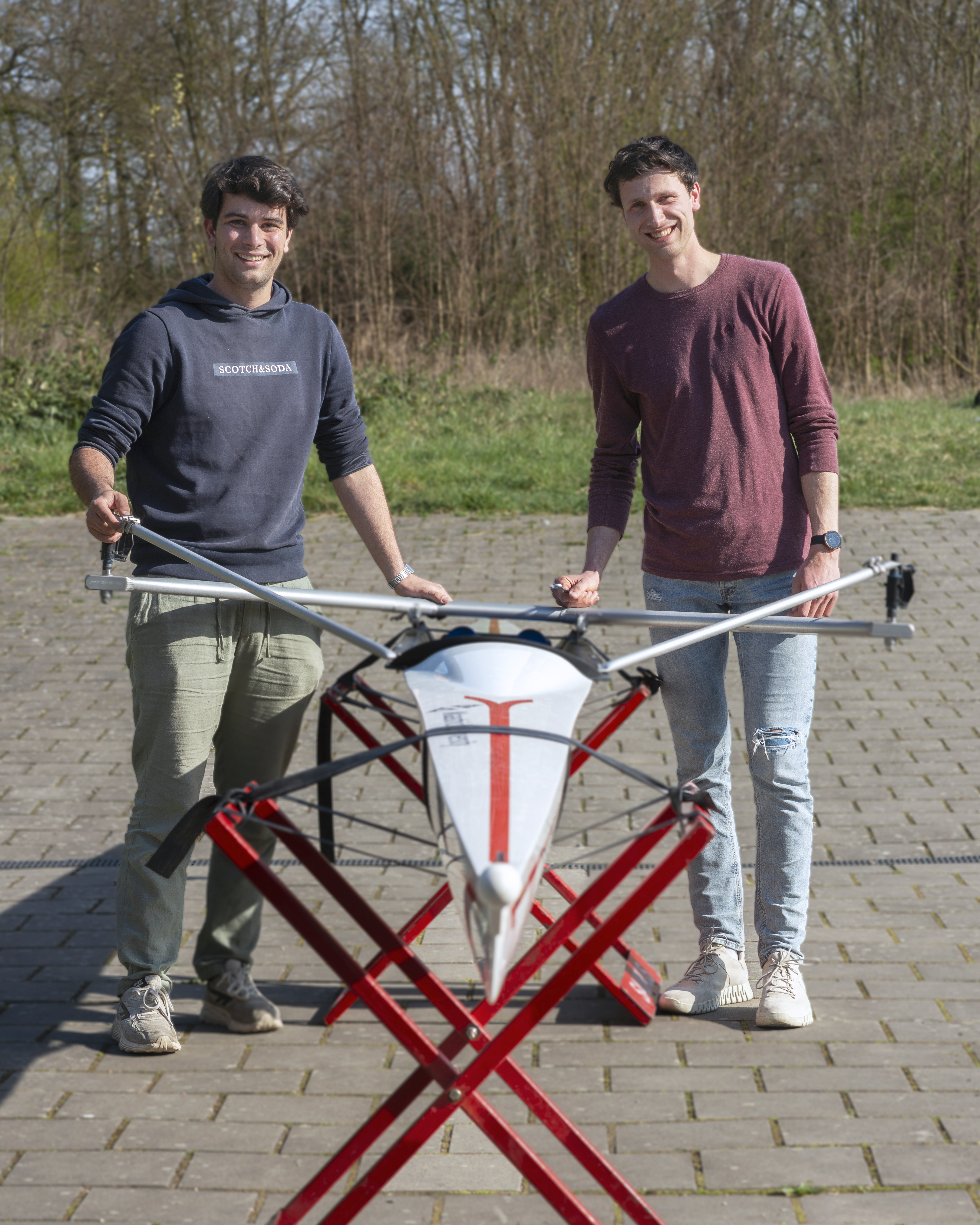 Chair Joep Eijkens (l) of Saurus and secretary Ole de Jong (r). Photo: Ellen Oosterhof
De Jong also had one of those conversations. “I was asked whether this had been a steady weight, whether I had to work hard to maintain it, what had changed over the years. I knew that I have a hard time gaining weight, hadn’t needed a crash diet to reach this weight, and wanted to row in the lightweight category.” Eijkens: “That’s an easy choice to make.” Lightweight rowers are still monitored closely, the same way everybody is monitored, said the chair. “Especially competition rowers. They keep a logbook of what they eat and what they weigh, they see their coaches several times a week, sometimes every day, we check in with them individually. And we have a dietician who supports our rowers, because no student is ever a good cook,” he added, laughing. “We can tell if someone is starving themselves, or is having real trouble maintaining their weight.”
Testing limits
And yet, it is hard prevent incidents entirely, both Eijkens and De Jong acknowledged. “There is always a risk in top-level sports, and despite all precautions, there are always those individuals who will test the limits.” There are plenty of stories of rowers who have to ‘weigh in’ just before a competition and who try absolutely everything to lose a little more weight. A student in Leiden recently told student weekly Mare that it was not uncommon on his team to spend the day before a competition cycling in a set of waterproofs, to ‘sweat it out’ and lose a little more water weight. And in the Ukrant, from Groningen University, there was a story recently of rowers who sat in a heated car in thick winter coats, just to lose those last few grams.
“I’ve never done anything like that,” said De Jong. “I was mindful of my weight, and if I noticed I was still a kilo over my weight in the weeks leading up to a competition, I could very easily adjust my diet. Make different choices, fewer potatoes, or just more vegetables.” “That’s what a coach is for,” added Eijkens. “They see the bigger picture, it’s never the case that you discover that you’re too heavy the day before a competition. If that’s the case, there’s something wrong with the supervision.”
“It gives a lot of people the opportunity to get in a boat, there is absolutely value to it"
The two committee members for Saurus don’t expect it to happen soon, but they would be sad to see the lightweight category disappear from student rowing associations, in line with the decision by the international rowing federation. “I wouldn’t have been able to row without it,” said De Jong. “It gives a lot of people the opportunity to get in a boat, there is absolutely value to it.” Eijkens agrees. “For those who can manage the responsibility of everything it entails, it would be a great shame if it were dropped. But for rowers who prize their performance over their health, it would be better if the option weren’t there to begin with.”
The most important thing is fairness and not taking part at all costs, said Eijkens and De Jong. “You can’t force what isn’t possible. There’s a reason we don’t have a first-year lightweight men’s boat this year, because we thought, ‘this is going to be hard, and hard work’. It doesn’t help to have a borderline case fail at the last minute. It only hurts that person. We do handle it very consciously.”