“No sob stories, alright, don’t dwell on the stammering and stuff. Oh heck, I don’t like interviews like this.” It’s her turn to discover what it’s like on ‘the other side’, to pour out her heart and soul. And she also knows: the more open they are when answering questions, the more interesting the article.
Riki Janssen (1959), the second editor in chief Observant has ever had, is handing over the reins. “It’s been a good run. I don’t always need to be at the front anymore.” She has been at the helm since 1996; she has seen how much the university has grown, the introduction of English as a second working language, the digitalisation, including of the university newspaper.
Isn’t 29 years a long time? “I had already decided to stop before covid. But then, well, so much happened, in the office, in colleagues’ lives. You wait. I knew who I wanted to hand over the reins to. But they still had to think about it,” she says, winking at her successor. “An outsider wasn’t an option for me. I have seen it go wrong so often for fellow newspapers. It’s very hard if you don’t know the university.”
How often has she heard, ‘When are you moving to a serious national paper?’ “In the eyes of many, a university newspaper is ‘lesser’. I understand the sentiment, but it still feels like a shame. The work is the same. Our standards are just as high, we adhere to the journalistic code, we’re critical, just like a Volkskrant or NRC. Moreover, I didn’t want to leave Limburg, or the team, or this university, and I feel it has to be said, it’s nice here, there are fascinating people here, doing fascinating things. Should I give all that up because there is ‘more’, because of the prestige? Absolutely not.”
Frills
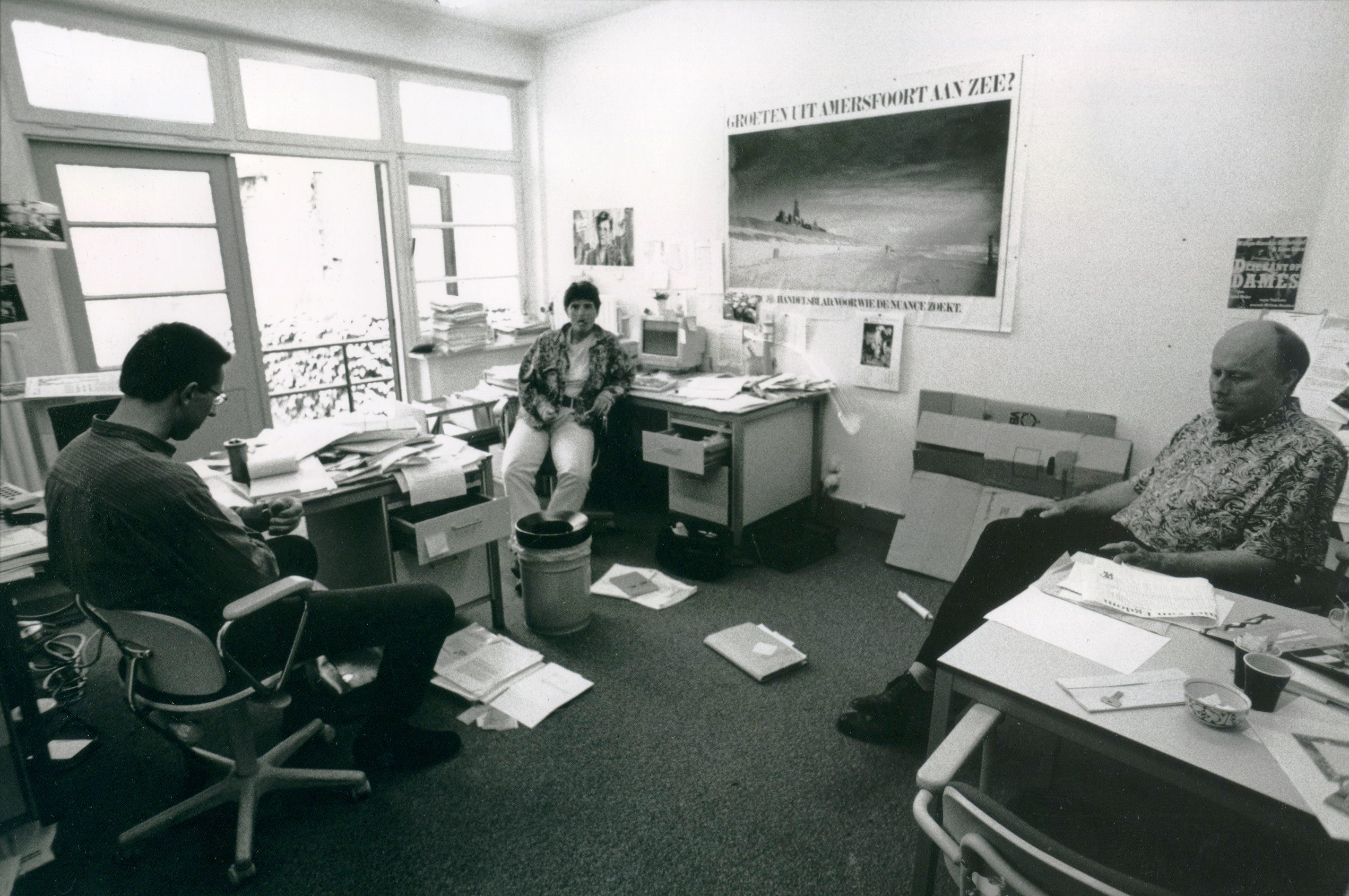 The editors of Observant in the nineties, in the middle Riki Janssen
About that ‘prestige’, a while back it was the subject of some debate at the office: the email signature. What do people put next to their name in an email? Their position, obviously, but also their titles? Janssen admits that for a very, very long time, she didn’t list her degree. Just ‘Riki Janssen, editor in chief’, not ‘drs. Riki Janssen, editor in chief’. Too many frills, bragging. Yes, of course, you should be proud of who you are and what you’ve achieved, but blowing your own trumpet like that, no, not her thing. She doesn’t feel she’s better than anyone else. Nor even than her colleagues, because “sometimes they do know more”, she says. “There’s no shame in it.” Her motto – ‘I am the first among equals’ – reflects that.
"I’m not sure I could have led a larger organisation. Is that connection still there?"
“When you produce a newspaper together, you need each other. I want contact, I want to know how my people are, whether there is anything going on, so that I can take that into account. That’s why I’m not sure I could have led a larger organisation. Is that connection still there?” Janssen’s leadership? Empathetic, respectful, she gives her employees freedom, trust, “because I know how nice it is to be in charge of your own schedule, to work on your own project. Looking back, I wouldn’t have changed a thing, although I could be too focused on the madness of the moment, on a paper that needed to be finished.” That weekly deadline and all the organising that surrounds it are still a source of stress. If people don’t submit their pieces on time, things don’t go as planned, especially on Wednesdays, if the printer is waiting, then you’re better off leaving Janssen alone.
Tough
After studying philosophy at what was then still the Catholic University Nijmegen, Janssen had two options in mind – it was the early eighties, jobs were scarce, so you took what you could get. “I thought about academia, researching things. Or something with writing, because I quite enjoyed that, no more, no less.” She had already contributed to a student journal – reworking a paper into an ‘academic article’ – and took part in a course on how to write about science more simply. After that, she applied to join ‘Observant’s sister paper’ in Nijmegen, now known as Vox. At the same time, she applied for a PhD position in ‘women’s studies philosophy’ in Amsterdam, “I wasn’t selected”. A moment later, “I read recently that the person who got that job is now a professor.”
Janssen and academia, it wasn’t what was expected at all. Not that she lacked the brains for it, far from it, but as a teenager, she was “focused on other things”. “I didn’t do any homework. I was an active child, spoke up if I had an opinion, enjoyed sports. I wanted to be tough, strong, a tomboy. After primary school, I went to the mavo [lower general secondary education]. If anybody wasn’t ready for school, it was me.” Was she bossy, too? “Not so much, but I did like to be at the front.” She remembers organising a circus in the final year of primary school. “I took joint lead and organised the whole thing with a group of other girls.” The same thing applied to handball, a sport she played at quite a high level in her hometown of Nederweert, and which she was very good at. Janssen was captain for years.
Sports mad
“Now that I’m older, I recognise that that toughness, that shouting, was compensation. I had a fear of failure and a terrible stammer. I’ve carried that with me my whole life. In the end, I decided that training as a teacher, something I did consider briefly, wasn’t for me, because you had to talk so much.” It’s why, when she was a student journalist for the newspaper at the Catholic University Nijmegen, she dreaded phone calls. Speeches as the editor in chief of Observant: “In the beginning, I would write out my whole speech. It’s still not my favourite thing in the world, haha, but I did always do it. ‘You can be afraid, but you mustn’t let it hold you back’, it’s what I also always told colleagues and students who would freelance for us.”
"I instantly knew: ‘I want to live like De Beauvoir.’ I wanted my own Sartre"
Coming back to her school career: mavo, havo [senior general secondary education], the social academy, and then through a colloquium doctom – a university entrance examination – university. Reading philosophy, no less, not exactly a practical degree. “My older brother, who started a degree in biology and changed to psychology halfway through, gave me a book by Simone de Beauvoir. He thought I was too sports mad and needed elevating,” she laughs. “I read it and I instantly knew: ‘I want to live like De Beauvoir.’ I wanted my own Sartre – and I found him, with glasses [former Observant editor Wammes Bos, her husband].”
At university, the fear of failure reared its head again. “I was scared I wouldn’t be able to handle the academic environment. I did it anyway, even though it was a struggle at times. I learned to think, analyse, ask critical questions. It has been incredibly valuable in my career as a journalist.”
Chaos
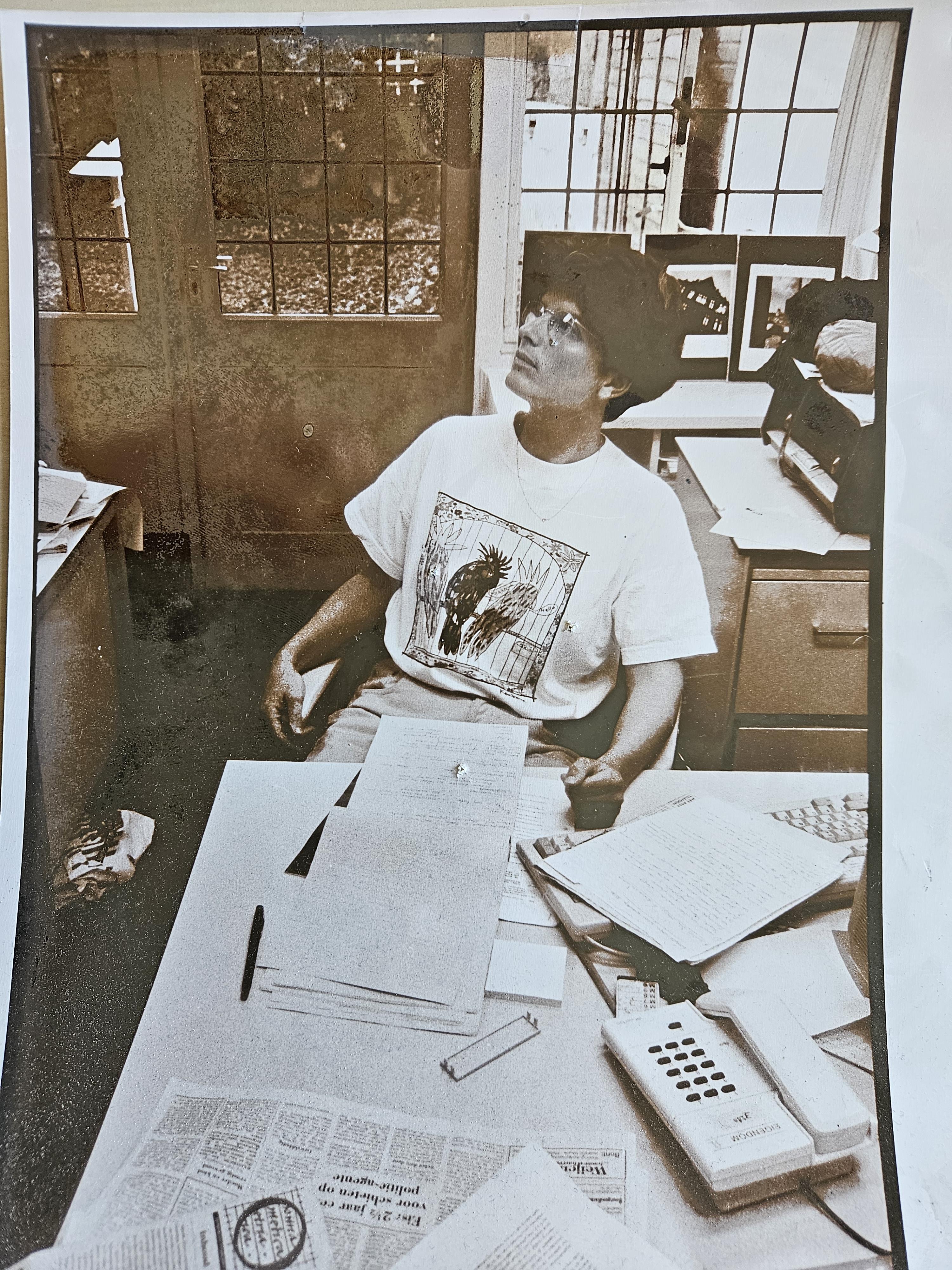 Archive Observant
“What utter nonsense,” she cries, when the start of her tenure as editor in chief comes up. The foundation board at the time (Observant is a foundation; the board is in charge of personnel, including hiring and firing) did not want to appoint her as editor in chief, despite the fact that Janssen had taken on a number of crucial responsibilities. “Things were so badly organised.” Five years earlier, in 1991, when she had been hired as an editor, she had been surprised at the “disorganised chaos”, no weekly timeline, no agreements regarding deadlines. Naturally, she could have left, but she didn’t. She went into organisation mode. “I have no idea why the board didn’t want to promote me to editor in chief. ‘Because I’m a women’, I’ve always thought.” In the end, it was her fellow editors who took up her cause. They sent a letter to the Executive Board, which at the time included rector Hans Philipsen, with a request to intercede, so that Janssen would get the job. “It was one of the last things that Marja Verhulst, secretary of the board at the time, did. Marja thought I was on the young side – I was 36 – but I was allowed to try.” Janssen was appointed as the interim editor and given a coach. “Irene Levy. She taught me so much.” Her top tip: “You are not God, you cannot always do everything perfectly.”
Feminists of Maastricht
There was a time when she faltered; that ‘mantra’ didn’t help her anymore. Janssen calls it one of the hardest periods of her career. It was the end of 2021. Feminists of Maastricht (FOM), a student organisation, was displeased about an article on free tampons and sanitary pads in university premises. It was started as a pilot and Observant had written that they were intended “for women” who had insufficient money to buy them. FOM wanted that changed to ‘for people’, because “not only women menstruate”, the students wrote in an email to the editor. “We were told to change it immediately, or else they would ‘mobilise their community’. I felt we shouldn’t have to give in to that, but the mood was threatening. The online article was flooded with the worst comments, calling us ‘racist, right-wing extremists, transphobic’ and a host of other things.”
There were posters around the city accusing the university newspaper of discriminatory language. In the middle of January 2022, the Observant website crashed. A targeted cyberattack by FOM sympathisers, according to an email sent to the office some two weeks later.
In bad faith
“It was bizarre,” says Janssen, “I had never experienced this before.” What didn’t help, was that she’d only recently lost both her parents. The loss was still fresh. Her mother had been bedridden for a long time and died during the covid pandemic in 2020. She also lost her father, quite suddenly, a year earlier. “I’ve always been a very outspoken individual, but there was hardly anything left of that person. Fear took over. It got very personal, I was being insulted in online reactions by people who didn’t know me. But that wasn’t what really got to me. It was the accusation that the editorial team, that I, had acted in bad faith. Of course, there were numerous times when I thought, ‘What could I have done differently?’ It’s a reflexive reaction. Could I have prevented this? I don’t know, I don’t think so. But I should have rung those students rather than sticking to email. Talking is often so much better.”
"I said no, I was scared I might never come back"
The fact there were ‘anti-Observant’ posters around town, that FOM had warned about mobilising the community, it meant that Janssen sometimes felt physically unsafe, too. It was winter and still getting light as she arrived at the bicycle parking behind Boullionstraat. “I often thought, ‘What if there actually is someone behind me?’”
It broke her down, but she persevered – albeit, less intensely. HR adviser Pierre Schröder advised her to rest, to not work for six, seven weeks. “I said no, I was scared I might never come back.”
The Observant team were “worth their weight in gold, not just in that situation, but in all my years as editor in chief [there have been few changes of staff]. My team feels like a family.”
She also enjoyed the support of the Executive Board during this tough time. That hadn’t always been the case either. “When Jo Ritzen, former Minister of Education, was the head of UM, I always felt a little threatened, ‘he’ll pull the plug’. He was not a fan of an independent newspaper. Countless times, Cor Spreeuwenberg, head of the foundation board at the time, had to meet with him because there was something new Jo didn’t agree with.” There is much more of a mutual respect with the current chair, Rianne Letschert, and her fellow board members, “although she is not always happy with the negative publicity”.
Struggle
Janssen is not just a manager, she is still very much ‘on the front lines’ herself. “It was a deliberate choice to keep writing. I know what it is like to struggle with a story, to ask difficult questions, to have to call back an interviewee because there is something else you want to know, to approach people in a random university building.”
"An independent university newspaper is still incredibly important"
Since 2017, she has written a weekly editorial about the goings-on in the office. “I had my doubts in the beginning, ‘What have I got to say’, but I always managed, there’s always something.”
She is clear about the role of an independent university newspaper in 2025, “it is still incredibly important”. But shouldn’t the format be different, especially to retain students, who spend so much time on social media? “It is difficult. We have a very varied readership, there are people who still want to pick up a paper copy of Observant, and there are a lot of online readers. We try to serve them both.”
Janssen will continue working as an editor until she is 67. “I’m looking forward to it, writing articles, with no other responsibilities. I’m not going to get in your way,” she tells her successor. “I promised myself and you that. I’m completely ready for it, I can leave it all behind with confidence.”