When Strating was asked to help come up with a gift for Bos, who also served as the head of the Art and Heritage Committee, she quickly concluded that she didn’t want a traditional catalogue: white pages with a picture of the artwork and some information. “It had to tell a story, be an artwork in and of itself.”
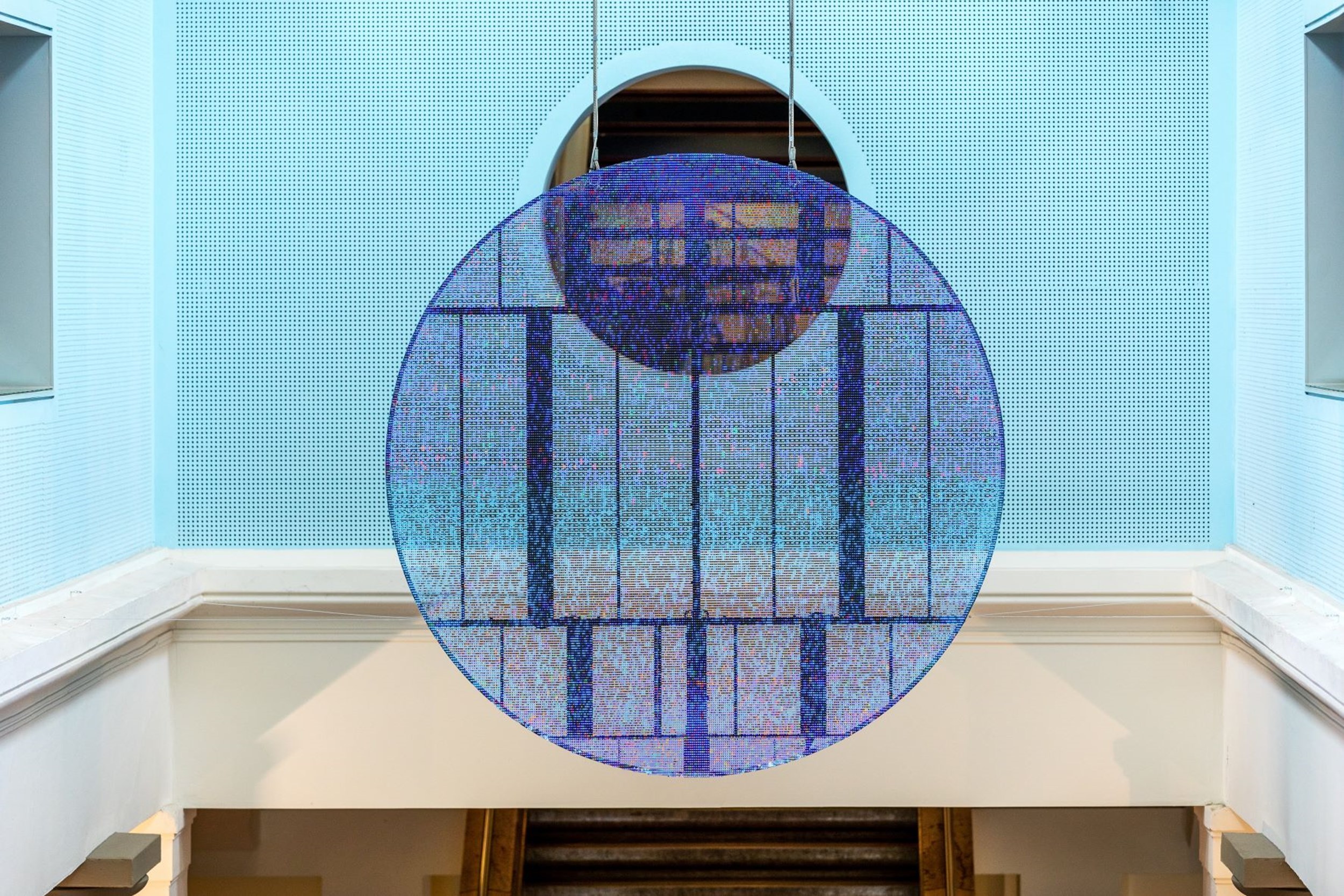 Eternal Blue by Richard Vijgen as it can be seen in the hall of the Minderbroedersberg
PHOTO: Philip Driessen
Not to mention that the UM art collection was built up very differently than one in a museum might, she said. “Those often have a predetermined theme. In our case, whenever there was money, people commissioned an artist. Often for a particular building, which makes the art collection very location specific. You can’t turn it into an exhibition, or even see all of it, as some works are in areas that aren’t open to everyone.” The title of the book says it all: THIS IS NOT A MUSEUM/THIS IS NOT A CATALOGUE.
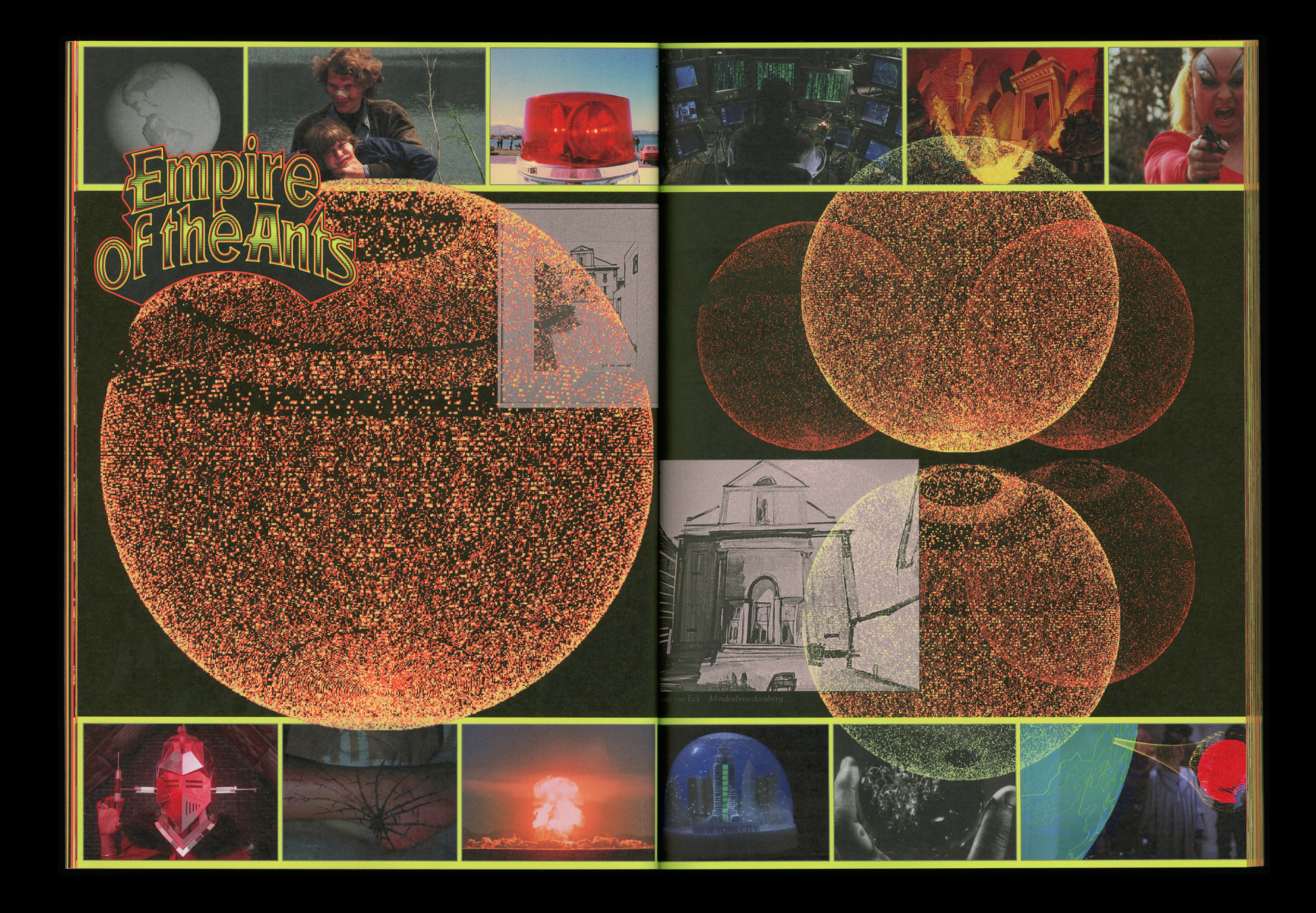 The way Eternal Blue is portraited in THIS IS NOT A MUSEUM/THIS IS NOT A CATALOGUE, through the lens of Yannick Nuss
IMAGE: Yannick Nuss
In Nuss, Strating found a like-minded person. “A traditional art book is, of course, of great archival value, but from a visual point of view, it feels very much like homework,” he said over Teams. “For me, images are like text, you can tell a whole story with them. This is not an objective book. There may not be a hierarchy – I wanted to celebrate all the artworks – but it is my perspective, my vision of the collection.”
While Nuss was shown around by Strating (“I had to keep coming up with excuses why I had to show him things, so that Nick wouldn’t find out”), he looked not just at how the work made him feel, but also how the people in the building experienced them. “I wanted to know as much as possible, I looked for interviews with the artists. Why did they make certain choices? What do they hope I think when I see the work? And how does it actually make me feel?”
In the meantime, he gathered an enormous archive of movie stills and titles (both the name and the font) of horror and science fiction paperbacks from the 60s, 70s and 80s. They appear side by side with the artworks and take the reader on a cinematographic tour through the book, giving it the movie-like quality that Nuss was after. “If there had been more time, I would have liked to create a soundtrack as well. That would have made it a true experience.”
Enough copies of the book have been printed to hand out to PhD graduates for the next five years. That’s one reason why the book neatly includes index pages listing exactly where the artwork can be found. “And because I wanted people to already be acquainted with the work before showing it to them from my perspective,” said Nuss. Strating also hands it out as a sort of business card. “Now I can show people what my work, what this collection entails.”