“It can be hard to grasp the sheer scale of this project”, says lab technician Eliott Duvieusart, looking out from the large windows of the viewing platform over the space where ETpathfinder is being built. Several of his colleagues, wearing blue overalls, face masks and plastic gloves, are working on scaffolding. “I’ll give them a quick call to let them know we’re about to take a flash photo – we don’t want to startle anyone.”
The facility will be used to develop and test technologies for the Einstein Telescope. This gigantic gravitational wave detector, designed to measure tiny ripples in spacetime, is expected to offer physicists a new view of the universe – potentially from beneath South Limburg (see box). “It’s truly the next big thing in our field”, says assistant professor Sebastian Steinlechner. The project has been years in the making. “As early as 2008, I wrote my thesis in Hannover on the technologies that would be needed here. Now it’s all coming together.”
In early 2020, the hall was still being used to store desks and chairs for exam sessions at MECC Maastricht. Now, it houses a pristine white clean room – accessible only via an airlock, virtually dust-free and temperature-controlled, resting on a floor isolated from the rest of the building to minimise vibrations. Inside stand six huge towers, connected by tubes that will eventually maintain a vacuum and temperatures close to absolute zero. The total cost of the test facility’s construction will be many millions.
Trail and error
The towers will house mirrors between which laser beams will bounce, using the same technique the actual detector will use to measure gravitational waves. (This test setup is almost certainly too small to ever detect them directly.) But that’s still a long way off. “The outer structure is complete, but we’ve only just started working on the internal systems, like the lasers and mirrors”, explains Duvieusart. That’s what the people in blue overalls are working on. “We’re going tower by tower – we’re currently on the first. So far so good. But how long it’ll take? No idea. It’s a process of trial and error.”
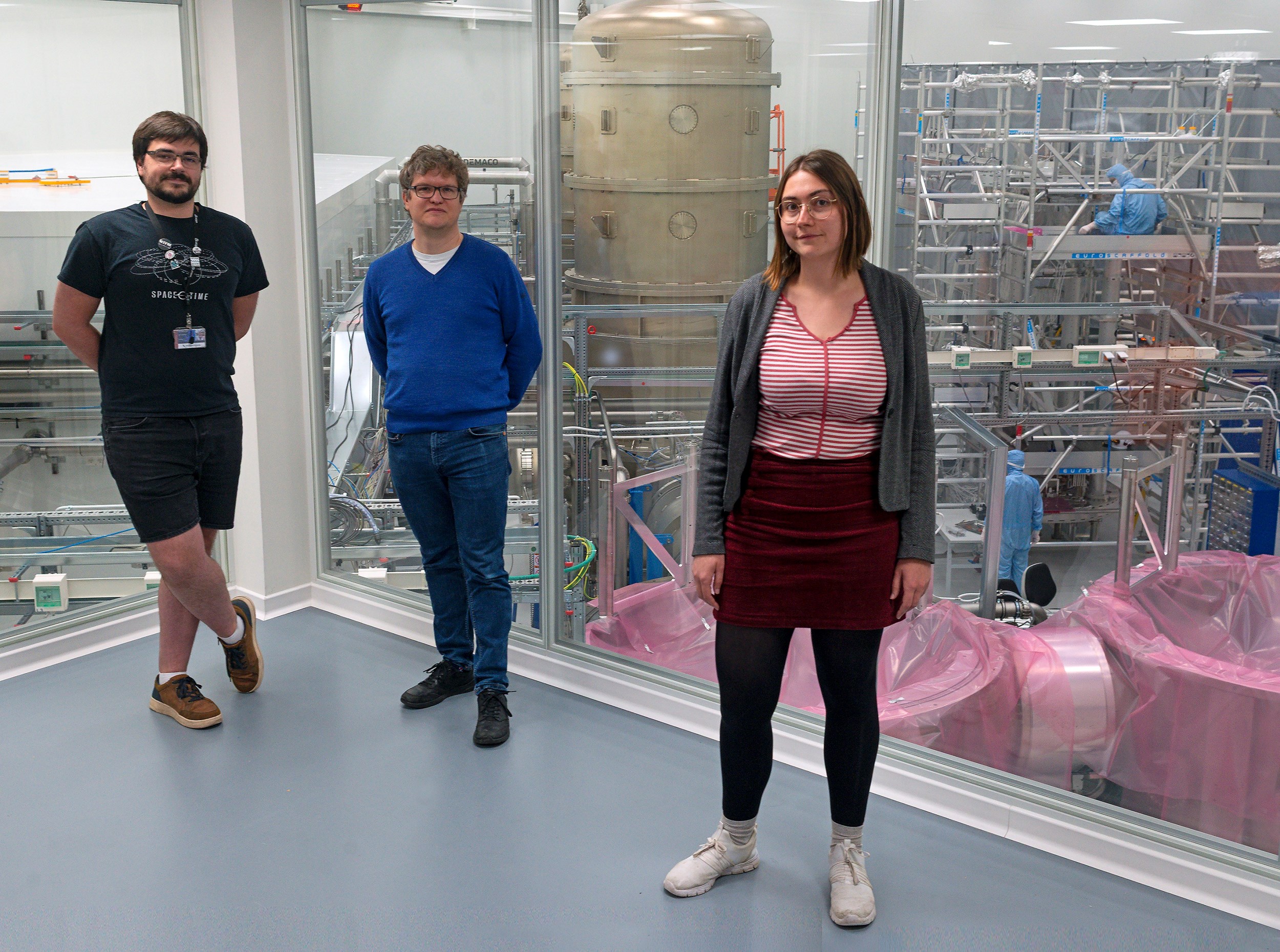 Photo: Ellen Oosterhof
That’s not to say they’ll be twiddling their thumbs until everything is up and running, though. “We can start experimenting before the entire system is complete. In fact, the process of building and developing the necessary technologies is incredibly valuable in itself. You run into practical issues you might never have considered – small details that can have a big impact on the construction of the actual detector, like how much room you need to clean certain systems. That’s not something you want to discover when the whole thing has already been build deep underground.”
Black holes and the Big Bang
The biggest challenge, however, lies in developing the technology to measure gravitational waves. The concept was first proven by LIGO, a pair of detectors in the United States, in 2015. It was a scientific milestone; for years, physicists – including Albert Einstein himself, who developed the general theory of relativity that predicts the existence of gravitational waves – believed it was impossible to detect such tiny ripples in spacetime directly. Since then, LIGO and the Virgo detector in Italy have recorded hundreds of detections.
“But those detections are still riddled with noise”, says Steinlechner. “You can tell there’s something there, but you miss a lot of details. It’s like Galileo’s first telescope, which only gave blurry images of bright objects.” With the Einstein Telescope, physicists hope to really get down to business: far more, and far more precise, measurements from deeper in the universe. These could help answer big questions about the true nature of black holes and other, possibly still undiscovered, exotic celestial bodies – and perhaps even about the Big Bang.
First of all, the Einstein Telescope will be much larger, with arms stretching up to ten kilometres. But the technology is also getting a major upgrade. “Part of it is improving on current detectors, but we’re also adding new elements, like low-frequency lasers”, explains Steinlechner. “These allow us to make more and different measurements, which researchers are really excited about. But it requires specific materials, like mirrors made from silicon rather than glass.” The mirrors will also be cooled to around minus 250 degrees Celsius. “Warm objects vibrate more than cold ones.” And vibrations need to be reduced as much as possible, as they can seriously interfere with such sensitive measurements.
Noisy fridge
That’s one of the main challenges, says Steinlechner. The installation must be as quiet as possible. “We can’t have it interfering with the measurements. But it’s tricky – cooling systems tend to be noisy. Just think how you can hear your fridge humming when the house is quiet.” Then there’s the issue of polishing the silicon mirrors to reflect the laser beams with as much precision as possible. “If the mirror was the size of IJsselmeer [the largest lake in Western Europe at 1,100 km2], the highest ‘wave’ on its surface would need to be less than the width of a human hair. Very few companies in the world can achieve that”, explains Duvieusart. “Existing techniques need to be improved, sometimes by a factor of one to ten thousand.”
To tackle these challenges, researchers in Maastricht are working with industry, universities and research institutions across the Netherlands and beyond. Various consortia have already been formed, with several millions of euros in funding, to develop specific components – from quiet mirror cooling and suspension systems to ultra-stable lasers, sensitive measuring techniques and vacuum systems.
“It takes companies with a very specific mindset”, explains Steinlechner. “They’re not just selling us a product – if the technology already existed, we’d be using it. They need to be willing to help us develop something that’s never been built before.” That comes with risks, adds PhD candidate Luise Kranzhoff, because success isn’t guaranteed. “But if they succeed, they’ll be the first in the world to do it. And they know the components for the actual Einstein Telescope will have to be built eventually, too.”
Economically attractive
What’s more, technological breakthroughs from large-scale scientific projects like this often ripple out into other fields and far beyond academia, which can be economically attractive. This is already happening, says Kranzhoff. For her PhD research, she’s working with a small company to reduce vibrations in equipment. “They’re already coming up with ideas for other applications, like stabilising microscopes.” Dutch chip giant ASML, which co-owns a company involved in mirror polishing for ETpathfinder, is keeping a close eye on the project, says Steinlechner. “Creating ultra-smooth surfaces is relevant for chip manufacturing, too.” And those are just a few examples. “We’ve even seen that major conferences on topics like vacuum technology are being held in Maastricht all of a sudden.”
While not all technologies and materials are being developed on site at Duboisdomein, over the coming years they will all eventually come together here to build a single working system. “It’s quite special to be working on something that brings together so many different fields”, says Duvieusart, casting another look at the towering installation. “I don’t know of anywhere else quite like it.” And the best part, adds Kranzhoff with a grin, “is that it’s a test facility, so we get to play around with everything. You definitely won’t be able to do that with the actual detector.”