This lack of a rush to sign up had its upsides, especially considering the new mentor policy. Before the summer break, project leader Jeroen Custers said they wanted to make “improvements”. The INKOM organisation would be looking critically at the quality of the older students who wanted to mentor a group of students. They were hoping that enough people would sign up, so that all the first years could be assigned a mentor ‘of their choice’. In previous years, students would be randomly assigned a ‘mum’ or ‘dad’ who would guide them through the introduction week. This edition, the first years had to fill in a digital decision tree and decide what ‘sort’ of group they wanted to join – one focused on sports, culture, or parties – in an attempt to prevent groups from falling apart.
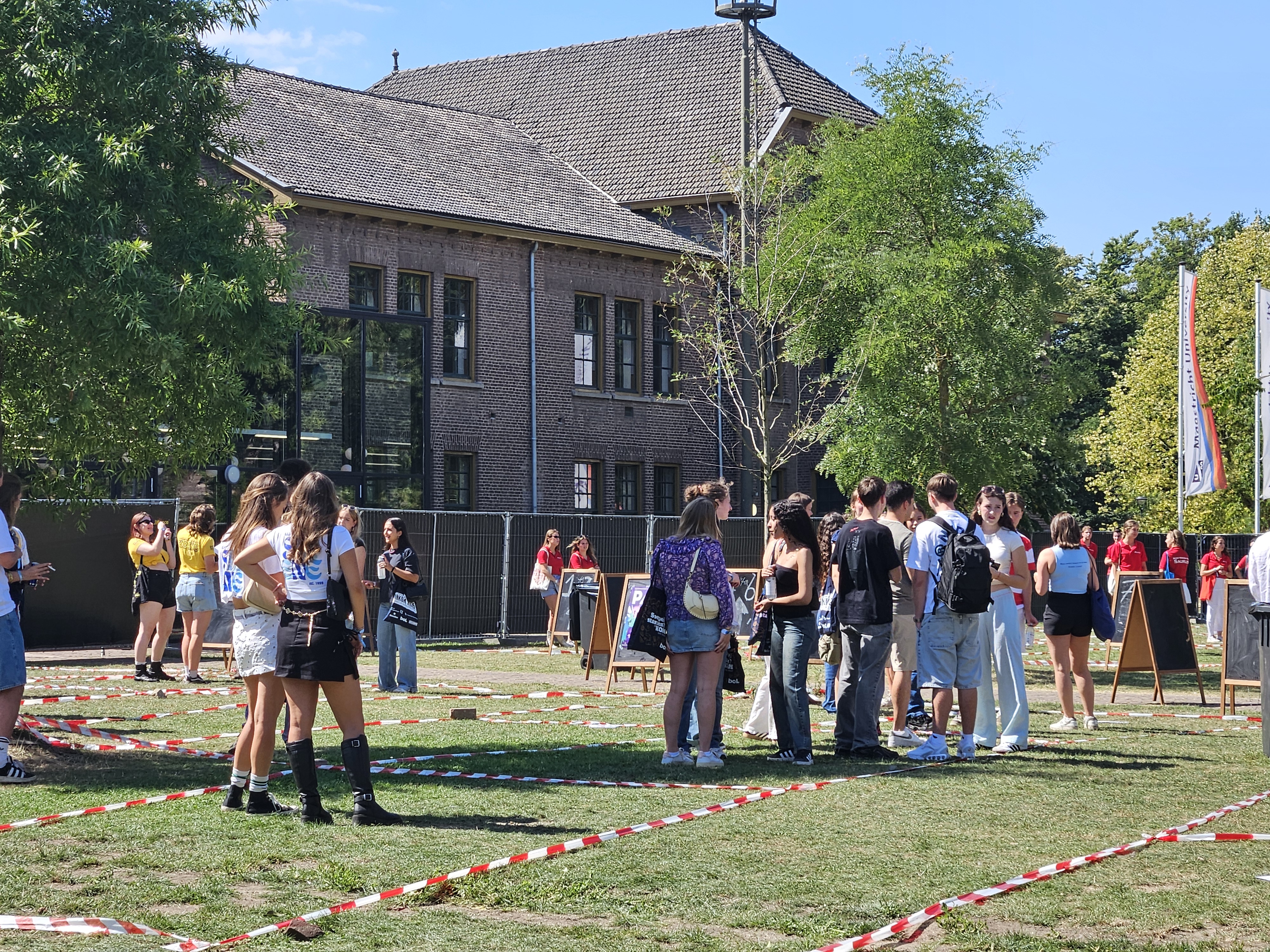 Day 1 at Tapijn: INKOM-participants are looking for their mentorgroup
Before the summer, Custers told Observant that there was a particular need for mentors for groups of international students. The problem is that many students abroad don’t return to Maastricht until the week after INKOM.
In the end, the INKOM organisation chose to increase the size of the groups, the project leader explained. “A mentor was found for everybody who wanted one.” When Observant asked around on Monday and Tuesday, groups of 20 to 25 students were not unheard of. The flipside of that is that an increase in the number of people means an increase in the number of opinions. Participants still choose to go their own way, either alone or in smaller groups.
Complex
There have been changes behind the scenes, too. The INKOM team (previously, Working Group INKOM) only has three student members this year, in contrast to the four or five of previous years. The core of the team consists of university employees. Aspects such as permits, procurement, and safety have grown increasingly complex, and responsibility for them could no longer be placed on the students’ shoulders. The week’s programme itself had already been changed last year: shortened from five days to four. The cantus also disappeared, a student party centred around beer and Dutch music.
Volunteers
What about the money worries and the lack of volunteers needed to organise introduction weeks, which Dutch news website nu.nl recently wrote about in an article? “Student volunteers are increasingly hard to find,” said Custers. “But that is not limited to our university; that’s a problem in society as a whole. My local swimming club faces the same issue.” Having university employees helping out at the Central Post or working the bar balances out the number of students. “And it’s also nice that more colleagues are involved with INKOM,” said Custers. “People who don’t usually deal with the introduction week are surprised at how much it involves.”
Regarding the money worries: INKOM receives a ‘contribution’ from the university in the form of offices, telephones, computers etc, but other than that, the organisation has to be self-sufficient. That is possible thanks to sponsors and the income generated by the food trucks and bars that INKOM sets up for events and parties. Custers has noticed that everything has become more expensive. “Take renting a stage, for example. The money you spent on a large stage pre-covid, now only gets you a little one.”