It’s early May 1993. Minister of Education Jo Ritzen has announced controversial plans to scrap free and discounted public transport and cut basic government grants for students. Students across the country take to the streets in what will become known as the Woeste Wilde Weken, the “Mad Wild Weeks”. During a national demonstration in The Hague, students clash with riot police. The protest on Vrijthof in Maastricht is a more good-natured affair, apart from the occasional critical passer-by.
Most people sympathised with the student hunger strike, dreamt up by the now-defunct Maastricht Youth Platform (an alliance of student unions, student associations, faculty associations, trade unions and political youth organisations) for its publicity potential. It appears to have been the first ever hunger strike by UM students. The next wouldn’t happen until 2024 – sparked not by concern for student finances, but by outrage over the genocide in Gaza.
Paperboys
Back to 1993, Vrijthof square. Early in the morning, paperboys hand out free copies of De Volkskrant and De Limburger. An ice-cream vendor parked nearby isn’t worried about losing business; he gives the protesters cans of mineral water and a deckchair, and promises the three hunger strikers as much ice cream as they can eat if they decide to give in. Shoppers shout words of encouragement as they pass. At night, members of the city’s unhoused community stop by for a chat with what they see as their potential future comrades. Meanwhile, the annual spring fair is being set up behind the kiosk.
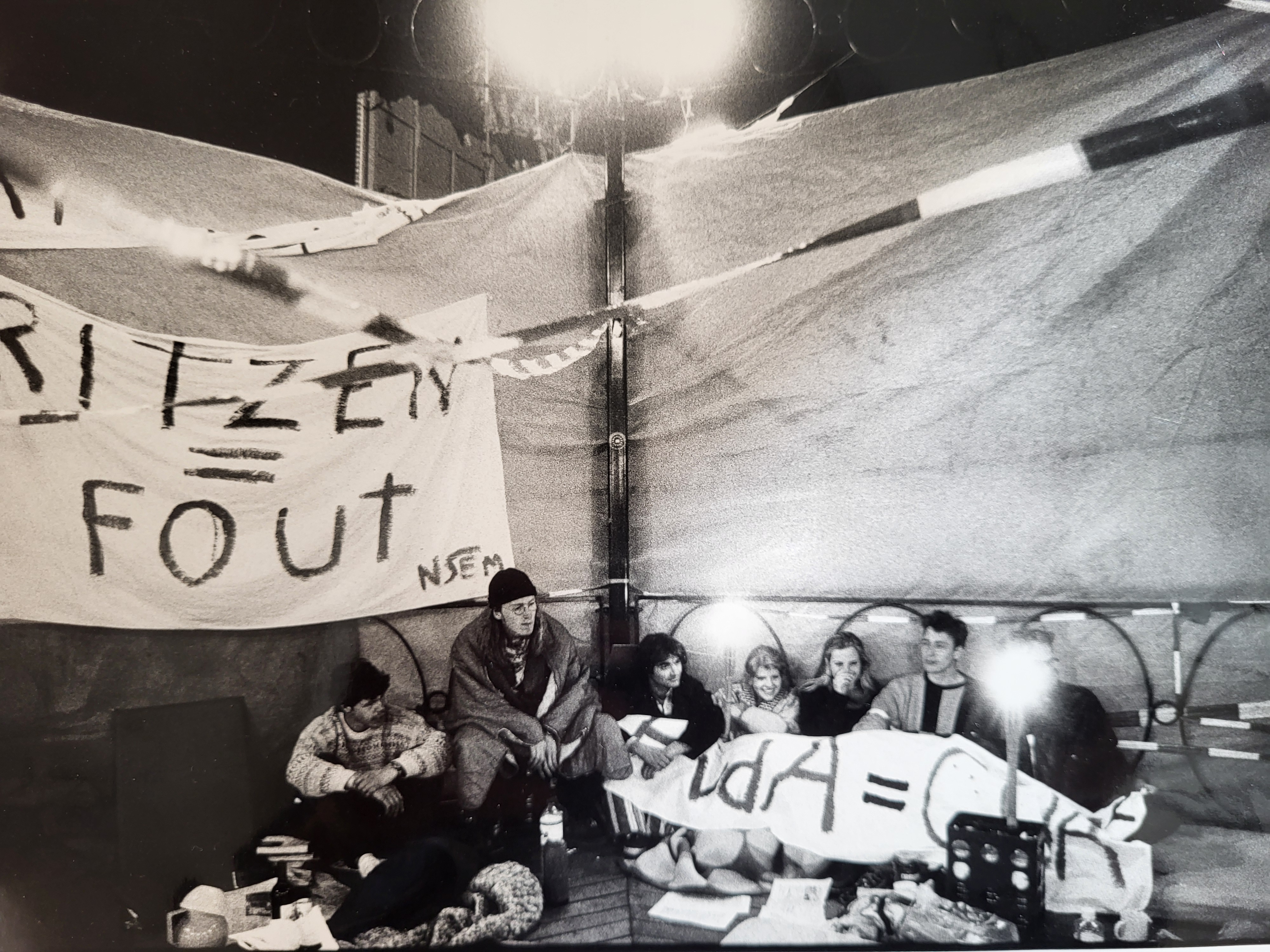 Hunger strikers and supporters on Vrijthof in 1993
Lit torches
The hunger strikers last three days on water and cigarettes. On Thursday evening, just before the start of a torchlight procession through the city centre – another protest against the rather unpopular Minister Ritzen, who will later go on to become President of Maastricht University – the three students have a few bites of Chinese food. It’s tough, they tell Observant, but their spirits are lifted when some three hundred demonstrators with lit torches (five hundred, according to the organisers’ own tally) gather at the kiosk around 10 pm.
Minister Ritzen
Another protest is planned for the following Monday, when Ritzen is due to visit a local secondary school. But by then, the momentum has faded. Over the weekend, the minister has struck a deal with Dutch Railways to maintain free student travel. One of the hunger strikers, a Medicine student, wasn’t keen on showing up again anyway. He doesn’t want to become the face of Maastricht’s protest movement, he explains.