It wasn’t brought on by the Russian invasion of Ukraine, nor the war in Gaza, no. In fact, neither of those had even started yet, when in 2021, Erlichman joined together with a colleague at King’s College London to found the Occupation Studies Research Network. The goal was to bring together academics researching military occupations.
It’s something they have managed quite well, as thanks in part to the interest in the two conflicts dominating the news, the network now has more than two hundred members around the globe. An excellent opportunity to study the subject more systematically, says Erlichman. “That has hardly ever happened until now, even though the knowledge is very useful.”
Why do those in power occupy a territory, what drives them?
“First of all, they never use the word ‘occupy’, because if they acknowledge that could be legally disadvantageous. Instead, they often speak of ‘liberating’ an area, or a ‘regime change’, or in Putin’s case, a ‘special military operation’. Or they claim it is to protect their own state, as the Israeli government is doing.
“It is an attractive option; leaders think they will achieve their goal quickly: get in and get out. That’s what the Americans thought about Iraq and Afghanistan, too. Putin believed he could ‘quickly’ install a puppet government in Kyiv. But it almost always drags on longer than planned.”
Are there ‘successful’ examples?
“Politicians often point to the occupation of West Germany and Japan by the Allies after World War Two in response to that question. They’ll say, ‘Those went on to become prosperous democracies’. And that is true, but the circumstances were favourable. In Germany, the aim was to drive out Nazi ideology and establish a stable form of democracy. A large portion of the population was not opposed to this, as the previous system had failed: the end of the war was catastrophic, with heavy losses and massive material destruction, and even an atomic bomb in Japan. In addition, the Germans also felt threatened by a third party, the Soviets, who they feared more than the Western Allies.
“That context is completely absent in Ukraine and Gaza. There was no mass destruction caused by the indigenous government before the current occupation, and in the eyes of most civilians, there is no greater threat imaginable at the moment than the occupier. You have to be very careful when referring to ‘good’ examples, as they are rare. It’s much more common for occupations to end in failure, the goals aren’t met and all the while, countries are destroyed.”
Why is it generally a recipe for failure?
“Occupations face several fundamental problems, for instance when it comes to legitimacy. The inhabitants of the area often see their new ruler as an outside force that has no claim to legitimate rule, and which will ultimately depart again. Violence, or the threat of violence, is often the only way to suppress the inhabitants. And that can be very costly for the occupier: it takes tremendous resources – money, equipment, soldiers – and you have to be constantly on guard.
“You also find yourself in something of a trilemma; you have to convince people on three fronts that what you are doing is justified. You want to show the occupied population that they will also benefit. At the same time, you have to justify the cost of the efforts to your own population. And finally, it is important to convince the international community that your invasion is justified, so that you do not become isolated. These three audiences have often very different interests and expectations.
“That makes it untenable in the long term. Just look at how the Americans suddenly withdrew from Afghanistan, after two decades of expending tax payers’ money and human lives. They were unable to convince both their own population and the Afghans.”
And is a country such as Israel unaware of this?
“Of course, they are aware. They have occupied territories such as Gaza before and partly withdrawn again because it proved too costly and impossible to establish a form of stable rule. Almost two years after the brutal Hamas attack on 7 October 2023, however, it is unclear which political objective the Israeli government is pursuing with the suffering and destruction it is causing in Gaza. Its policies have become increasingly radicalised, and the new goal seems to be complete occupation, against all better judgement.
“And now you can see it failing on all three fronts. The Israeli population is increasingly fed up with the war situation and the fact that the central political objective of freeing the hostages has still not been achieved; the Palestinians will never accept the takeover of power, meanwhile, Israel is increasingly becoming an international pariah. The Israeli government has manoeuvred itself into an untenable situation. The question is, when will the pressure on Netanyahu become too high.”
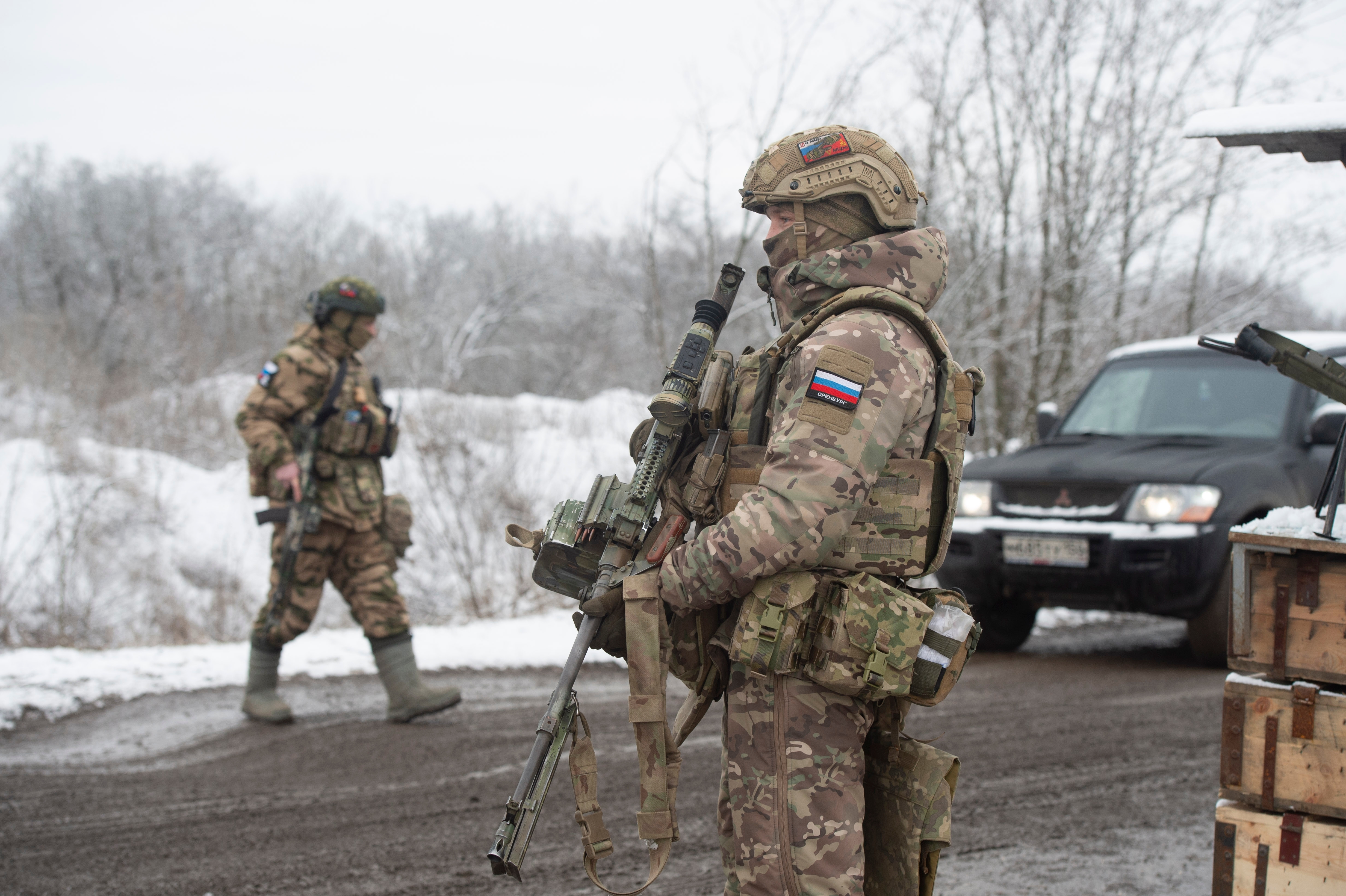 Ukraine, 19 February 2024: Russian soldiers inspect vehicles at a checkpoint in the part of the eastern Ukrainian oblast of Zaporizhzhia that has been occupied by Russia since 2022. Photo: Shutterstock
Is Putin in a similar situation?
“In a way, yes. He promised his people results. Many Russians have seen their sons killed, the money spend on the war machine could have been spent elsewhere, while the international sanctions imposed on Russia are very disruptive. How long can he continue to delay a peace treaty? When does it become too costly, politically and economically?”
Does the current situation move Netanyahu and Putin closer to their goal?
“The paradox of occupations is that, in the long term, they often have the opposite result to the one the occupier had in mind. The traumas suffered by the inhabitants of the occupied territory can have a decades-long influence on society. Just think of feelings of hate or resentment. The Israeli government claims its actions serve to protect the Israeli state, but how on earth could this situation lead to a safer environment for the Israeli population? How could they ever live peacefully alongside Palestinians if feelings of resentment are only fuelled further?
“History also shows us that nationalism often increases in occupied territories, fuelled by tales of an evil enemy and the heroic resistance of the native population. Political parties who focus on security, the restoration of the nation state and ‘normalcy’ are often popular after the end of the occupation. I expect something similar to happen in Ukraine, whereas Putin was seeking to increase his influence.”
Do these conflicts also yield new insights?
“There are different ways to approach this as a researcher. From a legal point of view – what an occupier can or can’t do according to international law – or politically, how people rule over occupied territories. As a historian, I am most interested in social and political interactions between occupiers and occupiers, including how populations deal with the presence of an occupier and the many privations they face, as well as with the reality of violence.
“For historical situations, it is sometimes difficult to capture the daily lives of ‘ordinary’ people under occupation because of the paucity of sources. But now, you can study it almost in real time. I recently attended a lecture by a Ukrainian researcher, Svitlana Makhovska, who had interviewed hundreds of people in villages where the Russians had just been driven out. That was very moving. These people have been scarred for life, some have seen their daughters raped by Russian soldiers. And yet, they have found ways to survive, to carry on with their lives.
“It is important to understand how this works, what the consequences are. Because however painful the idea may be, these are absolutely not the last military occupations we will ever witness.”