This article was first published on 01-10-2025.
“Let me just switch on Strava”, says Smits, reaching for his phone.
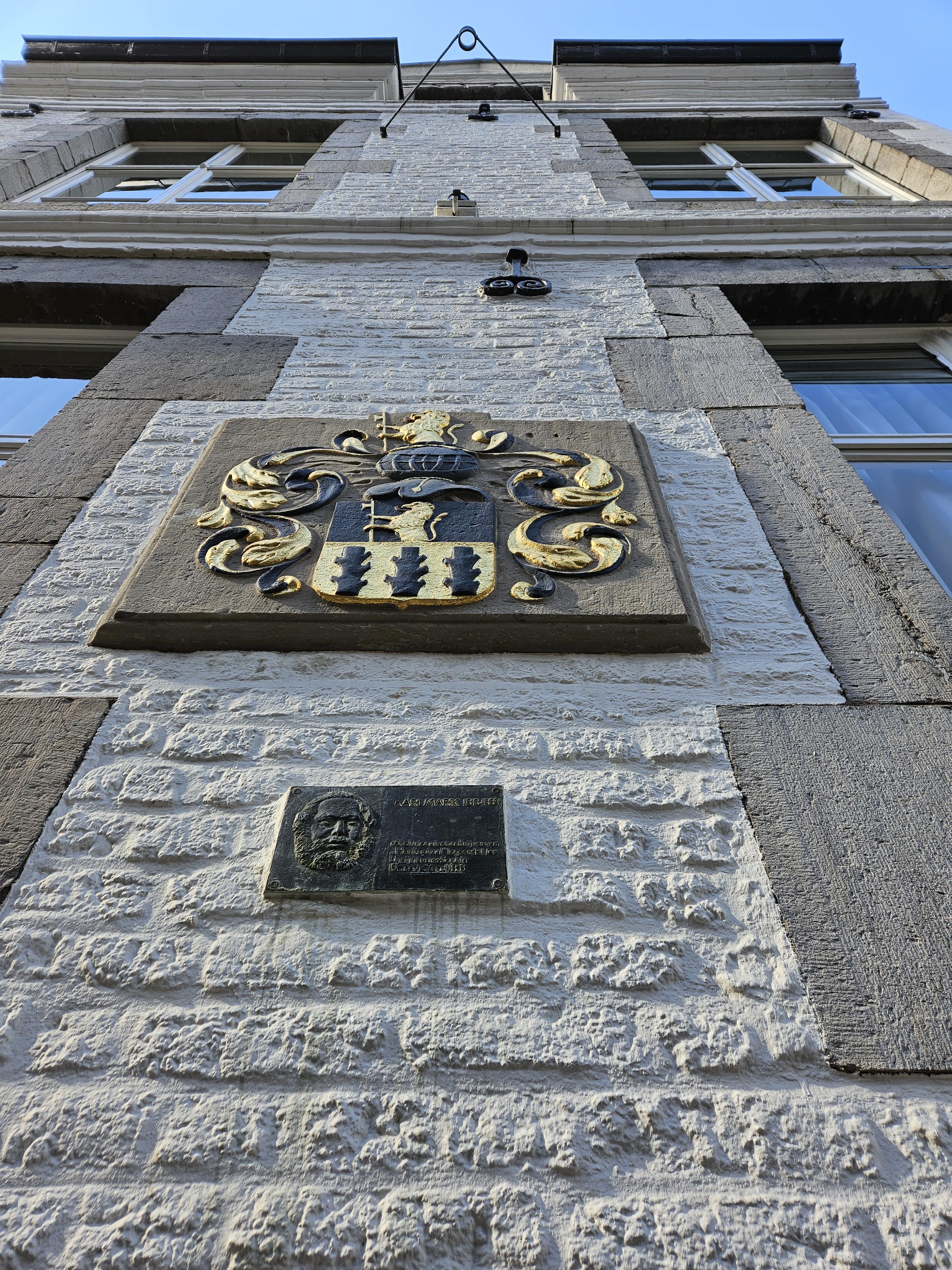 At the opposite of the Faculty of Law: the stone coat of arms and the 'Karl Marx plaque', photo: Observant
We are standing opposite the Faculty of Law building, at Bouillonstraat 8-10. This old townhouse, Hof van Slijpe, was once home to the grandson of William of Orange, Smits explains with practised ease. The professor and dean cannot resist mentioning that he dislikes the stone coat of arms – not of the Van Slijpe family – that was recently installed on the façade. “It doesn’t suit the building.” A plaque beneath the coat of arms claims that the German philosopher Karl Marx once stayed here in the 19th century. “Absolute nonsense. Marx visited his sister, who was married to a Maastricht lawyer. It’s true that he had his offices here, but she lived on Markt when Marx visited her.” Fake news, as we’d say today.
Leiden
Smits’s new bilingual walking guide, in Dutch and English, is filled with snippets of history that are interesting from both a legal and political perspective. At seven kilometres, the walk is manageable for most people. Smits previously published a similar city guide for Leiden, where he taught at the Faculty of Law, in 1995. “The cities are different”, he admits. “Leiden has a rich legal history; its university is more than four centuries old. Practically every building has a relevant story to tell.” By contrast, Maastricht University – soon to celebrate its fiftieth anniversary – boasts fewer big names. Still, Smits serves up plenty of fascinating facts, from a landmark court ruling with a Maastricht connection to the story of the first woman in the Netherlands to exercise her right to vote here.
Knee
Smits is a keen walker and runner who has covered every street in the city, from Heugem to Borgharen, on foot. He first came up with the idea of mapping out a law-themed walking route through Maastricht ten years ago. The inquisitive scholar pored over history books, combed the Historisch Centrum Limburg archives and consulted Delpher, an online platform providing digitised newspapers, books and journals. “All very valuable.” In the end, he had to cut a lot of material, “or it would’ve been unreadable.”
The guide makes readers look differently at buildings now housing popular shops like Rituals (where the original Roman street level is still visible) and Sostrene Grene (where Petrus Regout was born, the founder of the pottery factory later known as the Sphinx). It even draws attention to the cobblestones: charming, but treacherous. On 8 June 2011, a woman was walking down Sint Bernardusstraat when her shoe caught on one of the cobbles, Smits recounts. She fell, injured her knee and sought compensation from the city. Her claim was rejected, as she could not prove which cobblestone had tripped her. Smits advises readers to “Continue – carefully!”
Cells
Next stop is the city hall on Markt. Smits has a wealth of stories to share here, to which he devotes considerable space in the guide. Even if all those dates and facts make your head spin a little, they also give you an instant feel for the city’s rich history. For nearly six centuries, Maastricht was ruled by two powers: the Prince-Bishopric of Liège and the Duke of Brabant (later the States General of the Dutch Republic). This unusual system of joint governance is reflected in the design of the city hall. The chambers of the Liège officials and judges were to the left of the stairs, those of the States General to the right. One court met on Wednesdays, the other on Fridays.
Before that, judges held court in the Dinghuis, today’s tourist information centre, on Grote Staat. Smits shows an old photo of the former court building. There used to be small overhanging rooms on the side that served as prison cells. Once convicted, criminals were hanged, strangled or burned. Those guilty of less serious offences were banished, Smits explains, and hanged anyway if they returned to the city. “This was highly effective in preventing overcrowding of the cells”, he notes. His wry remarks create a light, humorous tone throughout, as in his description of Sint Pieterstraat 21, which was home to a notorious gallery in the 1960s. During the Levende Opjekten Sjoo (“Living Objects Show”) – which included a dance by two women in transparent plastic from which they slowly stripped – the police intervened. “Of course they first had to watch the entire show before they could take action.”
Harlequin
The origins of street names such as Vrijthof, Grote Staat, Het Kinderwetje and Vijf Koppen are all explained. Smits also highlights Maastricht’s socialist history, including the old Leiter-Nypels printer and bookshop, where the former leader of the Limburg socialist movement worked as a young typesetter in the 19th century. For those with a taste for the macabre: a lawyer and two of his children were murdered by “a disgruntled client” in the townhouse at Sint Servaasklooster 33, now the Toon Hermans Huis.
Observant concludes the walk at the sculpture of the Mestreechter Geis, the Spirit of Maastricht. “The cheerful harlequin is said to embody the minds of the locals”, writes Smits, adding, “if this is true, the city apparently houses few jurists.”
Finally, if you’re still curious to know what “getting a haircut in Liège” means, continue to the Bat, where coal used to come into the city. The area was notorious for its sex workers until the Immorality Act of 1911, which left Maastricht men with little choice but to travel to Liège – and no, not for a haircut.
Een juridische wandeling door Maastricht/ A legal walk through Maastricht, Jan Smits, WJS Uitgevers, ISBN 978-90-835481-7-3