Enrolment rates in 1985 were falling short of expectations, to university rector Vic Bonke’s concern. There were doubts about whether Law and Economics would meet their targets of five hundred first-year students per year, he said at the start of the academic year, when Maastricht enrolled just over eight hundred first-year students in total. Only Medicine was attracting sufficient student numbers. To achieve its goal of growing from roughly three thousand to six thousand students by 1995, Bonke added, the university would step up its recruitment efforts beyond Limburg.
Full-page adverts
Not long after, full-page adverts began appearing in national and regional newspapers. One read: “In Maastricht, you learn how to deal with problems. Isn’t that right, Prime Minister Lubbers?” Another proclaimed: “Rotterdam, The Hague, Utrecht, Leiden, Groningen, and so on – but Maastricht is the real treat.” The campaign, which cost over two hundred thousand guilders, soon proved money well spent. By January 1987, pre-enrolment figures had risen by nearly 30 per cent. The University Council decided to allocate an additional three hundred thousand guilders to student recruitment – due to popular demand, as they say.
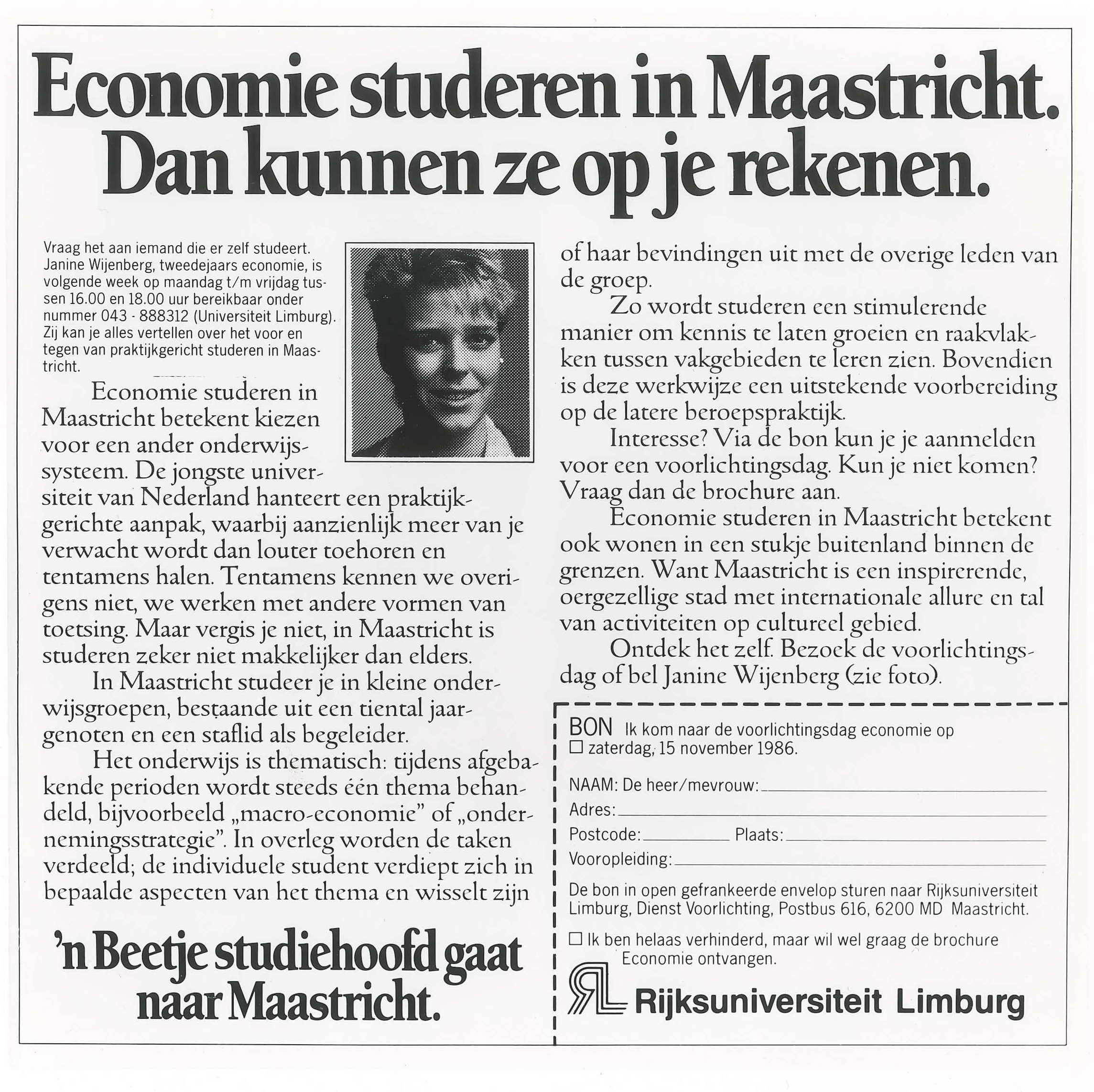 Campaign in national and regional papers to attract Economics students: 1986
Turn up its nose
A few years later, no Dutch university would turn up its nose at PR activities any longer. As competition grew fiercer, UM’s newspaper adverts began to lose their impact. The university decided to switch tack and try a different medium. Its first radio spot aired on 7 February 1994 on Radio 3 and 538. It was broadcast around sixty times over a four-week period. An accentless (!) Dutch voice urged secondary-school students to “use [their] brains” and call a mobile phone number, where a friendly voice – again without a Limburg accent – invited them to attend the university’s open days. This direct-marketing approach had been borrowed from the University of Twente, which enjoyed notable success with it in those years. It was never officially explained why Limburg accents were deemed off limits for the radio commercials – perhaps it was to avoid discouraging students from other regions.
Still, the spots, highlighting Problem-Based Learning and internationalisation, did the trick. Within six months of the first broadcast, the university had attracted a record number of 1,950 new students – a 7 per cent increase from the previous year.
Fake professors
By then, television commercials were also running. These featured “fake professors strolling past picturesque locations and cheerful students driving a 2CV from campus to a sunny Vrijthof square”, as reported by Observant at the time. But after seventeen airings, only 240 prospective students had called the phone number – a disappointing first result, especially compared with the full-page newspaper adverts, which had generated 150 to 200 responses each.
The student recruitment campaigns had already peaked. Universities began to focus more on rankings in the Dutch University Guide. Around the turn of the millennium, Maastricht topped list after list. The university took pride in its rankings, but when Observant asked open-day visitors what drew them to Maastricht, the rankings were rarely mentioned. Prospective students were more likely to cite friends, the city or the appeal of a specific study programme as the deciding factor.