Children find it much easier to reimagine things we take for granted, as Harris knows from the workshops she occasionally runs. In these sessions, children are asked to redesign a hospital. “Imagine the world has been completely flooded and the only building left standing is a hospital. The children are in charge, and the doctors must listen to them. They come up with the most extraordinary ideas.” It would be wonderful, says Harris, if the adult world allowed more “time, space and appreciation for this kind of creativity and imagination.”
What would happen if it did? Harris gives an example in her inaugural lecture, delivered just two weeks ago and included in the book. During the Covid pandemic, nurses in Brazil filled discarded gloves with warm water and placed them on ICU patients’ wrists. This didn’t just raise their body temperature, making it easier to monitor oxygen levels, but also felt like a comforting hand on their arm as they fought for their lives. An ordinary object, technically waste, creatively repurposed.
Distinctive smell
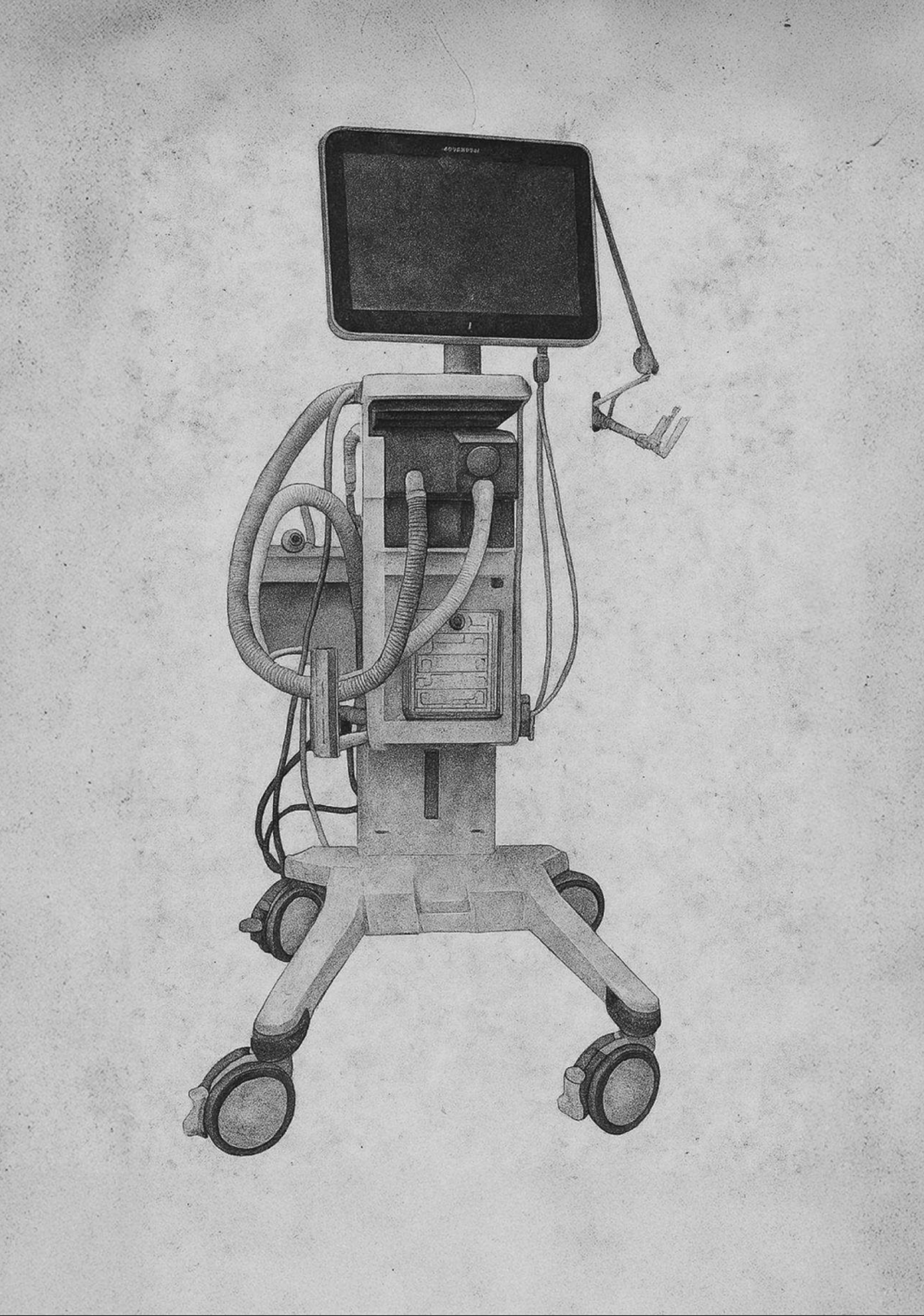 ServoI ventilator - from The Matter of Hospitals, appears with essay 'Ventilators'. Based on a photo by Wikimedia/BreathDiver. Final refinements done using Adobe software.
In a way, all hospitals are the same, says Harris. “You can recognise them by their smell, a particular mix of hygiene and illness. The smell isn’t exactly the same everywhere – it might depend, for instance, on the cleaning products they use – but it’s one of those things that instantly tells you where you are. Then there’s the atmosphere, especially at night. Hospitals are both quiet – patients are resting – and busy, with work continuing around the clock.”
But local differences are considerable. “For the book, I asked anthropologists, medical professionals and other writers from around the world to write essays about particular objects. That’s when you notice that things like healthcare systems vary greatly across countries. In the chapter on ventilators, authors write about shortages in African countries during the pandemic, whereas we in the Netherlands are used to always having enough of everything.”
A door to another world
What strikes her when she walks into the Maastricht University Medical Centre (MUMC+)? “First, the incredible aeroplane sculpture in the entrance hall. I always pause to admire it. And I still love how you can walk straight from the university to the hospital on every floor. You just step through a door into another world. I haven’t seen that in many other academic hospitals.”
And Harris has visited plenty of hospitals, both for her anthropological research and as a medical student and doctor. “I always knew I wanted to be a researcher, but I used to imagine myself discovering a new medicine with a microscope. When I asked our neighbour, a biologist, how to get into medical research, she advised me to study medicine.”
Harris took her neighbour’s advice, but it was only in the fifth year of her studies that discovering anthropology while doing an obstetrics assignment set her heart racing. “I later travelled through China and Vietnam during the SARS outbreak. I realised how important it is to observe how such situations are handled, and how much you can learn from that.”
CliniClowns research
Anthropology and medicine might sound like an unusual combination to some, but Harris isn’t the only one at the Faculty of Arts and Social Sciences combining the two fields. She works with a new interdisciplinary team on a project called The Upcycled Clinic, studying creativity in hospitals. “Also, for example, one of my colleagues studies the CliniClowns Foundation and has even trained as a healthcare clown. And others focus on the history of medicine and nursing.”
If the administrative integration between Maastricht University and MUMC+ goes ahead, Harris sees plenty of opportunities for collaboration. “And we can learn from each other’s cultures. Here at the university, a conversation between a historian and a political scientist is called ‘interdisciplinary’. At a hospital, it’s perfectly normal for a physiotherapist, a dietician and a nurse to consult each other daily. I also think hospitals are excellent at prioritising. In turn, they could learn from us how to maintain a broader perspective – some medical professionals are so specialised they develop tunnel vision.”