It all started in 1998 when the research line (later department) cognitive neuroscience was established. The first researchers – Bernadette Jansma, Lisa Jonkman, Leo Blomert – are mainly focused on EEG-research (measuring brain activity through electrodes, placed on a test person’s head). They want to extend the expertise to MRI and convince Rainer Goebel, a German professor of cognitive neuroscience, to come to Maastricht University in 2005. He goes to work with a 3T scanner – the “T” stands for Tesla, the unit used to measure the strength of a magnetic field. The stronger the field, the more detailed the images.
Director
“I was very happy with that scanner”, Goebel recalls in his office. “But my interest shifted to parts of the cortex and layers of the brain you can’t see with a 3T scanner.” For context: the human cerebral cortex has an average thickness of 2.5-3 mm. A 3T scanner typically captures image slices of 2 mm, whereas a 9.4T scanner can achieve slices of 0.5 mm. “If, for example, you don’t just want to see that someone is talking in the brain’s language centres, but exactly what words are communicated, you need a more advanced scanner.”
So when Goebel was offered the role of director at the yet-to-be-built Spinoza Centre for Neuroimaging in Amsterdam, complete with a 7T scanner, he said yes. “It didn’t occur to me to ask whether the same could be done in Maastricht. It’s such a huge investment.” But Jo Ritzen, the UM president at the time, surprised him. “When he heard I was leaving, he said, ‘If you stay, we won’t just bring a 7T scanner to UM – we’ll bring in something even better.’ It was a gamble – nothing was guaranteed – but I decided to stay.”
€45 million
It took Ritzen considerable effort to convince the rest of the Executive Board and the Supervisory Board. The three scanners – a 3T, a 7T and a 9.4T, replacing the old 3T – and their new home, including offices for researchers in the same building, would end up costing €45 million, with UM investing €26 million. But Ritzen managed to get both boards and, later, the municipality, the province and the hospital on board. “It helped that I had already secured a European ERC Advanced Grant for research using an advanced scanner”, says Goebel. “It showed that the researchers would contribute financially as well.”
Together with Bernadette Jansma, the then dean of the Faculty of Psychology and Neuroscience, Ritzen toured Europe “to see how others managed their scanner facilities”, Jansma recalls in a phone interview. They eventually decided to establish a limited company, now Scannexus. FPN, the Faculty of Health, Medicine and Life Sciences and the Maastricht University Medical Centre+ each purchase a fixed number of scanning hours per year. The faculties partially recoup these costs, as researchers pay for scanner use from their own research budgets.
Jansma was never very enthusiastic about this arrangement. “It meant that we, as researchers, had to pay VAT on our scanning hours – an additional 21 per cent. But it was apparently necessary for collaboration with Siemens [the manufacturer of the scanners] and to obtain certain grants. I accepted it; otherwise, we wouldn’t have got the scanners.”
Groundbreaking research
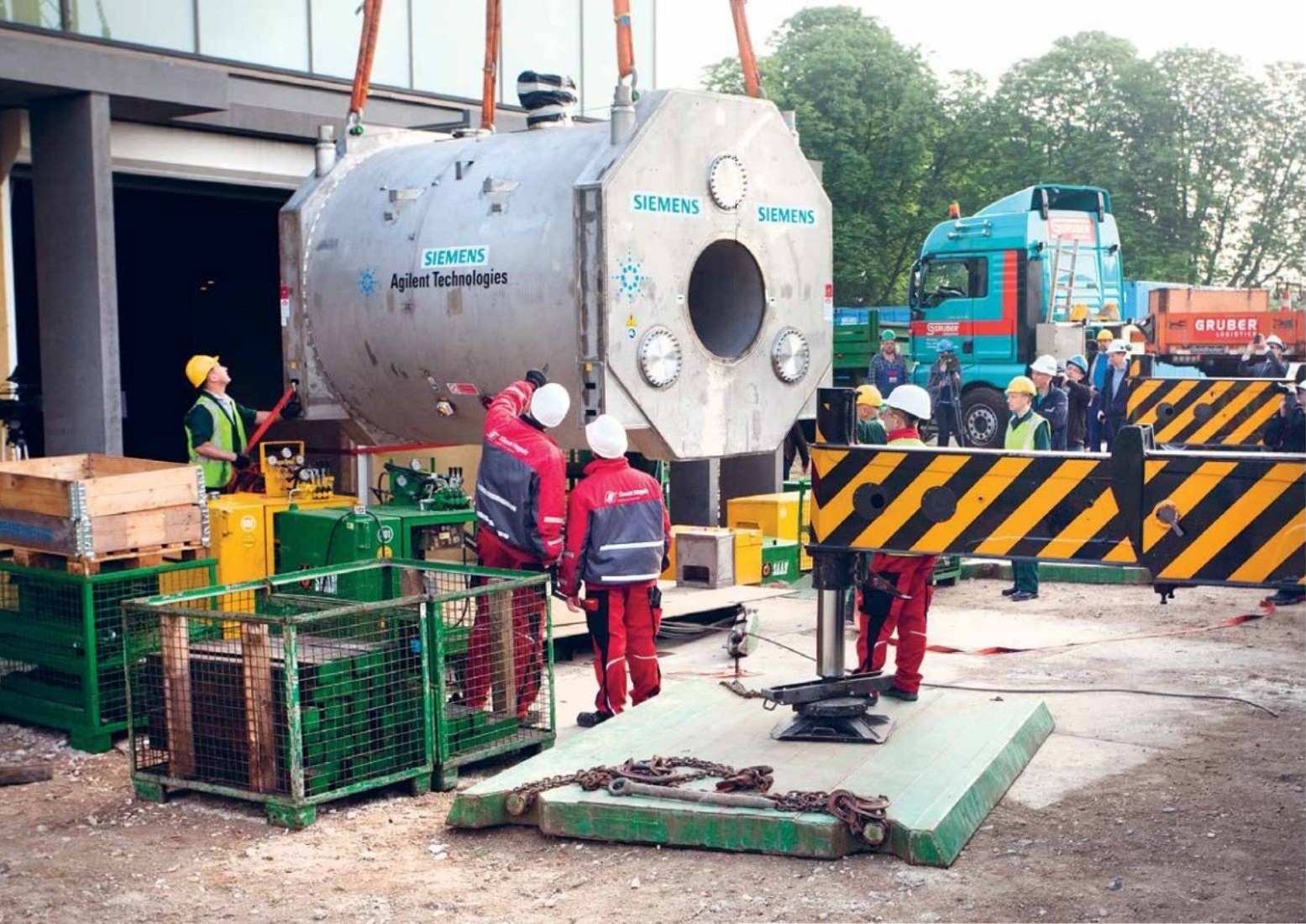 In the morning of 3 May 2013, the 9.4T MRI-scanneris hoisted into the Brains Unlimited-building
Photo: Loraine Bodewes
In October 2013, King Willem-Alexander of the Netherlands inaugurated the building, then called Brains Unlimited. Expectations were sky-high. “This could lead to a Nobel Prize”, claimed the then director of Siemens Healthcare.
Research grants quickly began to pour in at the Department of Cognitive Neuroscience. “Being able to state in our applications that we’d be using a 9.4T or 7T scanner in our study gave us an edge over other universities”, explains Goebel. This attracted talented researchers; the department grew rapidly from ten to twenty people to the current number of about a hundred. “People like Elia Formisano, Bea de Gelder, Alard Roebroeck, Teresa Schuhmann and many others would likely not be here if it weren’t for the scanners.”
Groundbreaking research followed. “We were the first in the world to visualise letters that someone has in their mind’s eye. Participants imagine a letter of the alphabet, while in the 7T. Through their brain activity we can show which letter it is. We now work on translating this to a mobile, non-invasive device to enable communication with locked-in patients – people who are almost entirely unable to move, let alone speak. Using a simpler device was only possible because we first used a high-end scanner to study how the brain worked.”
New degree programmes were established: a research master’s in Cognitive Neuroscience and, since last year, a bachelor’s in Brain Science. “We’re very proud of that”, says Goebel. “It gives students the opportunity, early in their studies, to see research with scanners firsthand and draw conclusions by learning data analysis and modelling.”
Setbacks
But money remained an issue. Dean Jansma lobbied for FPN to be officially recognised as a STEM faculty by the Dutch government, as these receive more funding than humanities and social sciences faculties due to their expensive infrastructure such as laboratories and equipment. But the plan failed. Jansma’s successors cut back costs: they reduce FPN’s annual contribution to Scannexus and discontinue the master’s programme in Neuroeconomics, a collaboration with the School of Business and Economics.
A master’s programme for professionals, designed to bring in funding, never quite took off. “Our aim was to teach people who work with scanners at other universities or large companies how to use the equipment, but employers preferred in-house training”, explains Goebel.
Around 2017/2018, a number of physicists and computer scientists left UM, taking considerable expertise about the scanners with them. “We couldn’t offer them professorships”, says Jansma. “They stayed for quite a while, but there comes a point where people have to prioritise their own careers. It takes time to rebuild that expertise.”
Use
PhD students also struggled with the 9.4T scanner. “Think of it as a Formula One car”, says Goebel. “It’s high-end, but that also makes it highly sensitive. When something breaks – which happens regularly – repairs often take weeks or even months, when a part has to be shipped to the US. PhD students have tight deadlines, so I understand why they might opt for the 7T scanner, which has much less issues, instead.”
In 2023, FPN set up a fund to encourage researchers to make more use of the 7T and 9.4T scanners, as scanning hours frequently went unused. The fund had the desired effect: according to Goebel, about 70 per cent of the available hours were used in recent years.
Other institutions also began using the scanners more. “MUMC+ uses the 7T to prepare for deep brain stimulation surgeries, where an electrode is put into the brain to affect brain activity, for instance in Parkinson’s patients. And FHML used the 9.4T for research on various types of cancer.”
Sacrifice
Even so, the Department of Cognitive Neuroscience itself proposed retiring the 9.4T scanner earlier this year. It was a huge sacrifice, says Goebel. “This scanner put UM neuroscience on the global map. If one of our research master’s students wants an internship at Oxford or Stanford, all I have to do is make a call. And if I’m in the US for work, I often get free access to other universities’ scanners. They know us and the reputation we’ve built thanks to this machine.”
But they had to be pragmatic about it, he says. In 2027 and 2028, the current scanners will be fully depreciated and due for replacement. “That’s another huge investment. The 9.4T scanner uses far more helium than newer scanners, even when idle, and the price of helium has skyrocketed in recent years. It’s also the most expensive machine to maintain. Retiring it three years earlier than planned saves us hundreds of thousands of euros – almost enough for a new 3T scanner. That’s why we suggested it to the Executive Board. It’s a hard pill to swallow, but it had the desired result: the university is going to develop plans to replace the 3T and 7T scanners.”
14T
In the meantime, Goebel and his colleagues aren’t resting on their laurels. A 14T scanner is currently being built in Nijmegen. “It’s intended for national use. Elia Formisano and I are on the grant application team, and about 20 per cent of the scanning time will go to UM. My focus will be on studying brain activity in layers and parts of the cortex at a fine-grained resolution of only a few hundred micromillimetre, to crack the code of the brain. Understanding how the brain ‘codes’ thoughts, mental images and emotions could help in treating conditions such as depression. This way, we can continue our work, but it remains a compromise. We’ll have to ask our researchers to travel to Nijmegen, for example.”