“It works a bit like one of those puzzle boxes for small children, where only blocks of a certain shape fit through the holes in the box.” In her office at the Sensor Engineering department of the Faculty of Science and Engineering (FSE), Arreguin Campos sketches a flat surface with a few small notches. “The sensors work in a similar way: only specific molecules or microbes fit in those cavities. If they are present and make contact, it creates a signal.”
The principle isn’t new. Home test kits for covid and pregnancy tests make use of it as well. “Our department is investigating all sorts of different applications,” says Arreguin Campos. “Not just medical, but also, for example, using it to detect chemicals or pathogens in food.” During her PhD research, for example, she worked on a sensor to detect bacteria in a fresh smoothie maker. “The challenge is that, although they all use the same principle, the design of the sensors can be very different, depending on what you want to detect.”
For the ‘smoothie bacteria’, she used a heating plate under the surface with the cavities. “The heat rises through the holes, but if there are any bacteria in them, they block the flow of the heat. That leads to measurable differences in temperature on the other side of the surface. That is very different to a covid test, for example, where the test uses substances that cause a change of colour.”
Brazil
Once she graduated and became a post doc, her interest was drawn to a collaboration between her research group and the Federal University of Minas Gerais in Brazil. “Malaria is a huge problem there, and the idea of a malaria sensor had been discussed previously, but we didn’t know how to approach it yet. I thought that the system we used for the smoothie maker might also work in this case.”
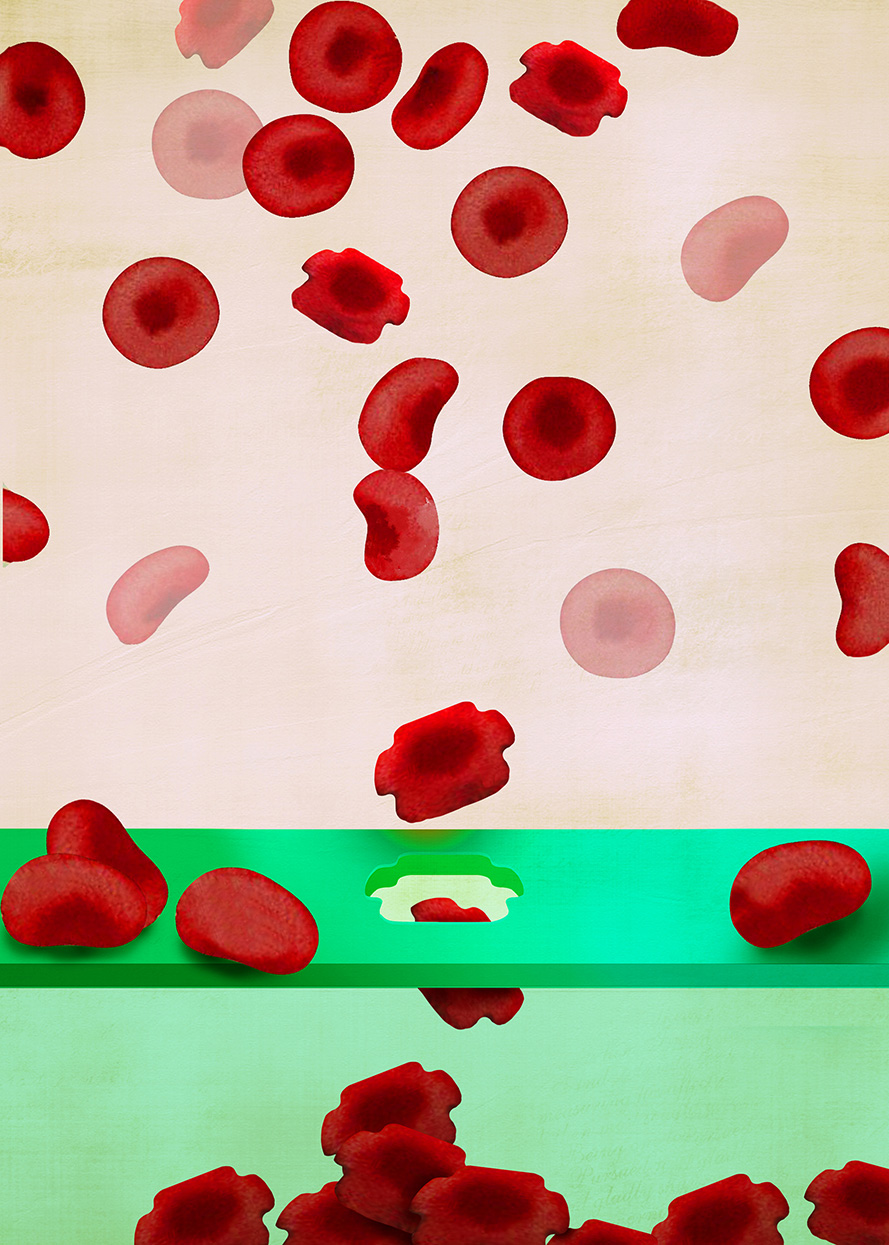 Illustration: Simone Golob
After all, malaria is caused by parasites infecting red blood cells, which then swell up and produce a spiky surface. “The cells are about the same size as bacteria, so you could develop a similar sensor, with cavities that allow spiky, infected cells to fit in, but not healthy, ‘smooth’ cells. Then, instead of a smoothie, you would run a blood sample through the sensor.”
It is a system that could potentially make a noticeable difference in poor and remote areas in Africa and in Brazil. “Labs that carry out malaria tests are often far away, which means people usually wait until the symptoms have advanced to get tested. Even though it’s easier to treat if you catch it early. The benefit of a sensor is that it could be cheaper, is easier to transport, and doesn’t require trained lab technicians. You can take the malaria test to the patient.”
There are already home test kits available for malaria, says Arreguin Campos, but they are often seen as less accurate and quite expensive. “They measure malaria indirectly, using so-called biomarkers. That requires expensive resources, whereas our bio-sensor can be made of simple plastic. Moreover, they react less well to mutated parasites – just as covid tests were less sensitive to new variants. We expect the sensor wouldn’t be affected by that, because it would directly measure the infected blood cells.”
Growing parasites
Two years ago, Arreguin Campos was awarded money by the Dutch research council NWO to work out her ideas. “A limited grant, purely to investigate whether the idea would work in practice. We genuinely didn’t know.” Within a few months, they had succeeded in developing the sensor. “With massive thanks to our Brazilian colleagues’ incredible knowledge of malaria parasites. That was of particular help when designing the cavities, which have to match the shape of the infected blood cells. You have to make the moulds for the cavities by literally imprinting cells in liquid plastic, and that means you have to know how to grow the malaria parasites, isolate the infected cells, and keep them alive during the mould-making process – dead cells change shape. If we had had to do that by ourselves, it would probably have taken us years.”
In the summer of 2024, a month-long research trip to the laboratories in Minas Gerais was organised to see whether it would work. “They have a lot of experience growing parasites in blood samples.” The sensor worked as they had hoped: infected blood created a definite signal, even if the level of infection was still low, which is crucial for early disease detection. The sensor didn’t react to healthy blood.
Long way
A huge success, but still only a “first step”, says Arreguin Campos. “We would like to carry out tests in areas with malaria, with blood samples taken directly from infected patients. And experiment with other types of malaria; so far we have only done research using the most common parasite. Red blood cells also take on a different shape in the early stages of the disease. Maybe we can combine them, so that the sensor will also be able to detect those variations.” Another challenge is the size: the sensor is currently the size of a laptop, but making it smaller would make it even easier to transport. “Maybe at some point, people will be able to use it at home, but that is still a long way off.”
So, lots of plans, which will require funding. “We are working hard to find funding. We’ve noticed it is a difficult topic. Because malaria isn’t a problem here, it can feel less relevant to funders. Grants for food safety sensors, for example, are easier to get. Even though malaria is a huge problem globally: there are about a quarter of a billion cases every year, and over half a million people die. And climate change is leading to larger areas being affected by malaria.”
But, says Arreguin Campos, “we are not letting this go. There is so much potential, it is very promising. For malaria, yes, but our Brazilian colleagues think that, in the future, we might also be able to apply it to other infectious diseases.”