Around noon, the Dam square in Amsterdam begins to fill with demonstrators. They wear green caps or red hats handed out by the trade unions. They carry banners, flags, and protest signs.
Wageningen, Groningen, Leiden, Utrecht… The demonstrators have come here from all over the country. A seven-member student band welcomes the crowd with cheerful pop music.
“I don’t like slogans”
“I really don’t like demonstrating,” says Amsterdam professor of media studies Jeroen de Kloet. “I don’t like slogans and I get bored. But sometimes you just have to.” He wants to make his voice heard against the cuts to higher education and research.
These cuts are still included in the national budget for now. The elections have not changed that. Education-focused party D66 is negotiating the formation of a new cabinet, but the demonstrators remain cautious — not least because the VVD is also at the table.
A Ukrainian chemistry student has come to the Dam from Groningen. He follows Dutch politics closely and does not dare trust that the cuts will be reversed. “In the coalition talks, education isn’t a topic at all,” he says.
“Not everything is about immigration”
Onstage, representatives of education unions FNV and AOb, various activist groups, and local student unions speak. “Don’t forget us,” one of them says to the negotiating parties. “Not everything is about immigration, Defence, or housing.”
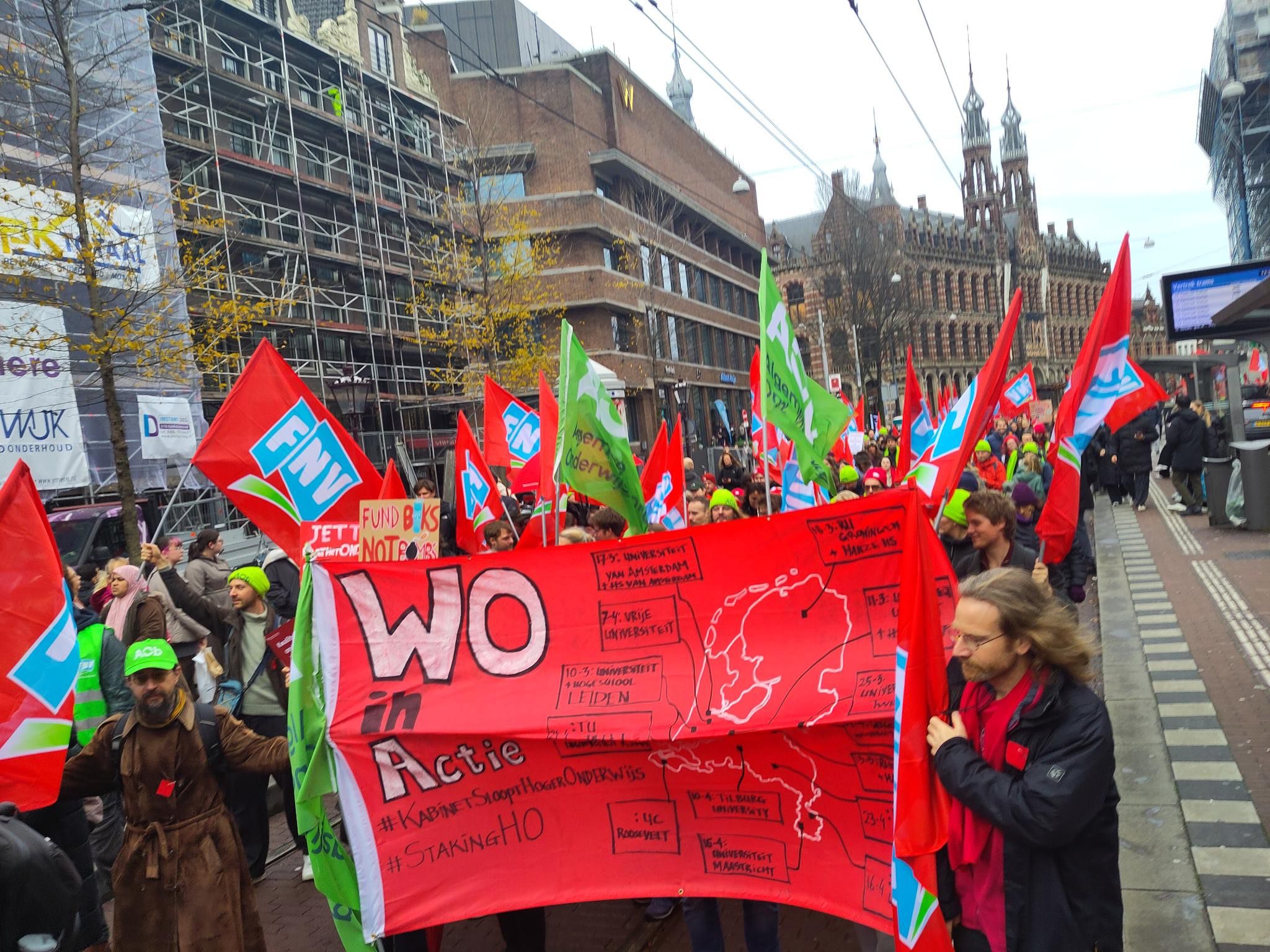 WO in Actie at the demonstration in Amsterdam
Photo: Janosch Prinz
Three politicians also take the stage. They are from the Socialist Party, GroenLinks–PvdA, and — yes — from D66. The distrust is palpable when MP Ilana Rooderkerk (D66) begins to speak. There is even some booing. Only when she says that D66 wants to invest in education and research do the attendees seem to soften a little. She poses next to a sign the organizers bring out: “We will reverse the cuts to higher education,” it reads.
The demonstrators’ distrust is also tied to what the speakers call the “militarization” of higher education. So much money is going to the military — including under D66’s plans — that it will come at the expense of the public sector, several speakers fear. Education must show solidarity with, for example, healthcare and public broadcasting, they warn. “Books, not bombs!”
In the same breath, some activists shout “Free Palestine” and call for severing ties with Israeli institutions, the fossil fuel industry, and American tech companies. Universities should also become more democratic, they argue. “We will choose your successors,” one of them shouts as a message to university administrators.
“Super happy”
Among the demonstrators (though not onstage) is Maaike Krom, chair of the National Student Union (LSVb). She is “super happy” with the turnout. It could have been even larger, she thinks, if everyone had been given the day off. “Some students simply weren’t allowed to miss their classes!”
After all speeches are done, a long procession starts moving. Somewhere a brass band plays, further along there is drumming, and at the front loud dance music blasts from speakers. The march also passes the Maagdenhuis of the University of Amsterdam, which has been occupied regularly since the 1960s but remains untouched today. A small group of demonstrators climbs the steps to the entrance and waves flags, but that is all. There are no incidents.
HOP, Bas Belleman