He was woken up at four o’clock on this particular Tuesday morning. His little boy is eight months old and although he laughs a lot, he doesn’t sleep nearly enough. “Does it get better?” Gabriel Paiva Fonseca, assistant professor and father of two small children, asks in hope. Jenny Schell-Leugers, associate professor and mother of two teenagers, is quick to reassure him: “Yes, it gets better. Although you’ll get other problems in turn, worrying about teenagers!”
Grades
Just about any research done into workloads has shown that younger researchers in particular, in their thirties or early forties, work incredibly hard. What’s more, many start a family at the same time as working on their careers. What does that mean for their work-life balance? In absolute terms, on a scale of one to ten (one being bad, ten, amazing), what would they rate it?
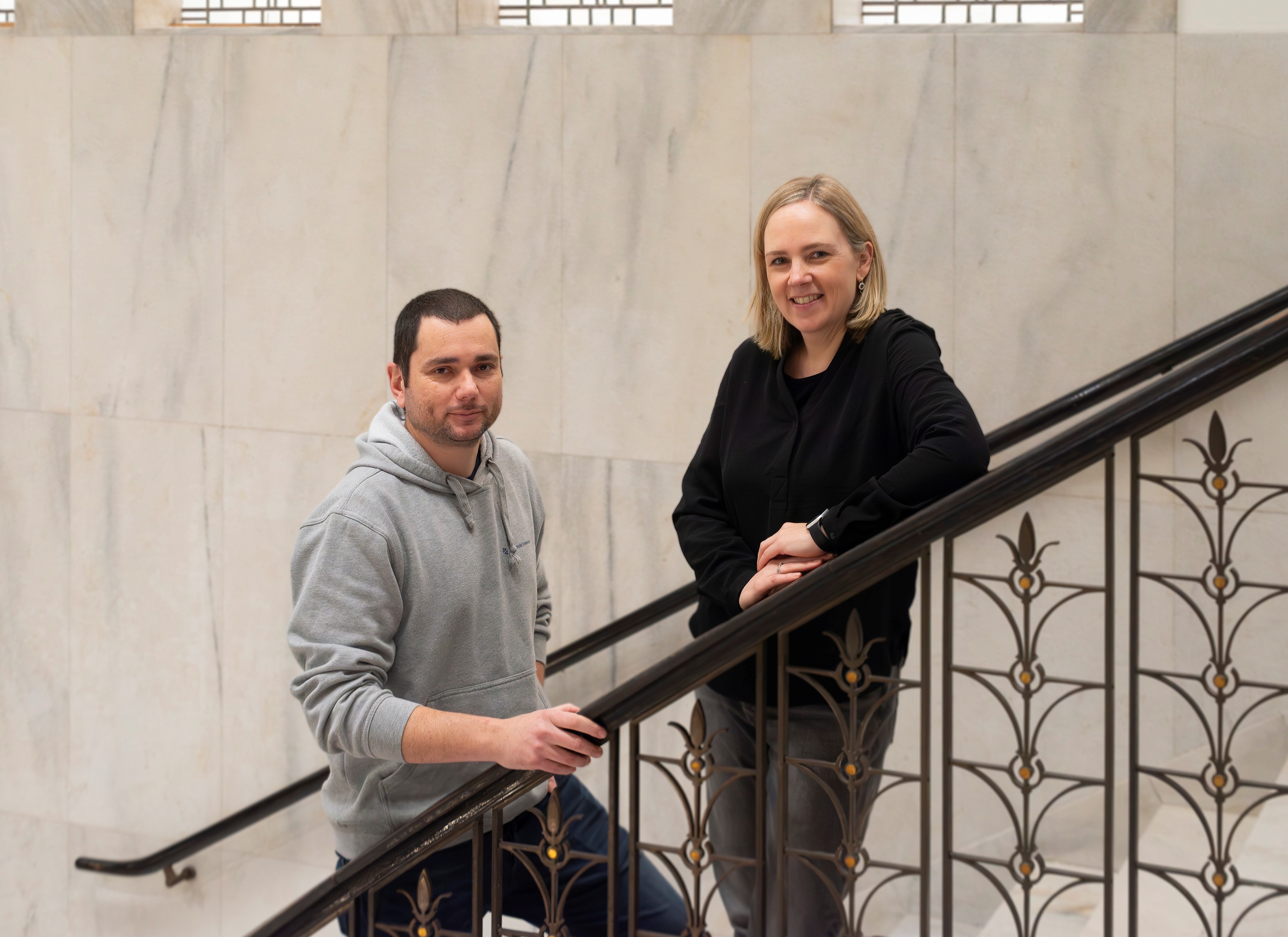 Left Gabriel Paiva Fonseca, right Jenny Schell-Leugers Photo: Ellen Oosterhof
“Either six or seven,” says Pavia Fonseca. “I like working with 3D printers, it’s my hobby. I make drones and toys for my dogs in my spare time.” But he also uses the printers for work. In the evenings, he can often be found ‘fiddling’ with a prototype. “At the MAASTRO clinics, we’re developing and improving radiotherapy treatments. You want to target a tumour with radiation, but you also want to put as little extra pressure on the patient as possible. So I build patient-mimicking devices at home or in the lab, for example lungs that can deform or simulate breathing. Doing that at home, doesn’t feel like work, because I enjoy doing it. I do realise that I need to slow down a bit, especially for my family. They deserve more quality time.”
Schell-Leugers rates her experience lower. “A five. Not terrible, but not good either. Although I used to work more before, every weekend and every evening. For a long time, I didn’t have a permanent contract – I waited six years, I was still part of the old system – and I always said yes to everything. I wanted to show how engaged I was, I’m interested in a lot of stuff, and I felt I couldn’t really say no, because then someone else would do it instead. And there was always that sense of uncertainty, would I be allowed to stay? At a certain point, all you do is work, work, work. I sometimes ask myself how I managed to do it for so long.”
Pressure to perform
What changed? Health problems, being diagnosed with a chronic disease. “It’s a shame that’s what it took to get to that point.” It has been “easier to say no to things” since she was appointed to a permanent and more senior position. “You have more freedom to decide what you want to do – of course, you have to work on grant submissions, there are people working under you, but there is less pressure. I no longer think, if I don’t do this thing, I might lose my job.”
Pavia Fonseca recognises that pressure to perform. “I work in the clinic. Ultimately, my research has to be in service of the patients, which adds pressure, but it’s amazing when it works.” Like Schell-Leugers, he sees a difference between how research and education is valued. The Recognition and Rewards programme (started in 2019) has yet to sufficiently change that. “I like teaching. But then there’s an assessment and they say, your teaching is great, but it mustn’t get in the way of your research. Which makes the teaching look like something I do on the side, whereas it actually takes up half my time. Developing a new module counts for much less than publishing a paper. I work in the clinic a lot, but I think it’s the same in other departments: large grants are celebrated, new courses receive far less recognition.”
"I can still see around me that it’s all about publication numbers and money"
There is a possibility of an associate professorship, but he’s unsure whether he’ll be able to ‘tick’ all the boxes, “you don’t know what aspect they value most. If I want to advance my career, then I will have to compensate the time I now spend on teaching. But that shouldn’t be how it works; it’s part of my job and of the university.”
Schell-Leugers is grateful that she works at an educational institution (UCM), where education is prised more highly in general. But she recognises the problem. “Recognition and Rewards should broaden the focus, but I can still see around me that it’s all about publication numbers and money.”
Parents just around the corner
Although she is at home more, Schell-Leugers believes her children occasionally draw the shortest straws – her husband works even more than she does. “I would love to be there for them more. My daughter had a tough start when moving to secondary school, so I really feel I should be at home in the afternoon. From next spring, I will be working less – 32 hours – and I’m going to stick to that. Thankfully, my parents often help when I’m not there.”
The luxury of having parents round the corner is not one afforded to Pavia Fonseca. “My Brazilian wife is a doctor and does research at the university in Leuven. That’s an hour’s drive from Maastricht; my office is five minutes away by bike. If anything happens with the kids, then I stop working. I don’t have a choice, I don’t have any family here. In the past, I used to work all the time. So did my wife. The birth of our son and daughter has improved my quality of life.”
No time for hobbies
As soon as his children are in bed, at about 19:30, he gets back to work: programming or ‘playing’ with his 3D printer. The television is almost never switched on, although before his son was born, he did train for and run a half-marathon. Does she have any hobbies? Schell-Leugers laughs. “I wouldn’t know what, no time for hobbies.” She gets up at 6:45 every morning. Then she drives from Eschweiler to Maastricht, only returning home by about 18:00. Her parents have often already cooked in the afternoon, which leaves time for her to listen to her two teens and, later on, to answer emails and text messages. She’s often tired by 21:30.
A good example
How do you achieve the right work-life balance? What does it take? “It starts with good leadership,” says Schell-Leugers. “People in charge should serve as role models. For example, today, a PhD researcher came to my office for a meeting, unwell, so I sent them home. And if we want working from nine to five to become the norm, then as the person in charge, you have to set a good example. The young people are not the problem. It’s the older generation who think you can’t be a good academic if you don’t work eighty hours a week.” But there is more: “A good leader gives people their freedom and, more importantly, trusts them. So if a subordinate says, ‘I’m sorry, I can’t do it, it’s too much’, then you believe them.”
She does see that the leadership at UM is improving, albeit slowly: “When I started, people would get shouted at in meetings, that really is a no-go nowadays. I’m glad that we’ve agreed that the position of supervisor doesn’t give someone carte blanche to just do what they want.”
“A good leader gives people their freedom and, more importantly, trusts them"
Pavia Fonseca feels there is also a role here for colleagues to serve as mentors. “In the beginning, I felt a little lost because of all teaching tasks. What’s more, I’m the only one in my group who coordinates courses and teaches. In my first year, I spent so much time running, I asked myself, is this normal? It got better in the second year. After talking to some colleagues who were in the same position, I concluded I had to find my own way. I know that I have to plan carefully and accept that I can’t do everything. Especially now I have two kids.”
Emotional
We have been talking for well over an hour. Are they sticking with their initial assessments of their work-life balance? Schell-Leugers: “I think I was too harsh. I probably gave such a low grade because I always feel so guilty. When I’m at home with the kids and my inbox explodes; at work when I know they’re missing me at home. I’m changing it to six.” To Pavia Fonseca she says, “You really need to adjust yours down, you’re working evenings and weekends.”
He laughs, but sticks with six or seven. “My problem is that it often doesn’t feel like work. I don’t enjoy the paperwork, but then, I don’t work on that at the weekend.” Like Schell-Leugers, he feels he lacks the time to think. “Recently, I had lunch with my boss. He asked after my schedule, saw no empty spaces and was adamant: ‘If you’re going to do research, you have to make time for it. Otherwise you’re merely surviving.’” Thinking is a part of “our work”, they conclude. But it does feel like a luxury, as a waste of time.
Pavia Fonseca says to Schell-Leugers: “Get a dog. Every time I come home from a walk, I feel relaxed. And you have time to think.”
Riki Janssen and Wendy Degens