On two separate occasions, crisis manager Janneke Liebregts had to cancel her appointment with Observant at the last minute because she was urgently needed elsewhere at the university. Is the situation at UM really that serious? Are crises a regular occurrence? No, she says. “In my first six months here, we haven’t had a single crisis. These were incidents I was called in to deal with.” Such matters are usually handled by the university’s safety and security consultant, Frank Vinken, but Liebregts steps in when he is unavailable. “An incident usually affects one or two people”, she explains. It might involve an employee being physically threatened, or a distressed individual intimidating front-desk staff. In such cases, the safety and security consultant is called in. If the threat is psychological, such as workplace bullying or inappropriate emails, the situation – if the victim agrees – is handled by a confidential adviser, a psychologist or the dean of the Concerns and Complaints Point (CCP).
Crisis
A crisis is something quite different, Liebregts stresses. It often affects an entire faculty, service centre, building or even the university as a whole. The question then is whether research, teaching or operations “can continue as usual”. There have been several examples in UM’s history. In September 2009, the launch of a new student management system (Maastricht University Student Lifecycle, MUSL) caused chaos – students without timetables, missing classes and queueing for hours at education offices. In 2020, the university had to close because of the Covid-19 pandemic. In July 2021, exceptionally high water levels in the Meuse River threatened the basements of buildings in Randwyck. And in June 2025, pro-Palestinian protesters occupied University College Maastricht.
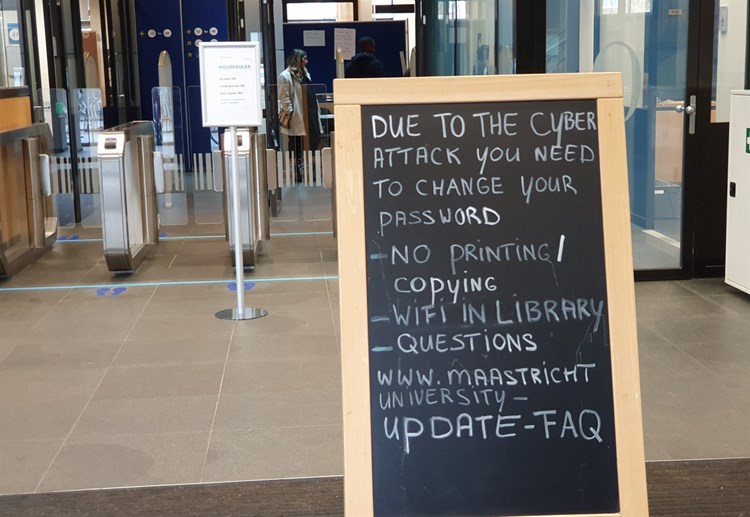 Cyberhack at UM in December 2019 Photo: Observant
Prevention
Liebregts (48) has always felt drawn to crisis management and, in particular, prevention. “You can really make a difference for people.” She has held several safety-related roles at organisations such as municipalities (disaster response coordinator) and Zuyd University of Applied Sciences (integral safety coordinator and crisis manager). What is the worst situation she has experienced? “That’s hard to say. I can’t really single one out. But a bird flu outbreak years ago in a small rural community left a deep impression on me. Even hobby farmers had to give their animals up to be culled. Sometimes their relatives or neighbours, working for the municipality, were the ones who had to collect the animals. It was harrowing. It has stayed with me, perhaps also because it happened at the start of my career.”
Pro-Palestine protest
A key part of her job is risk analysis: identifying potential problems or dangers and figuring out how to prevent them. “You try to anticipate and prevent as many threats as possible, and determine what to do if things still go wrong.” Take the Dies Natalis on 23 January 2026, when Maastricht University celebrated its fiftieth anniversary at the Basilica of Saint Servatius. There were many guests and – making matters particularly complex – several dignitaries in attendance, including the King of the Netherlands. It had also been announced that a pro-Palestine protest would take place near the church at the same time. “The better your risk management in advance, the better and faster you can respond if something does go wrong.” In this case, the event passed “without disruption”.
High water
Prevention is another key element. “When high water levels in the Meuse River threatened university buildings a few years ago, vulnerable equipment was swiftly moved to higher floors and sandbags were put in place.” Later, barriers were installed so that equipment would be protected in the event of future flooding.
Every crisis involves competing interests. “In the event of a major power outage, how do you decide which areas get emergency power first? The lab where tissue samples are being studied, or the Einstein Telescope project? Conflict management is always part of my job as well. But the best part is working together to find the best possible solution.”