“Are you ready? Then let’s do the exercise again.” A sweaty badminton player, covered in dozens of sensors, starts her next set of short sprints involving a 180-degree turn. Followed swiftly by a series of dozens of little jumps. Cameras on the ceiling capture every movement, sensor plates in the floor measure the force of her movements. To the side, a small cluster of PhD researchers and students watches all the data stream in on large screens and tablets.
Bas Van Hooren watches on beaming. This is one of the thirty team athletes – including football, volleyball and basketball players – he and his team have welcomed to this ‘sports hall’ filled with technology at Universiteitssingel 50 over the last few months. There is a similar room a few doors down with a treadmill, visited by dozens of runners, “from beginners to Olympians”.
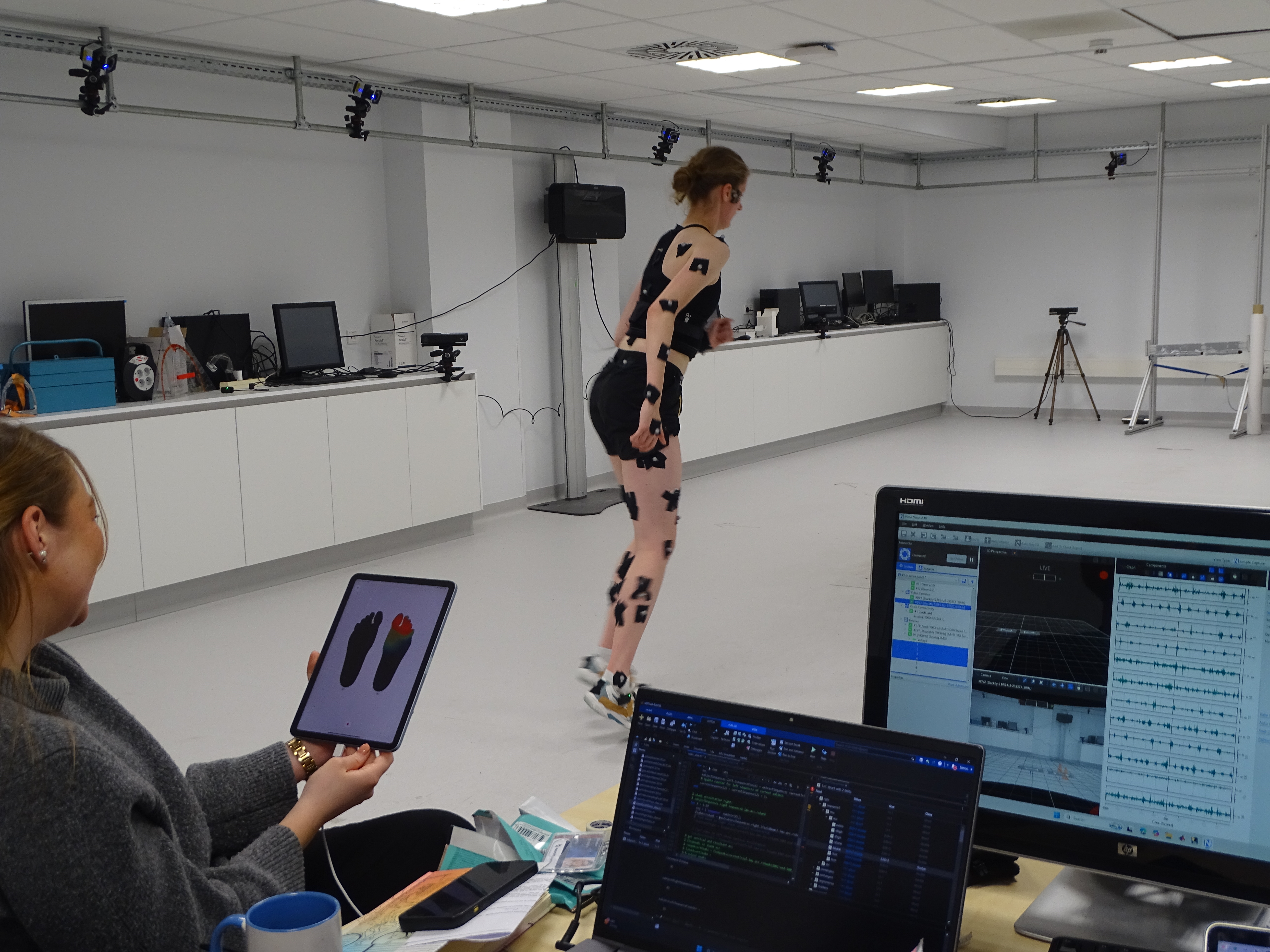 Cameras and sensors track the movements of a badminton player in the UNS50 'sports hall'. The tablet on the left displays the measurement data from the smart insole she is wearing. Photo: Observant
The aim is further development of ‘smart’ insoles. “They can be inserted into your shoes or trainers and contain sensors that measure the pressure, acceleration and position of the foot for each step,” says Van Hooren. A company from Eindhoven introduced the product years ago, but it wasn’t a great success. Not that strange, says the researcher, as by itself, the measurements taken by the insole don’t tell the average person much. They need easy-to-implement advice, such as ‘take smaller steps, because you are putting too much pressure on your knees at the moment’.
Van Hooren knows there is a demand for that, as a runner himself – not a bad one either, he has medalled at a number of national championships, including gold on the 3000 m indoors in 2017, and came eleventh in the European championship half marathon last year. “When you run, you stress your body in two ways,” he explains. Firstly, by using energy. “That is fairly easy to estimate yourself, by paying attention to your heartbeat and breathing. That is what ‘smart’ sports watches and apps try to measure, too.” But you also stress your body mechanically: the constant force and impacts your muscles, tendons and bones have to absorb. “You don’t really notice that until it’s too late. I know all about that, I’ve had just about every ‘popular’ injury. It would be of tremendous help if you could monitor that mechanical stress.”
Less injuries
And so, in 2019, when he started as a PhD researcher in Maastricht, he decided to “further develop” the product launched in Eindhoven. His main question was: using the ‘simple’ measurements taken by the insoles, can you determine the extent to which, for example, the hamstring, Achilles tendon or knee are stressed during, say, a run or a game of football? That’s where the athletes in the lab come in: they’re wearing the smart insoles while they’re doing the exercises. “Those insole measurements can then be linked to the extensive data we collect using the sensors and cameras. That way, we can try to find connections and develop models which use the data from the insole to estimate what is going on in the body.” So that eventually, athletes wouldn’t need complex machines to gain those insights, just the insole.
With his PhD research, Van Hooren proved that the idea had merit. He sent out over two hundred amateur runners, armed with the insole and an app with one of the early versions of his models. “Half the group received instructions from the app to change their movement in the case of overexertion during the run, the other half didn’t. After six months, during which time the runners went on at least two runs a week, the first group had sustained half as many injuries.”
Too cautious
He wants to use the measurements taken over the last few months to improve his models. “So we are now also looking at athletes in team sports, who move very differently, including jumps and quick changes of direction.” Furthermore, he hopes to prevent not just sports injuries in the future, but also explore the use of the insole when rehabilitating from those injuries, or even other conditions. “It can be used to help prevent overexertion, but also under-exertion, as it were, because people are too cautious. That is a factor in cases of arthritis, for example.”
Another question is: is it possible to tailor the insole to a particular person? “We estimate the force exerted on the muscles, tendons and bones. But how exactly these forces are absorbed depends on factors that differ from person to person, for example, how stiff the tendons are and what the diameter of the bones is. In an ideal case, you would take that into account to improve the advice given. We’re currently looking at whether that is possible without measurements from expensive machines. Because otherwise it may be of interest to top-level athletes, who have access to those sorts of facilities, but it would be useless to the average person.”
Messi
Van Hooren hopes to have improved models within the next six months, which could be “implemented in an app” in a year. Is this not just helping the commercial party that developed the insoles? “I understand how you could interpret it that way, but from a scientific point of view, this is a huge learning opportunity. And if it works, other companies could use the models too. That way the results don’t just end up in a drawer somewhere, they would make their way into the real world.”
When might we expect to see these insoles in shops? “I hope soon, but that depends on the companies. They’re also the ones who will choose whether to market this to amateurs or professional athletes. Real-time instructions about your movements would be of particular interest to the former; professionals have often already perfected their technique. They would get more out of advice about training programmes. For example, ‘You are in danger of causing injury through overexertion, consider skipping that intensive exercise or match.’ That’s what we are working on at the moment. We’ve noticed that a lot of sports teams are interested. It’s valuable, if it means you can minimise the chances of your ‘Messi’ tearing their ACL. I could imagine that as a possible future: every professional footballer wearing one of these insoles. Although I do hope that amateur athletes and patients will also benefit from it, as that’s a much larger group.”