The protesters must vacate the premises: that was the only thing that mattered to the Executive Board on Thursday, 2 April. At about eight o’clock in the morning, twenty activists from the group Maastricht4Palestine occupied the building on Oxfordlaan in Randwyck. According to spokesperson Koen Augustijn, only a few employees were on the premises at the time, including the receptionist. They were requested to leave the building by the protesters, who wore face coverings to avoid being recognised.
Among the occupants of the building at Oxfordlaan 55 are the Faculty of Psychology and Neuroscience, businesses from Brightlands and Scannexus. Coffee bar Banditos is also located on the ground floor. From the outset, there were major concerns regarding the dangerous situation because of the scanners at Scannexus, a 3T, 7T and 9.4T. The T stands for Tesla, which measures the power of the magnetic fields produced by a scanner. The stronger the scanner, the more detailed the images produced.
A scanner facility can be dangerous for people who don’t know what they’re doing, the Executive Board said last week. There are coolants such as helium, but crucially, the scanners have powerful magnetic fields. Anybody who approaches one with metal tools, a fire extinguisher or a metal (belt) buckle, will notice the intense pull the magnet has on the metal object. With possible consequences not just for the person, but also the machines. The scanners are always on. If a metal object ‘sticks’ to the machine, they have to be turned off, which affects the quality, according to insiders. Worst case scenario, this means expensive repairs.
Clues
Incidentally, the protesters posted a message on their Instagram account on Thursday morning, saying they were aware of the risks posed by the scanners and that they “had conducted thorough research into the occupied facilities and were trained in MRI safety”. Nevertheless, the Safety Region, including Maastricht’s mayor Wim Hillenaar, declared a GRIP 1, a procedure for high-risk incidents requiring cooperation between the emergency services. Consequently, there was a significant police and fire brigade presence.
It is unclear whether the activists actually got anywhere near the scanners. Anyone entering Oxfordlaan 55 cannot simply walk straight in. Enquiries with a number of UM staff members reveal that there are several doors there, at least one of which requires an access pass. According to rector Jan Smits, there are “signs” the activists entered the Scannexus annexe. There was “almost no damage” to the MRI scanners, president Pamela Habibović told the ‘Strategy’ committee members on the morning of Wednesday, 8 April. The occupation was otherwise treated as confidential.
Police report
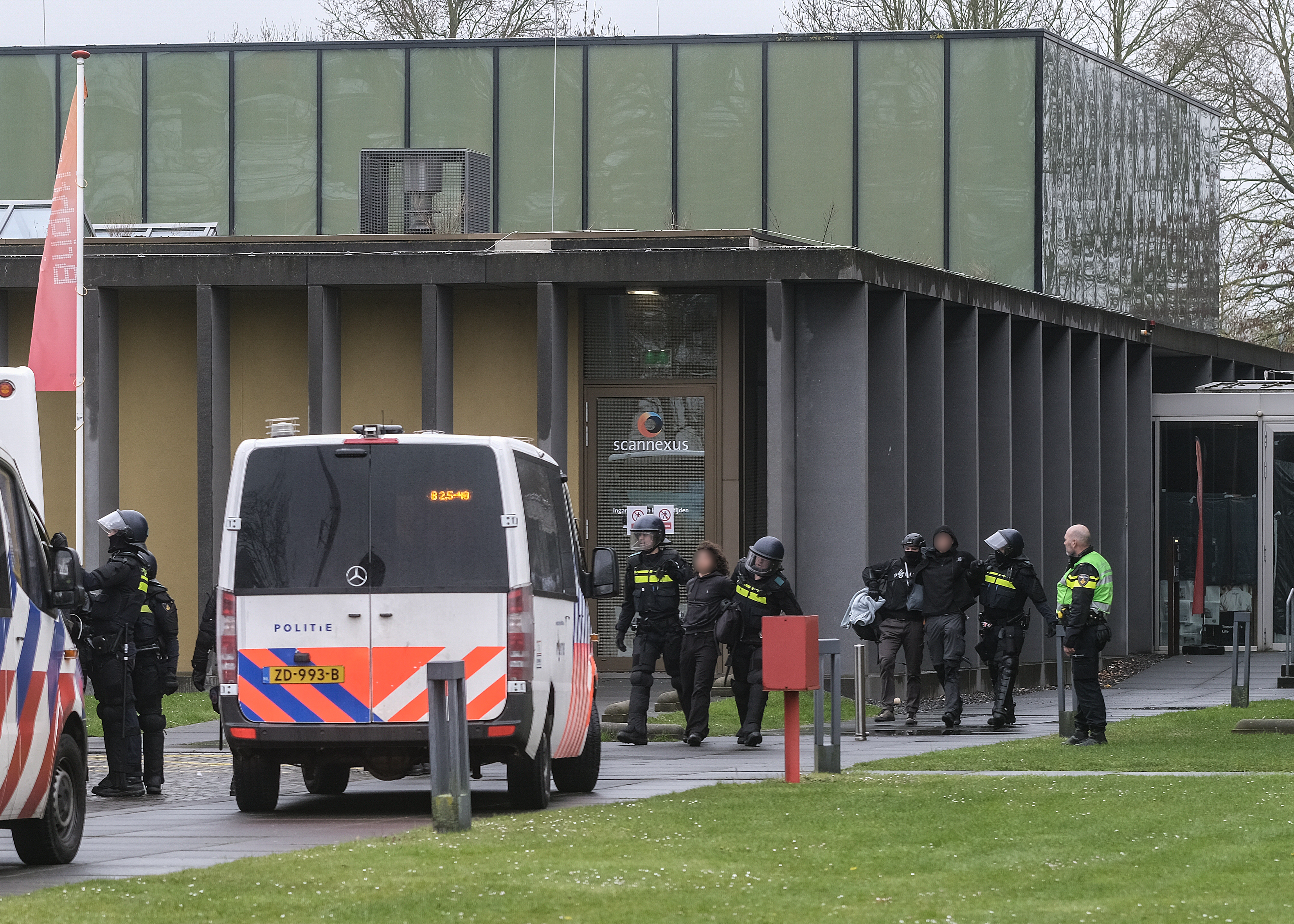 Activists get arrested by the police
After the Executive Board had twice ordered the protesters vacate the building, UM reported the unlawful entry to the police and the riot police put an end to the occupation at around five o’clock. The building was cleared, activists were arrested and released the next day, pending investigation by the Public Prosecution Service.
Was there no attempt at mediation? Yes, confirmed rector Smits, initiated by UM employees, who after contacting the group, wanted to talk; however, they were unsuccessful. The priority was vacating the premises, acknowledged Smits. There was no substantive discussion of Maastricht4Palestine’s demands. What are those demands? Amongst other things, that the termination of a lease agreement with Aroundtown, for a building on Paul-Henri Spaaklaan. They also feel that UM should be more transparent about any ties it forms with Israel.
“Absolutely unacceptable”
In June of last year, students occupied the University College Maastricht in the city centre on behalf of Maastricht4Palestine. Police ended that occupation the same day. Protesters were arrested and taken away by bus, before being released; they were never asked to identify themselves. Why were people identified this time and might now face prosecution? According to the administrative and communications adviser for Mayor Hillenaar, that was decided (by the local security triangle) because of the “risk of endangerment”, referring to the dangerous situation.
It is unclear whether there are any UM students among the activists. And it is also uncertain whether that will become clear. Can the police or the Public Prosecution Service pass on names to a university? Rector Smits couldn’t answer that question.
In The Hague, where former UM-president Rianne Letschert is now Minister of Education, the situation in Maastricht was discussed during a committee meeting on Thursday afternoon. René Claassen of the Markuszower Group asked whether she had been in contact with the university; he described it as a matter causing “complete disruption”. Letschert said she found it “absolutely unacceptable” for people to occupy the university, especially “in an environment with potential security implications”.