He dug them out of every nook and cranny imaginable: from a poster (to recruit students) to a trowel (used to place the first stone of the scanner building at Oxfordlaan 55) and a baton belonging to the conductor of the university choir. Some objects had been lost out of sight, out of mind, gathering dust in the attics and dark basements of the faculties. For example, the table where, in 1976, Queen Juliana signed the founding charter of what was then the State University of Limburg. It has only been on display in a place of honour in the Law Faculty for a decade or so, before that it stood in a forgotten corner somewhere. It should be noted that the table didn’t make the cut for the book; the chair the sovereign sat on did.
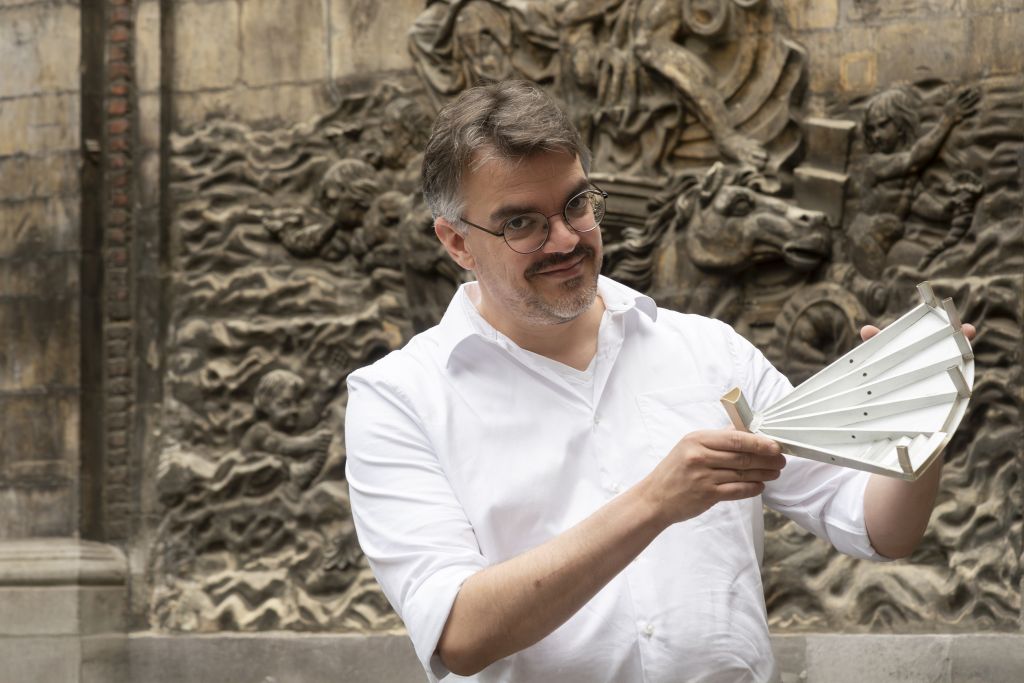 Bart Zwegers with a model of the Palmzaal, the lecture theatre at the School of Business and Economics designed by architect Jo Coenen
Photo: Ellen Oosterhof
And Zwegers was forced to make more choices like that over the two years he spent compiling the book in honour of the university’s golden jubilee. The result is Vijftig [Fifty] – 120 pages, a wine red cover, filled with large photographs of all sorts of objects and their stories. It’s something a bit different, acknowledges Zwegers. “Objects are a very good way to tell stories and to make history more tangible, it makes it recognisable for people,” he says, explaining his choice for the form and content.
“Ten years ago, during the 40th anniversary, the history of UM was already set down using conversations with pioneers, the people who made it all possible in the beginning. That was also the result of a slight sense of urgency, as this might be the last chance to speak to them and record this immaterial heritage. I didn’t think it would be suitable to do it again.”
Manageable
His idea may not be original, Zwegers knows, but it is engaging. Admit it, if you flick through a book and land on a picture of a bin, you’d be curious. It’s blue, stamped with the words 'Rijksuniversiteit Limburg', a perfect hook to tell the story of the start of the academic history (and that of the corporate identity that some people hated). As with all the other objects, Zwegers trawled through the paper archives to tell that story. He turned seemingly endless historical record into manageable stories.
Don’t expect the book to be a neat chronological record of the development of the preeminent academic institute in Limburg’s capital, the conservator is quick to add. Nor has he tried to find a special object for each year, either. “It was once written in a book on capitalism that the average person in Western Europe owns 10,000 objects. So, just imagine what that means for a university with over 20,000 students and 5000 members of staff. You’re talking about millions of objects.” It also means that selecting the objects was sometimes a matter of personal opinion. “There is a certain amount of personal preference.”
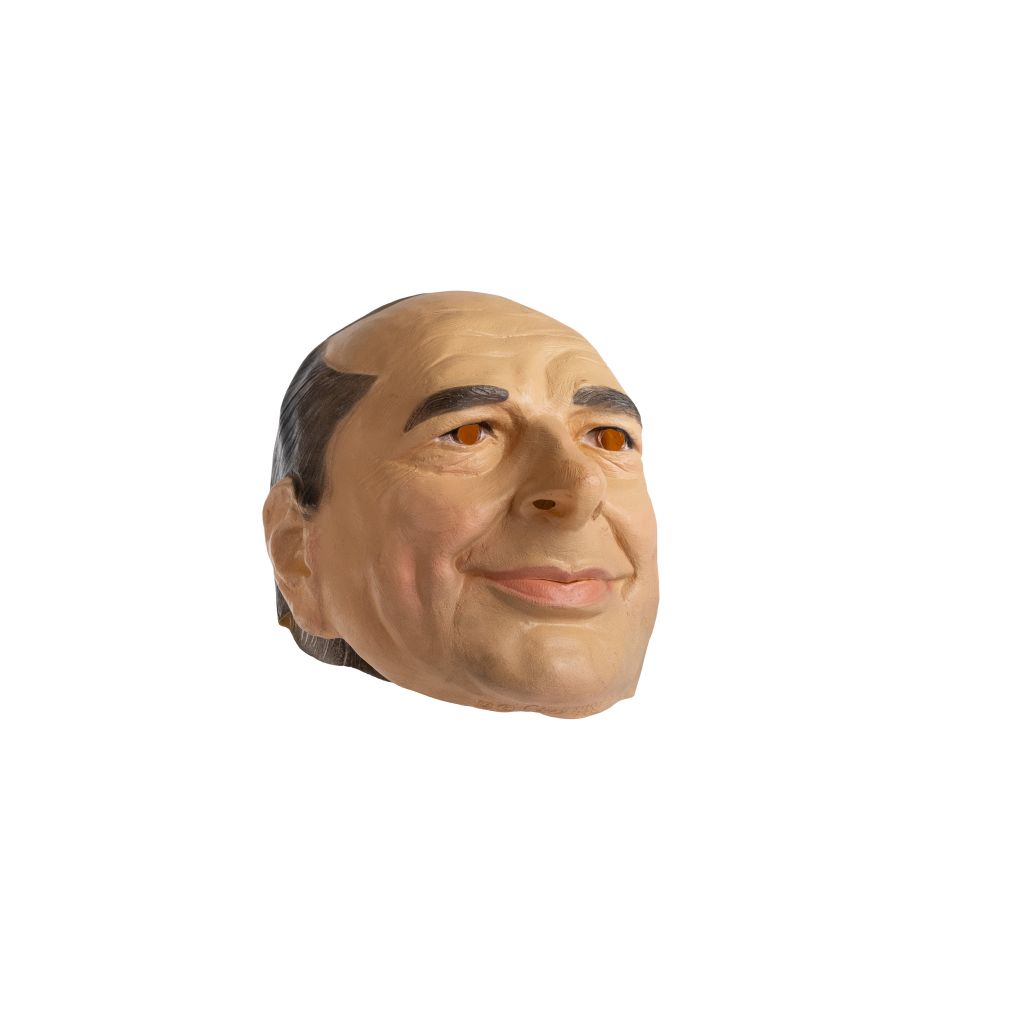 The Jacques Chirac mask used in the ‘barlab’ at the faculty of Psychology and Neuroscience
Almost pulled the plug
Zwegers did not work on the book entirely alone. He consulted with colleagues, former colleagues, alumni, and building managers to get as complete a picture as possible of the university’s history and everyone and everything that played a part. So there is a picture of a front cover of university magazine Maffius, the forerunner to Observant, of the chain worn by the Rector, and of one of the oars used by student rowing association Saurus, used as a hook to expound on the history of student sports at Maastricht. A tape with the UM logo, used for covid protective measures, is also included, as a reminder of the way a global pandemic brought everyday life to a standstill, only a few short years ago. As is a bust of Arie Pais, the Minister of Education who, in 1978, ordered an investigation into whether the university should be disbanded – he had doubts about the scientific level in Maastricht.
But among the objects included in the book is one decidedly odd duck – object number 44: the mask of Jacques Chirac, President of France from 1995 to 2007. What was his connection to Maastricht? “It is the weirdest object I found,” laughs Zwegers. It was used in the so-called ‘bar lab’ at the Faculty of Psychology and Neuroscience, a lab made to look like a typical pub, used for experiments involving alcohol consumption or social interaction. As part of research into dissociative amnesia, the phenomenon where people claim to have no memory of particular details after a traumatic incident, participants were told to knock down a murderer. “With a pool cue. The murderer was a life-sized mannequin wearing a mask of Chirac, don’t ask me why.”