The last time a Saurus crew took part in the regatta by the town of Henley-on-Thames was in 1999, says competition commissioner Isabelle van der Meij. She hadn’t even been born yet, but she knows exactly how remarkable that achievement was then – and still is now. “I can’t wait to see what it’s like there.”
From 30 June, rowing clubs from all over the world – both student and non-student – will compete in various events on the Thames. Since 1839, the river has been the setting for fierce competition. The highly prestigious regatta was long considered the unofficial world championships in the world of rowing. “You can compare it to the Champions League”, says coach Michał Dudek. “There will be rowers and clubs from all over the world – the United States, Australia, New Zealand. And we get to compete with them.”
Experience
According to Van der Meij and Dudek, Saurus owes its return to competing at the highest level to a combination of new talent and the continued development of rowers from earlier cohorts. “We’ve got someone on the crew who’s been rowing with us for three years, but also a first-year student from Italy who has competed in the World Rowing Junior Championships”, says Dudek. He oversees strength training for the rowers, who have been performing strongly all year – so strongly, in fact, that they do not have to compete in the qualifying races.
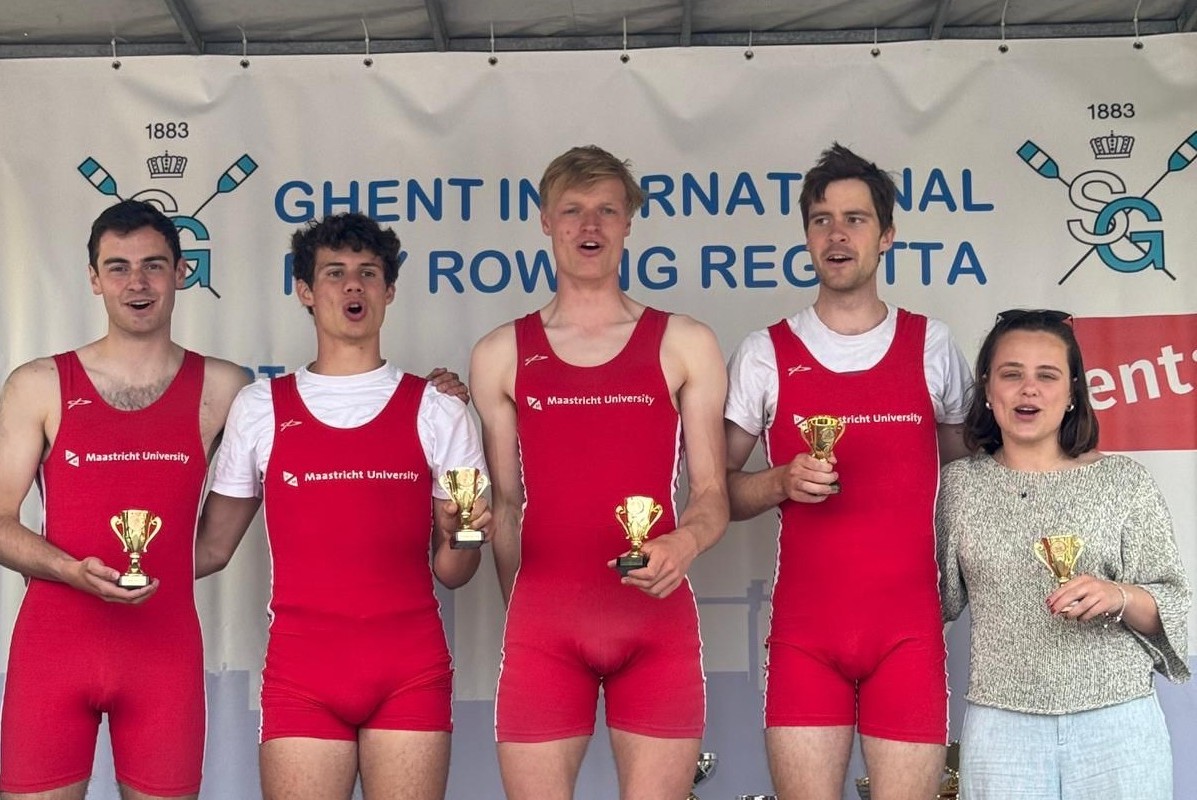 The Saurus crew, on the podium at the Ghent International May Regatta. From left to right: Lars Hochstenbach, Michele Zampaglione, Laurens Steijger, Christian Klein and coxswain Nele Olejnik.
Photo: Michał Dudek
That privilege is reserved for a select few. In the student category alone, 44 boats have entered, only twenty of which will advance to the main tournament. The Saurus crew is one of the lucky ones; the remaining places still have to be fought for. “The Henley organisers look at how you’ve performed this year compared with other crews that will also be racing. We clearly stand out”, says Van der Meij proudly. “We’re showing ourselves on the international stage again. This proves we can do it and belong there. It shouldn’t be an exception, but the rule.”
Once on the water, the format of the regatta is simple: two boats race head-to-head over a course of just over two kilometres (2,112 metres, to be precise). The winner goes through; the loser goes home.
Unpredictable
“We start on Wednesday and race once a day. One crew drops out each round until the final on Sunday”, says Dudek. He refuses to make any predictions: “We know who the strong crews are and what we are capable of, but there are so many factors outside our control – the weather, the current. We’ll just give it our all, every race.”
The hope is that, in over a week’s time, Saurus will stand on the top step of the podium and earn a place in rowing history – something the Maastricht crew failed to achieve 27 years ago. “We’ve been in touch with the men who competed back then, and spoken about their experiences”, says Van der Meij. Their advice will be passed on to the rowers before they leave for England. “We’ll see them off with drinks at the club on Thursday.”