A group of archaeologists and AI experts discuss a gaming die. It sounds like the opening line of a joke, but on this sweltering Thursday afternoon, it is a serious attempt to better understand historical board games. As temperatures soar outside, nearly thirty researchers from across Europe have gathered in an air-conditioned room in the Faculty of Science and Engineering building on Paul-Henri Spaaklaan. The games they discuss at length include Pente grammai – highly popular in ancient Greece – and the Roman game Ludus duodecim scriptorum, a possible forerunner of backgammon.
No, they won’t be playing the games themselves today, laughs Dennis Soemers, assistant professor and co-organiser of this two-day meeting of the GameTable network. “But that did happen at an earlier meeting. The archaeologists gave the AI researchers historical games without explaining the rules and said, ‘Just play and see what you can come up with.’” The exercise was intended to give them a better feel for the subject they are studying, explains Soemers, who has a background in AI himself. For the real work, however, computers are much more efficient. “It would simply take far too long to have people play hundreds or thousands of games in order to test different rule sets.”
Sense of drama
That is precisely why AI experts have been involved in this research. The rules of many board games from antiquity and the Middle Ages have been lost, either partially or completely. “But they can tell us about how people lived back then”, says Soemers. AI can help reverse-engineer the rules. “It’s not a time machine, but it can give you an idea of how plausible certain rules are. You can prompt AI to play a game over and over again using a particular set of rules, which generates statistics. If a game tends to end after a single move, or if it’s immediately obvious who’s going to win while players still have to make five hundred moves before the game is over, you probably haven’t got the right rules. The same applies if the first player always wins, although context matters – if it was an educational game played by parents and children, that might make sense. Or take the sense of drama: can a player recover from what looks like a hopeless position with a clever move? We enjoy that today, but did people in other cultures feel the same? The same question applies to aspects such as how much luck is involved.”
But where do you start? Which rules should you have your AI test? It’s usually quite a puzzle, explains Soemers. Archaeologists often have different hypotheses based on the available evidence, which can be quite limited. “In some cases, fragments of descriptions survive, sometimes in poetry or stories – for example, when someone’s behaviour or decision is compared to a certain move in a game, or a lucky break is described as a particular throw of the dice. In other cases, a game board has survived reasonably well and you can still see the markings. The amount of information varies enormously from one game to another.”
Common origin
Historical context – culture, region and time period – can also provide valuable insights. That’s why UM researchers, supported by EU funding, launched the Digital Ludeme Project in 2018. The aim was to create a database of every known board game dating from before the Industrial Revolution. “That allows you to identify broad patterns. No such overview existed before”, says Soemers, who worked on the project as a PhD student. It resulted in a collection of more than a thousand historical games.
In the database, a label is assigned to every known aspect of a game. This may include the shape of the board, whether dice are used, and the victory conditions – such as being the first to form a line in noughts and crosses or Connect Four. “Next, you get the computer to look for patterns and relationships. Did certain types of games occur frequently in particular cultures? Which games may share a common origin? In theory, this could even reveal evidence that certain cultures were once in contact with each other. A well-known example is the fact that in both Asia and pre-Columbian Mesoamerica almost identical boards are found for a game similar to Ludo [the games Pachisi and Patolli, respectively]. Some say this is evidence of contact between them. But we’re not quite there yet.”
The database has already proved useful in reconstructing lost rules. “If all you have is a game board and no rules, the AI can search for similar games from the same time period, region or culture and test different rule variations. That generates far more hypotheses than an archaeologist could come up with alone.”
Roman stone
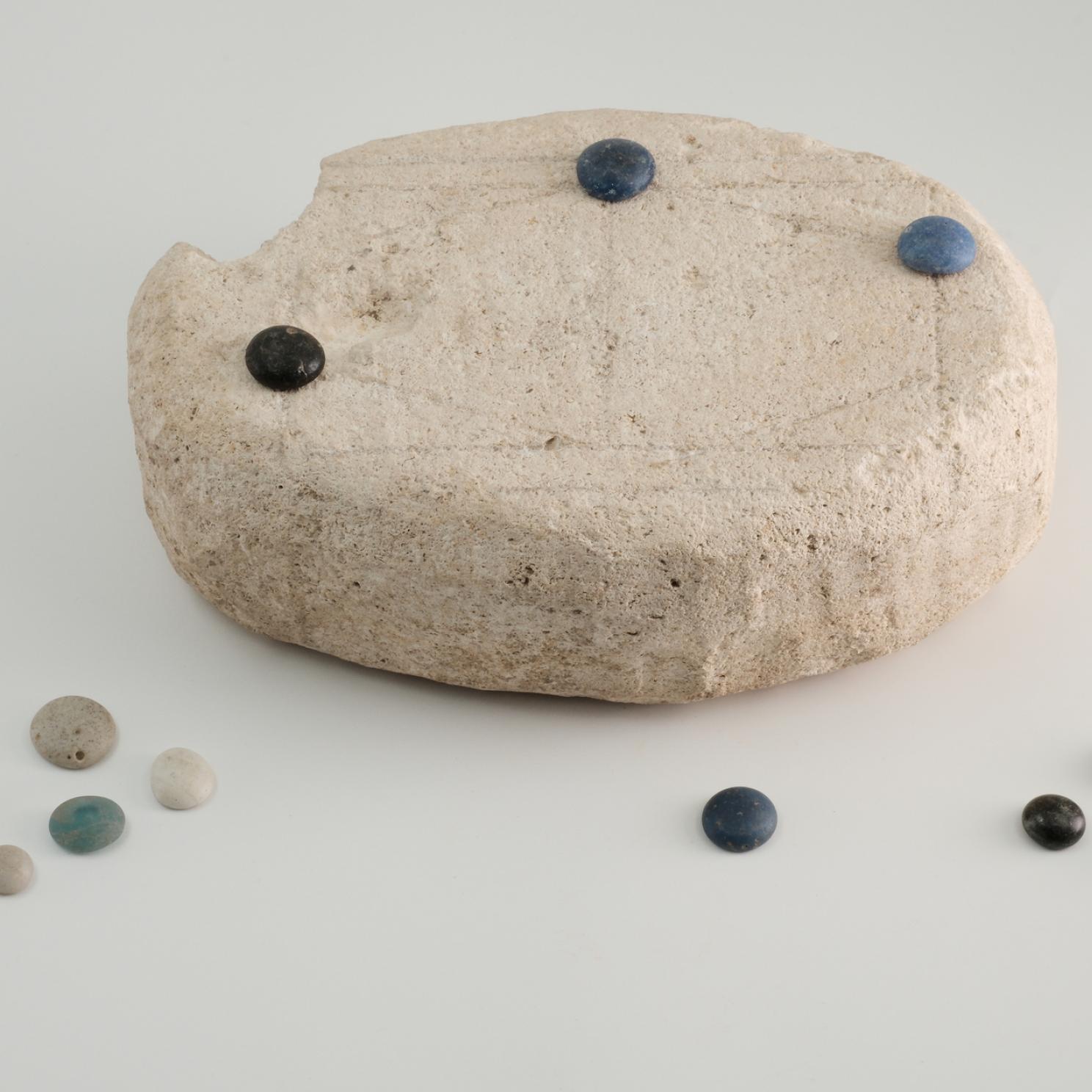 The Roman stone with markings, found in Heerlen, that the UM team helped decipher. Image: Het Romeins Museum
The UM team has already studied several games. Perhaps the best-known example is a circular stone with markings from the Roman era, discovered in Heerlen. It was long unclear what it had been used for at all. 3D scans revealed that some markings were slightly deeper than others, suggesting that playing pieces – often made of hard materials such as glass – had been moved repeatedly across them, indicating frequent moves. Using the database, the AI generated dozens of possible rule sets, some of which produced enjoyable gameplay. Nine rule sets matched the wear patterns on the stone. Although Soemers stresses that this is not definitive evidence, the discovery attracted considerable media attention earlier this year. “The great thing is that children can now play the game in museums – a fun way to connect them with an ancient culture.”
If one thing becomes clear during the GameTable network meeting, it’s that many historical games still remain shrouded in mystery. Soemers can name several games he would like to run his algorithms on, including Senet and the Royal Game of Ur, which were popular in Egypt and Mesopotamia thousands of years ago. “Archaeologists are very interested.”
But that will take time – and therefore funding. The Digital Ludeme Project came to an end in 2023, with GameTable as its informal successor. “In the sense that we can organise meetings like this, where we discuss ideas for future research. There are quite a lot of researchers from different disciplines in the network. But to take things further, we need more funding.”