Lucie Rauschnabel sits on her bed, with tears in her eyes. She looks directly into the camera and whispers: “I’m so fucking scared to go to college and actually be alone. I just want to be happy.” Cut. The wind rushes through her hair as she rides her bike through the streets of Maastricht with a big smile on her face. Cut. She toasts with a glass of Aperol Spritz, which glitters orange-red in the sun. Cut.
This short video is one example of the many videos that the 20-year-old University College Maastricht (UCM)-student shares every day on Instagram and Tiktok. Most of them are about feelings, about the sad and the beautiful, about living the moment. Within a few months, since setting up her account in January 2023, Rauschnabel has gained over 180,000 followers with her daily posts – a remarkable number. “I love this job”, she says. “The creativity, the filming and editing. It’s great. And sure, I also earn money with it. How much? Well, I could pay my rent with it.”
Loneliness
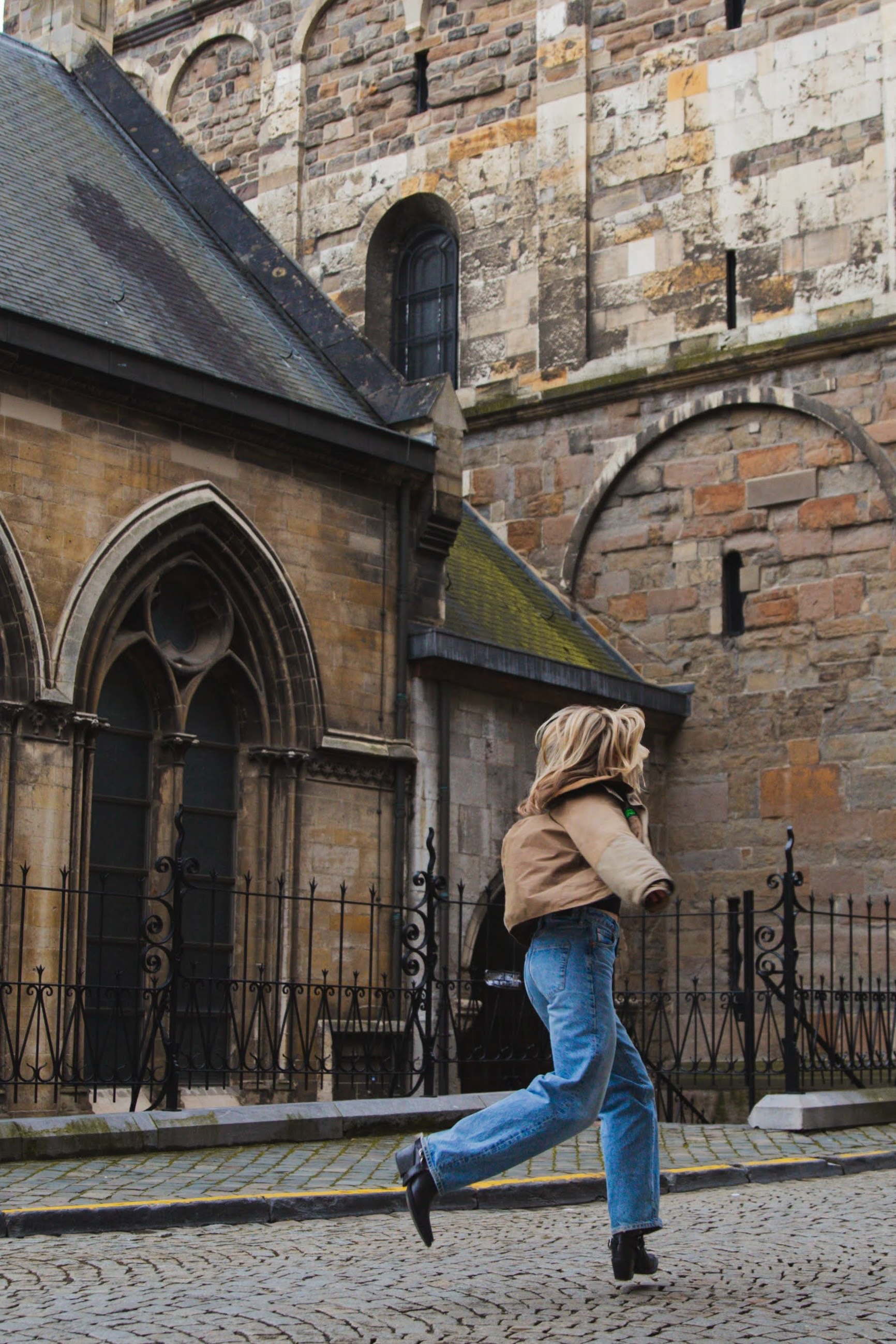 Lucie Rauschnabel in Maastricht, near the Vrijthof, passing the Saint Jan church. Photo: Spencer Morecroft
Maastricht city centre, on a rainy Tuesday morning in April in Rauschnabel’s apartment, which also serves as the backdrop for many of her videos. Bare walls, a glass table, a portable minibar. She grew up in the suburbs of New York, did seven years of competitive rowing in her youth, and was on the path of getting recruited for a training programme for professional rowers. But Rauschnabel had enough of the sports. “Then I thought, why not study in Europe, with all the English-speaking universities here. But finding the right one wasn’t that easy.” Rauschnabel eventually came to UCM through the agency “beyond the states”, one of many that helps Americans with finding English-taught study programmes in Europe. But once in Maastricht, the initial anticipation was gone: “It all went so fast. I found myself far away from home, with no friends, lonely. I missed them really much, also my boyfriend, who stayed in the US. I nearly wanted to go back.” But she stayed, and started to share videos of her everyday live in Maastricht - when doing groceries, at the gym, at university. And about being scared of the drastic change, as she moved from the US to Europe. “I wanted to inspire others to move to a different country and follow their dreams as well. Even if it is scary. I wanted to show them the light at the end of the tunnel.”
Her social media-accounts became a business eventually when she realized that the Instagram-page of “beyond the states’’ had a massive increase of followers after she tagged them. ”I told them: it seems to come through me. We should work together, you could reach so many more people.” From then on, having a side income through her cooperation, she refined her content: what was well received, what were people less interested in? “For example, I don’t post much about my studies because my followers don’t follow me for that. I’m a decent student, it’s however not my focus.” But healthy eating and exercise the more: “I want to inspire others to take care of themselves, mentally and physically.”. Within months and with increasing numbers of followers, more companies came forward: from cosmetics to all sorts of apps. And it seems to pay well.
‘Sugar babe’
But are there also less bright sides to this job? “Well, I can't take a day off. Never. And the direct messages I get are sometimes unbelievable.” Dozens of strangers message her daily on Instagram and Tiktok. “There was a lot of hate when I moved here, Dutch people saying that I take away their housing and should go back to the US. And some people are also looking for a ‘sugar babe’ or make sexual comments. They’re blocked straight away.” On the other hand, Rauschnabel feels sorry for people who message her on Instagram and want to go for a coffee or even be friends, but don’t know her in real life. “I would love to, but I can’t be friends with everyone online. And I’m feeling bad about it. I prioritise making friends in real life.” For the next years, Rauschnabel will be busy with ‘building her brand’, as she calls it. “I want to grow, create a valuable and respected brand, something long lasting.” What exactly will that look like? Rauschnabel has some ideas, but doesn't want to read them in Observant. “I want to keep them private, for now.”
Story behind the story
Wout Voorderhaak (22), second year student of medicine, is also an influencer alongside his studies. But in contrast to Rauschnabel, his accounts are exclusively about learning tips. In his videos, he is almost always sitting at a tidy desk, with plants and a humidifier in the background. Sometimes learning techniques are in the focus, other times it’s the ideal weekend planning for studying. It never becomes truly private, and feelings don't play a big role here either. Voorderhaak is another type of influencer than the UCM-student, produces for another ‘niche’, as the specific interests of followers are called. But with all the differences, there is an important parallel to her: the story behind the story, in this case: follow your own path. “I always wanted to be a doctor, but had to fight my way into university. I kept standing in front of closed doors. But I fought, and now I am in my second year of studying medicine”.
Lot of fun
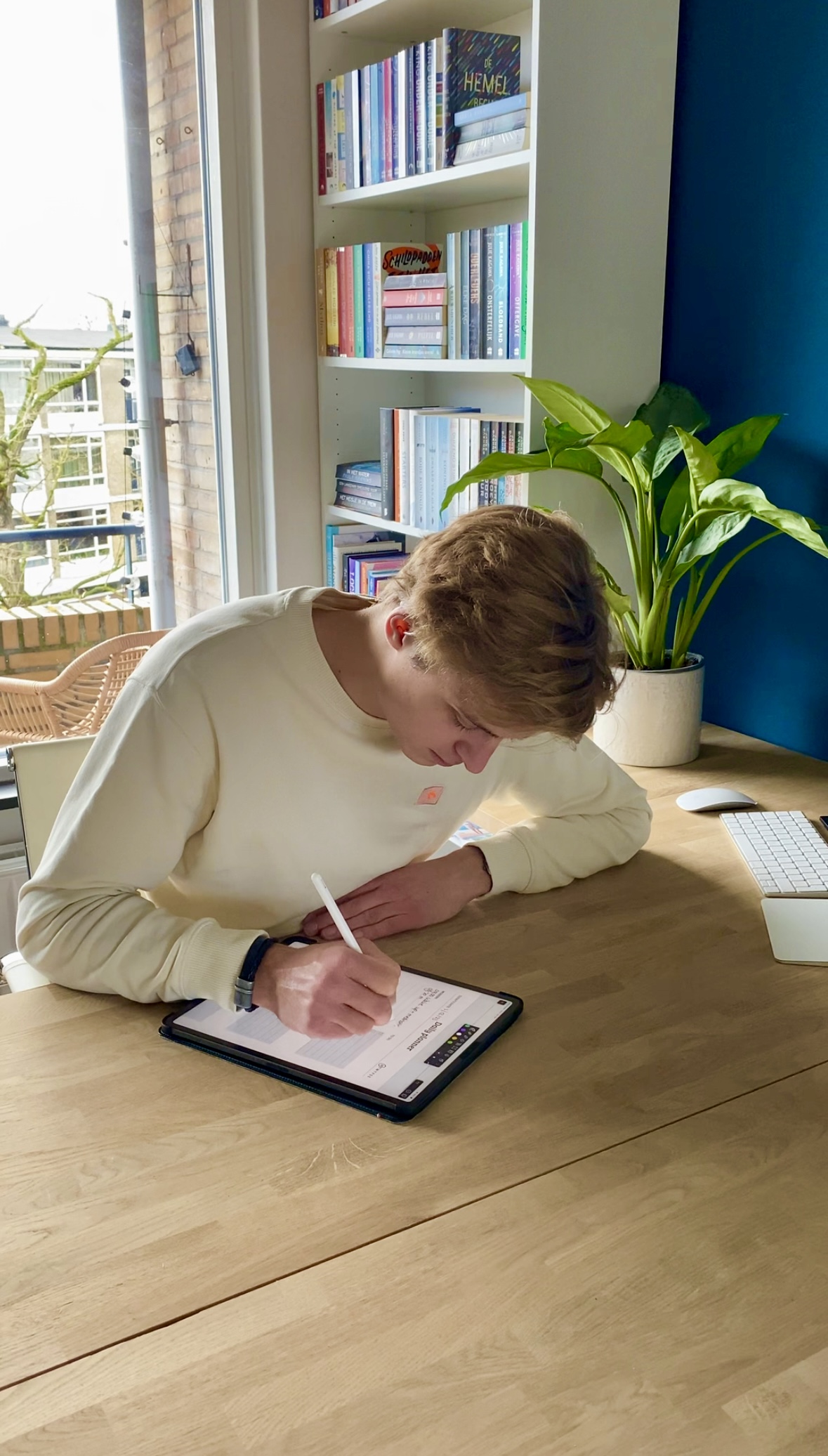 Wout Voorderhaak sitting at his tidy desk
Isn't it difficult to keep coming up with new content, if your account is just about studying techniques? Not for Voorderhaak. He has been running various accounts on other topics (also motivational accounts, but without showing his face, and with no small success) for the past five years, and has a lot of fun with this one. “It also gives me energy to get reactions from people who I can help to get better grades. And I learn from it myself, it helps me to study more and better as well.” Here, Voorderhaak refers to his study sessions, where he invites his followers to – virtually – study together, every few days. When he is not studying, the medicine student often films and edits. “Mostly 10-15 hours a week, often together with my girlfriend.”
"The work is not completely unpaid, but it’s not a lot that I earn”, he says. The little he does earn comes from advertisements for products – in his case, these are also, among other things, apps, for example an AI-driven app that summarises academic articles. Voorderhaak however also emphasises that he runs his account "for the fun and to help people", the small side income is just nice to have. “I’m happy if I gain more followers, so that I can help even more people”, says he, who currently counts around 150.000. Will his account stop after he graduated? "I don’t know yet what I’ll do in the future, I’m also not 100 percent sure if I want to be a doctor. Maybe I’ll do both.”