With a smile, Francisco Santos Silva admits that protesting is not something he was raised with, back home in Portugal. There was certainly a focus on politics, “but my parents, both journalists, are not such ardent activists as I am”. Newly discovered or not, the third-year University College Maastricht (UCM) student can often be found taking to the streets making his voice heard, against the cuts to education, for the rights of LGBTQIA+ people, and against the war in Gaza. When UCM was occupied by pro-Palestinian protests shortly before the summer holidays, he could be found outside Zwingelput proclaiming his support for their demands. He suspects it cost him his side job: he was very easy to recognise in pictures that made the local media, with his height and his red hair. “The restaurant where I worked, they stopped scheduling me for shifts. I think they were worried about their reputation.”
The activist in him was awoken by the Russian invasion of Ukraine in 2022. “My best friend is Ukrainian. I was affected by how unexpected it all felt. Everybody knew about the increase of Russian troops on the border, but nobody believed that it would really happen. When the invasion started, I thought, ‘I’m not going to take it, I have to raise my voice’. Since then, I have taken part in all sorts of protests. It’s a conviction – it feels like a moral duty.”
"This may be my last year, but I want new students to receive the same level of education, too”
What about the cuts to education? Why would a Portuguese student care about the education policy of a country he may soon be leaving? “There are some internationals who think that way, yes,” he acknowledges. “But I think education is one of the most important things there is. My experience at UCM has been very good, and that’s because of the high education standards in the Netherlands. This may be my last year, but I want new students to receive the same level of education, too.” He also wants to express his solidarity with other Dutch universities. “It looks like this will affect UM less than other institutions, but we have to stand up for each other. It’s why I’m disappointed I can’t be there on Tuesday, I have an exam. Otherwise, I would definitely have been there!”
A cynic might argue that protesting is ultimately a futile action, and that it doesn’t really lead to change: the war in Ukraine is still ongoing, and despite a ceasefire in place, people still die every day in Gaza. Santos Silva is not blind to this reality, but doesn’t let it discourage him. “The fact that this university cut ties with the Hebrew University in Jerusalem is a small victory, which the protests did contribute to. And the protests against the cuts to education have at least made it so more people are aware that there are budget cuts.”
“Standing up for education is the least you could do”
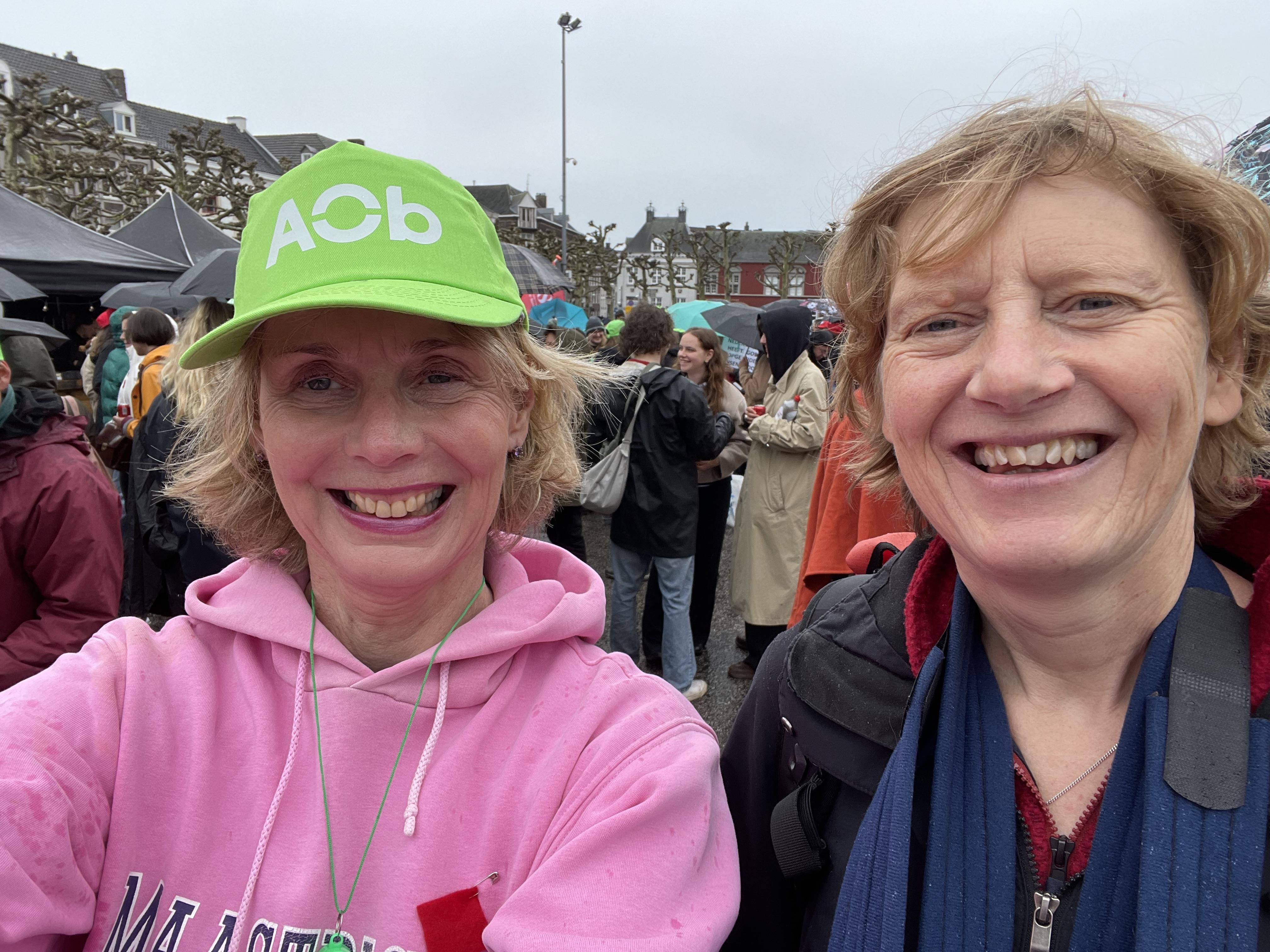 On the left, Corine de Ruiter, on the right, Sjaan Nederkoorn, during the protest at the Vrijthof, April 2025
Unfortunately, Corine de Ruiter, professor of Forensic Psychology, will have to miss out on the demonstration due to a work visit in Friesland, planned earlier in the spring. Something she deeply regrets. “I was at the Vrijthof in April,” she says, referring to the earlier protest in Maastricht against the budget cuts. Her presence there was never in doubt – you don’t touch education – and she would have loved to be there now, too. “Throughout my academic career, I have never been afraid to rock the boat or to voice opinions that go against the majority. Call it civil disobedience or one’s civil duty. Sometimes you just have to draw a line in the sand. Cuts to education are just about the stupidest thing you could do and standing up for education is the least.”
Her parents and grandparents previously displayed an equally strong sense of social commitment – volunteering for a refugee charity and spending free time in a nursing home after their retirement. “As a young woman, I was already concerned with women’s rights and animal rights. I became a vegetarian at 21 – I hated the idea of all those pigs locked in cages, waiting to be eaten. My essays were often about injustice in the world and the bigger picture.”
“Scientific geniuses such as Einstein were only able to flourish because they were allowed to innovate"
It is good to stand up for what you believe in, says De Ruiter. Especially in a peaceful and positive manner. “Not just saying what you don’t want, but making it clear what you do want.” In her case, that means good education for everybody, with enough room and the freedom to develop. “Scientific geniuses such as Einstein were only able to flourish because they were allowed to innovate. As far as I’m concerned, the Dutch government is far too involved in higher education, and not just financially!” De Ruiter has spent the last hour and a half filling in a form reflecting on the results of the National Student Survey – filled out by only ten students. “That is micromanagement and deeply unscientific, just like accreditations and I don’t know what else. All that administrative bureaucracy makes the work much less fun.”
It’s about planting seeds, something that can’t be started soon enough in education, or nothing will ever have a chance to grow. De Ruiter is cautiously optimistic about the direction CDA and D66 – “I always vote for them, they’re the best party for education” – are keen to take: significant investment in innovation, expertise and research. “Either way, it’s a good thing that a new generation is taking over in politics.” That doesn’t lessen the need to keep standing strong, “because if those well-intentioned plans ultimately result in nothing, then you can at least say that you made yourself heard. Every academic should do the same.”
"When politicians make bad decisions, you have to make yourself heard”
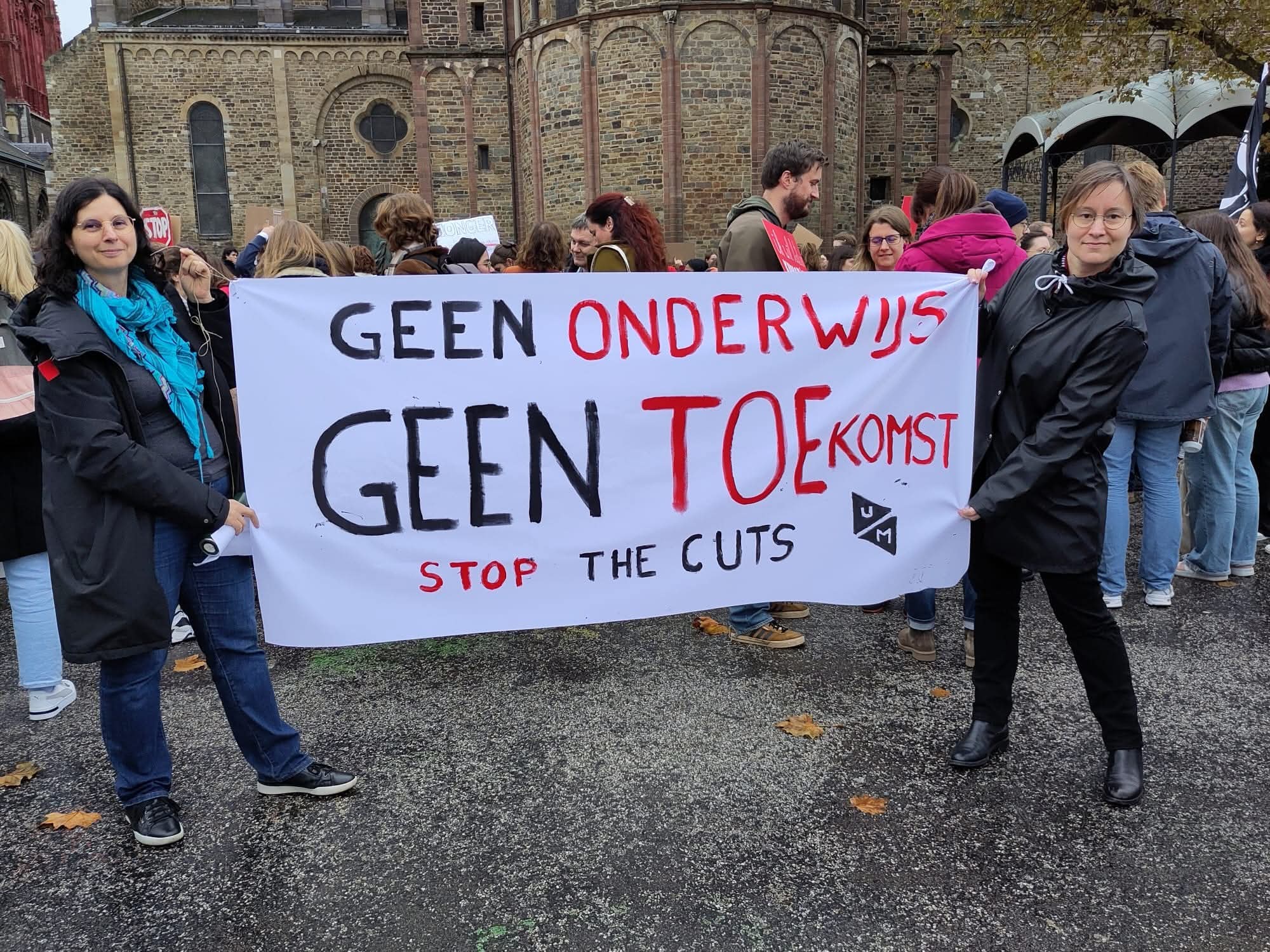 On the left, Brigitte le Normand, on the right, Christin Höne, during the protest at the Vrijthof, April 2025
Canadian Brigitte le Normand, associate professor of History at the Faculty of Arts and Social Sciences, was seventeen when she first manned the barricades. “Quebec, my home province, wanted independence from the rest of Canada, something I was against. It’s such a huge decision, that threatened to bring about an enormous change, so you feel you have to do something. That was the start of my political awareness.”
Later, when she lived in Los Angeles, she protested against the war in Iraq and while on research sabbatical in Germany, she took part in Fridays for Future, where people call on governments to tackle climate change. Recently, she has also taken to the streets in protest against the budget cuts for higher education and the genocide in Gaza. “The world is not a fair place and you can’t trust that politicians have our best interests at heart. When they make bad decisions, you have to make yourself heard.”
“There is so much at stake. This goes beyond merely education"
When it comes to the budget cuts and restricting English language teaching, it is also her only option. “Because I am not allowed to vote in the Netherlands, I march instead.” She is surprised by how little people at UM are engaged. “There is so much at stake. This goes beyond merely education. There are cuts to higher education all over Europe and North America, and that goes hand in hand with an increase in far-right politicians. These types of cuts are intended to limit the influence of universities on society, to put experts in their place. Because the more time we lose in scraping together grants in order to survive, the less chance we have to pass on our expertise. Former Minister of Education Eppo Bruins published an opinion piece this week in NRC, in which he said that academia and politics should remain separate. What he means is that he does not want knowledge to have any power. Knowledge is always inherently political, after all, it shapes what we know about the world.”
According to Le Normand, the importance of the act of protesting is unconnected to its political result. “It creates a community, brings together people and works to counter a feeling of hopelessness. When I look at my fifteen-year-old son, I see that the younger generation has a greater sense that nothing they do will change anything. We were much more optimistic about that. I find that incredibly concerning, I would like secondary schools to do something about that.”
Deborah Blekkenhorst, Peter Doorakkers, Cleo Freriks